
HiAPI
HiAPI provides a single API to access leading AI models for image, video, and text generation with persistent storage and production-grade.
Visit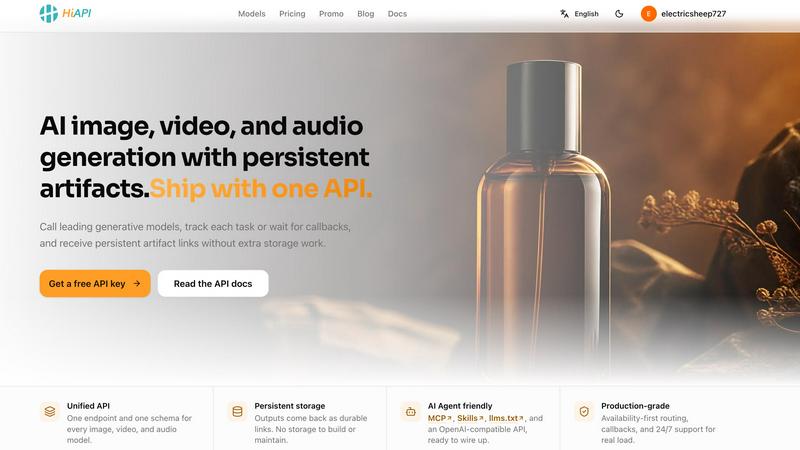
About HiAPI
HiAPI is a developer-first AI API platform designed to simplify and unify access to leading generative AI models for image, video, and audio creation. Instead of managing multiple API keys, billing accounts, and integration patterns across different model providers, developers can use a single API key and a unified endpoint to call a curated selection of top-tier models from companies like OpenAI, ByteDance, Black Forest Labs, Google, and MiniMax. The platform is built for production-grade workloads, offering features such as persistent artifact storage, callback notifications, idempotency keys for safe retries, and availability-first routing. It is specifically designed to be AI agent friendly, supporting protocols like MCP (Model Context Protocol), Skills, and llms.txt for seamless integration with autonomous agents. The core value proposition is eliminating the operational overhead of building and maintaining custom storage solutions, managing multiple provider integrations, and dealing with inconsistent API schemas. HiAPI provides transparent pay-as-you-go pricing, allowing developers to estimate costs upfront before integration. The platform is ideal for developers building applications that require generative media, from marketing content generation to creative tools and AI-powered workflows. With support for models like GPT Image 2, Seedream 5.0 Pro, Seedance 2.0, FLUX 1.1 Pro, and MiniMax Music 2.6, HiAPI covers a broad spectrum of generative tasks including text-to-image, image-to-image, video generation, and music composition. New users can sign up and receive up to $1 in free credits to test the platform.
Features of HiAPI
Unified API and Endpoint
HiAPI provides a single API endpoint and a consistent JSON schema for every supported image, video, and audio model. Developers pass the base model name and model-specific input parameters to the same POST /v1/tasks endpoint. This eliminates the need to learn and maintain separate API integrations for each provider. The unified approach reduces integration time from weeks to hours, as the request structure remains identical regardless of whether you are calling GPT Image 2, Seedream 5.0 Pro, or MiniMax Music 2.6. Optional fields for route, storage, and callback allow fine-grained control without breaking the standard interface.
Persistent Artifact Storage
Outputs from generation tasks are returned as durable, persistent links that do not expire. This feature removes the burden of building and maintaining custom storage infrastructure for generated media. When a task is submitted with the storage parameter set to "persistent," HiAPI automatically stores the generated image, video, or audio file and returns a stable URL. This is critical for production applications where artifacts need to be served reliably to end users. The platform handles all storage management, including redundancy and availability, so developers can focus on application logic rather than file hosting.
AI Agent Friendly Integration
HiAPI is designed from the ground up to be compatible with autonomous AI agents and developer tools. It supports MCP (Model Context Protocol) for agent-accessible tools, Skills for reusable agent instructions, and llms.txt for prompt-based discovery and setup. Developers can paste the llms.txt prompt into agents like Claude, Cursor, or Codex, and the agent will automatically understand HiAPI models, APIs, and the appropriate integration path. This makes HiAPI ideal for building agentic workflows where AI systems autonomously discover, call, and compose generative media tasks without manual configuration.
Production-Grade Reliability and Callbacks
The platform is engineered for production workloads with availability-first routing, automatic retries, and callback notifications. Developers can submit a generation task and optionally provide a callback URL that HiAPI will call upon task completion. This eliminates the need for polling and enables event-driven architectures. The idempotency key feature ensures that retrying a request with the same key does not create duplicate tasks, which is essential for safe error handling in distributed systems. HiAPI also offers 24/7 support to handle real production load and troubleshooting.
Use Cases of HiAPI
Marketing Content Generation at Scale
Marketing teams and agencies can use HiAPI to generate high-quality images, videos, and audio content for campaigns without managing multiple AI subscriptions. For example, a social media manager can use GPT Image 2 for product shots with sharp text rendering, Seedream 5.0 Pro for creative image editing, and MiniMax Music 2.6 for background music, all through a single API. The persistent storage feature ensures that all generated assets are immediately available via stable URLs for embedding in landing pages, emails, and ad creatives. This streamlines the content production pipeline and reduces the time from concept to publish.
Creative Tools and Design Applications
Developers building creative software like photo editors, video production suites, or music composition tools can integrate HiAPI to provide AI-powered features to their users. By using the unified API, a single integration unlocks capabilities such as text-to-image generation, image-to-image editing, video creation with multi-shot consistency (via Seedance 2.0), and song generation from prompts. The callback mechanism allows the creative tool to asynchronously notify users when their generation is complete, while the persistent artifact links can be directly embedded in the application's asset library without additional backend work.
AI Agent and Workflow Automation
Developers building autonomous AI agents for tasks like report generation, presentation creation, or social media management can use HiAPI as the media generation backbone. The agent-friendly features (MCP, Skills, llms.txt) allow the agent to autonomously discover available models, submit generation tasks, and retrieve results. For instance, an agent tasked with creating a product launch video could use Seedance 2.0 for video segments, GPT Image 2 for thumbnail images, and MiniMax Music 2.6 for the soundtrack, all orchestrated through HiAPI's task API with callback-driven workflows.
Prototyping and Rapid Application Development
Startups and internal development teams can use HiAPI to quickly prototype applications that require generative media. The free credits for new users and transparent pay-as-you-go pricing allow teams to experiment with multiple models without upfront commitments. The unified API means that switching between models (e.g., from FLUX 1.1 Pro to Seedream 5.0 Pro) requires only changing the model name in the request, enabling rapid A/B testing of different generation quality and speed characteristics. This accelerates the build-measure-learn cycle for AI-powered features.
Frequently Asked Questions
How does HiAPI's unified API work?
HiAPI uses a single endpoint (POST /v1/tasks) and a consistent request schema for all supported generative models. Developers specify the model name in the "model" field (e.g., "gpt-image-2/text-to-image" or "seedream-5.0-pro/text-to-image") and provide model-specific parameters in the "input" object. Optional fields include "route" for model variants, "storage" to enable persistent artifact links, and "callback" for completion notifications. This standardized approach means you learn one API to access multiple leading AI models, significantly reducing integration complexity compared to managing separate APIs for each provider.
What is persistent artifact storage and why is it important?
Persistent artifact storage means that when you generate an image, video, or audio file through HiAPI, the output is stored on HiAPI's infrastructure and returned as a durable URL that does not expire. This is important because it eliminates the need for developers to build and maintain their own file storage system (like AWS S3 or Cloudflare R2) to host generated media. The artifact links can be directly served to end users in production applications, embedded in websites, or passed to other services. This saves development time, reduces operational costs, and ensures high availability for generated assets.
Is HiAPI compatible with AI agents like Claude or Cursor?
Yes, HiAPI is explicitly designed to be AI agent friendly. It supports MCP (Model Context Protocol) for agent-accessible tools, Skills for reusable agent instructions, and llms.txt for prompt-based discovery. Developers can paste the llms.txt prompt into agents like Claude, Cursor, or Codex, and the agent will understand HiAPI's models and API structure. The agent can then autonomously decide whether to use Skills, Remote MCP, or the direct API as the integration path. This makes HiAPI a strong choice for building agentic workflows where AI systems need to generate media autonomously.
How does pricing work and are there free credits?
HiAPI operates on a transparent pay-as-you-go pricing model. Each model lists its price upfront on the platform, allowing developers to estimate costs before integration. New users can sign up and receive up to $1 in free credits to test the platform and experiment with different models. There are no upfront commitments or monthly subscription fees; you only pay for the generation tasks you submit. This pricing structure is designed to be predictable and scalable, suitable for both prototyping and high-volume production use.
Similar to HiAPI

Create release-ready album covers from a prompt or photo. Generate, refine, and export art for singles, EPs, mixtapes, and playlists.

Qwen Image Edit Online for prompt-based image editing, generation, and creative production.


Turn any image into editable layers with AI.

Create Wan AI videos from text, images, references, and clips with Wan 2.7 workflows.

Production-ready AI image generation and editing with Seedream 5.0 Pro and Lite for ecommerce, marketing, social media, and branded content.

NanoEditor is an AI-powered D&D portrait generator that turns character details like ancestry, class and gear into focused fantasy RPG art.

Create polished AI images and videos from prompts or references for social posts, ads, flyers, album covers, and campaigns.