
act101
act101 is a native Rust binary MCP server providing 163 grammars and 183 AST operations for AI agents to securely refactor and port code on your.
Visit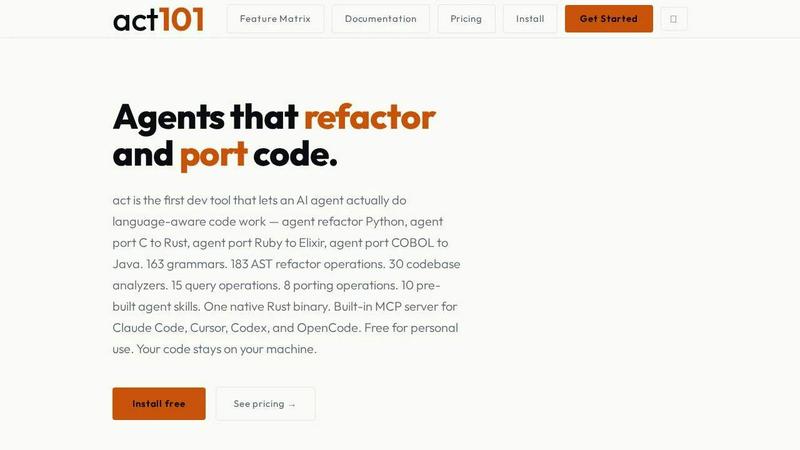
About act101
act101 is a groundbreaking developer tool that functions as a Model Context Protocol (MCP) server, enabling AI coding agents to perform language-aware code refactoring and porting across an unprecedented 163 programming languages. Unlike traditional AI coding assistants that rely on whole-file rewrites, act101 provides agents with 183 Abstract Syntax Tree (AST) refactor operations, 30 codebase analyzers, 15 query operations, and 8 porting operations, all exposed through a single native Rust binary. The tool is designed for professional software engineers working with AI coding agents like Claude Code, Cursor, Codex, and OpenCode, offering a secure, offline-capable solution that keeps source code on the user's machine with no telemetry or indexing. By eliminating cold starts and stale results through on-call parsing, act101 achieves approximately 85% fewer tokens than file-based operations, making it both efficient and reliable for complex code transformations. Its primary value proposition lies in giving AI agents the ability to actually execute structural code changes with automatic checkpointing and instant undo, rather than merely generating suggestions or performing destructive whole-file rewrites.
Features of act101
183 AST Refactor Operations
act101 provides AI agents with 183 typed, AST-aware refactor operations including extract-function, rename, move-symbol, inline, convert-to-dataclass, extract-trait, add-type-hints, generate-init, and organize-imports. These operations work across the entire codebase with cross-file consistency, ensuring that renaming a symbol in one file automatically updates all references throughout the project. Each operation creates an automatic checkpoint, allowing instant undo if the result is unsatisfactory, which eliminates the risk traditionally associated with automated refactoring.
8 Porting Operations for Language Migration
The tool implements a sophisticated state machine for cross-language porting through four core operations: port_contract to anchor source-to-target migration goals, port_inventory to enumerate every symbol requiring movement, port_order to resolve dependency ordering, and a port_manifest state machine that tracks progress through init, add, update, remove, and note stages. This systematic approach enables reliable porting between any two of the 163 supported grammars, such as converting C to Rust, Ruby to Elixir, or COBOL to Java.
30 Codebase Analyzers
act101 includes a comprehensive suite of 30 codebase analyzers that provide AI agents with structural maps before any code modification occurs. These analyzers assess cohesion, coupling, cycles, chokepoints, hotspots, dead code, layers, seams, clusters, surface area, fan balance, migration readiness, and type completeness. This analytical capability ensures agents understand the architectural context and dependencies of a codebase, enabling informed decision-making during refactoring and porting operations.
10 Pre-Built Agent Skills
The platform ships with 10 pre-built agent skills that compose individual operations into common engineering workflows. These skills include architecture-audit, code-review, refactoring, code-navigation, code-generation, migration-assessment, boundary-analysis, change-impact, health-check, and architectural-refactoring. Users can invoke these skills directly from Claude Code, Cursor, or other MCP-compatible clients using the /skill-name command, dramatically reducing the complexity of orchestrating multi-step code transformations.
Use Cases of act101
Large-Scale Code Refactoring
Engineering teams can leverage act101 to systematically refactor monolithic codebases across multiple languages without the risk of breaking changes. For example, a team maintaining a Python-based microservices architecture can use the agent to extract functions, rename symbols across hundreds of files, and convert classes to dataclasses while maintaining full cross-file consistency. The automatic checkpointing and instant undo features allow developers to experiment with structural changes and revert problematic modifications instantly, reducing refactoring time from weeks to hours.
Cross-Language Code Migration
Organizations modernizing legacy systems can use act101 to port entire codebases between languages with unprecedented reliability. A financial institution migrating COBOL applications to Java can leverage the port_contract, port_inventory, port_order, and port_manifest state machine to systematically translate each symbol and dependency. The tool's 163 grammar support ensures that source and target languages are both covered, while the analytical capabilities help identify migration readiness and potential bottlenecks before the process begins.
Codebase Architecture Auditing
Development teams can employ act101's 30 analyzers to perform comprehensive architecture audits of their codebases. The agent can assess coupling between modules, detect circular dependencies, identify dead code, and highlight architectural hotspots that require attention. This capability is particularly valuable for on-call engineers or new team members who need to quickly understand the structural health of an unfamiliar codebase before making changes.
Automated Code Review Workflows
Engineering organizations can integrate act101 into their code review processes by invoking the code-review skill, which composes multiple analyzers and refactor operations into a structured review workflow. The agent can analyze pull requests for potential issues, suggest refactoring opportunities, and even execute safe structural changes directly. This reduces the cognitive load on human reviewers and ensures consistent code quality standards across large teams working in multiple programming languages.
Frequently Asked Questions
How does act101 achieve 85% fewer tokens than file-based operations?
act101 operates on the Abstract Syntax Tree (AST) level rather than treating code as raw text. When an AI agent performs a refactoring operation like rename-symbol, the tool sends only the structural change instructions to the agent, not the entire modified file. This token efficiency is achieved through the MCP protocol, which allows typed, structured communication between the agent and the tool. Benchmarks consistently show this reduction compared to traditional file-based approaches where the agent must read and write complete file contents for every change.
Can act101 work offline and does it send my code to external servers?
Yes, act101 is designed to work completely offline. The tool is a native Rust binary that runs entirely on your machine with no indexing, caching, or cold start requirements. Your source code never leaves your environment. The only external communication occurs during license verification, which may contact act101 servers briefly. There is no telemetry, no package graph dependencies, and no supply-chain attack surface, making it suitable for air-gapped environments and security-sensitive projects.
Which AI coding agents and IDEs are compatible with act101?
act101 is MCP-native and works with any MCP-aware client. This includes Claude Code, Cursor, Codex, Windsurf, and OpenCode. The tool exposes a built-in MCP server that these agents can connect to directly. Users invoke operations through natural language commands within their agent's interface, such as "agent refactor Python" or "agent port C to Rust." The tool does not require specific IDE plugins or runtime environments beyond the Rust binary itself.
What is the difference between refactoring and porting operations in act101?
Refactoring operations (183 available) are designed for structural changes within a single language, such as extract-function, rename, move-symbol, or convert-to-dataclass. These operations maintain AST consistency across the entire codebase. Porting operations (8 available) are designed for cross-language migration and implement a state machine with four core operations: port_contract (define migration goals), port_inventory (enumerate symbols to move), port_order (resolve dependency ordering), and port_manifest (track progress). Porting works between any two of the 163 supported grammars.
Pricing of act101
act101 is free for personal use. For professional and enterprise usage, the product offers tiered pricing plans. Users can start with the free personal tier and upgrade as needed by visiting the pricing page on the act101 website. The tool's pricing model is designed to scale with team size and usage requirements, with additional features and support available in higher tiers.
Similar to act101

No-code 2D game editor: visual node logic, drag-and-drop scenes, live preview. Exports to Windows, macOS, Linux, Android, iOS, Web.

A free launch checklist for SaaS, apps, AI tools and more. Every step says why it matters and when you can skip it.

Moderation, routing, intent and scoring for any text over one Jev-compatible API, hosted in the EU.

A free directory of 950+ projects built on Laya, the open-source decision model. Updated daily.

The #1 Native Form Builder Plugin for Framer - No Code, No Embeds, No External Platforms.

Where modern software products get discovered, launched, and distributed. Explore verified AI tools, SaaS startups, and developer software.

