
Self-Healing Integrations
Plumbed.io uses self-healing AI to automate the full integration lifecycle, reducing custom development costs and ensuring continuous uptime.
Visit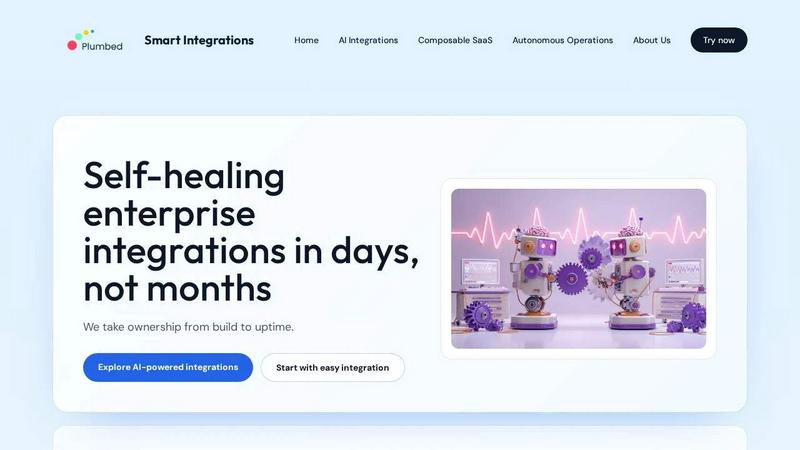
About Self-Healing Integrations
Self-Healing Integrations, as delivered by the Plumbed.io platform, represent a paradigm shift in how enterprises manage the lifecycle of their system connections. Unlike traditional integration tools that focus solely on the initial build phase, Plumbed.io offers a comprehensive solution that automates the entire lifecycle from deployment to ongoing maintenance. This product is specifically designed for organizations grappling with the high operational overhead and fragility of custom enterprise integrations. The core value proposition is the elimination of the "integration tax" the recurring cost and engineering effort required to keep connections between channels, systems, and partners operational after go-live. By leveraging AI-managed lifecycles, Plumbed.io replaces manual monitoring, reactive error handling, and continuous system updates with autonomous operations. The platform is prompt-driven, production-ready, and self-healing, meaning it does not just create a connection but actively ensures it remains reliable, up-to-date, and resilient to failures. For enterprises that require ongoing changes and maintenance for every new channel or partner, this product drastically reduces launch times from months to days and lowers operational costs by offloading maintenance from overloaded engineering teams. It is an AI-native solution for businesses that need their integrations to be a managed, reliable utility rather than a constant source of technical debt.
Features of Self-Healing Integrations
AI-Managed Lifecycle Automation
This feature replaces the manual, error-prone process of post-launch integration maintenance with an intelligent, automated system. Plumbed.io’s AI continuously monitors all active integrations for performance anomalies, data flow disruptions, and system compatibility shifts. When a potential issue is detected, the platform proactively executes predefined error-handling routines or dynamically adjusts configurations to prevent downtime. This eliminates the need for dedicated engineering resources to constantly watch dashboards and respond to alerts, ensuring that integrations remain operational and reliable without human intervention.
Prompt-Driven Integration Development
Unlike traditional integration platforms that require extensive coding or complex configuration, Plumbed.io allows users to define and deploy new connections through simple, natural language prompts. This feature dramatically reduces the barrier to entry for integration creation, enabling business analysts and operational teams to build functional connections in days rather than months. The prompt-driven approach ensures that the integration is not only built faster but is also structured in a way that is inherently production-ready, with the underlying AI handling the technical translation and best-practice implementation.
Autonomous Error Handling and Self-Healing
The platform’s core differentiator is its ability to automatically detect, diagnose, and resolve integration failures without human intervention. When a data sync fails or an API changes, the self-healing AI does not simply log an error; it actively attempts to correct the issue. This might involve retrying a failed transaction with a different data format, re-routing traffic through a backup channel, or dynamically adjusting to a minor API schema change. This capability ensures that data flows remain uninterrupted and that the operational uptime of business-critical integrations is maximized.
Continuous System Compatibility Updates
Enterprise systems and third-party APIs are constantly updated, often breaking custom-built integrations. Plumbed.io’s AI continuously monitors the external endpoints and internal systems it connects to for version changes and deprecation notices. When a change is detected, the platform can automatically update the integration logic to maintain compatibility. This proactive approach prevents the common problem of integrations silently breaking after a vendor update, eliminating the reactive firefighting that typically consumes engineering teams and ensuring long-term stability and reliability.
Use Cases of Self-Healing Integrations
Connecting New E-commerce Channels
For a retail company launching a new sales channel like a marketplace or a direct-to-consumer platform, Plumbed.io eliminates the months-long custom development project. The AI-managed integration connects the new channel to existing inventory, order management, and shipping systems. After go-live, the self-healing feature automatically handles API rate limits, data format mismatches, and connection drops, ensuring that orders flow seamlessly and inventory counts remain accurate without constant engineering oversight.
Managing Partner Data Exchanges
A financial services firm that needs to exchange sensitive data with multiple banking partners can use Plumbed.io to create and maintain these connections. Each partner may have unique security protocols, data schemas, and update schedules. The platform’s AI manages these complexities by continuously monitoring for partner-side changes and automatically adjusting the integration. This ensures that critical data for transactions, compliance reporting, and reconciliation is always flowing correctly, reducing the risk of costly errors and delays.
Automating CRM and ERP Synchronization
Many enterprises struggle to keep their Customer Relationship Management (CRM) and Enterprise Resource Planning (ERP) systems synchronized. Plumbed.io provides a self-healing integration that handles the bidirectional flow of customer data, orders, and financial records. The AI monitors for data conflicts, duplicate records, and sync failures. When a sync fails due to a temporary network issue or a field mapping error, the system autonomously retries and corrects the data, ensuring both systems always have a single source of truth without manual data reconciliation.
Onboarding and Maintaining SaaS Tool Stacks
As companies adopt new Software-as-a-Service (SaaS) tools for marketing, sales, and support, they need to integrate them with their existing data warehouse and core systems. Plumbed.io accelerates this onboarding by using prompt-driven development to connect new SaaS tools in days. Post-launch, the self-healing AI maintains these connections, automatically handling API version upgrades from the SaaS vendors and ensuring that data pipelines for analytics and reporting remain uninterrupted, allowing the business to scale its tool stack without increasing operational overhead.
Frequently Asked Questions
What exactly does "self-healing" mean in the context of integrations?
Self-healing refers to the platform's ability to automatically detect, diagnose, and resolve integration failures without human intervention. This includes retrying failed transactions, adapting to minor API changes, and re-routing data flows to maintain continuous uptime. It shifts the model from reactive firefighting to proactive, automated reliability.
Who is the primary user of Plumbed.io’s Self-Healing Integrations?
The platform is designed for enterprise teams that are burdened by the ongoing maintenance of custom integrations. This includes IT operations managers, integration architects, and DevOps engineers who are currently spending significant time monitoring and fixing broken connections. It also enables business analysts to create integrations through prompts, reducing dependency on engineering for simple connections.
How does Plumbed.io reduce integration costs compared to traditional methods?
It reduces costs by eliminating the need for custom development projects for every new connection and by automating the expensive maintenance phase. The AI-managed lifecycle replaces manual monitoring and error handling, which typically consumes high-cost engineering hours. Faster deployment times also mean faster time-to-value for new business initiatives.
Is Plumbed.io suitable for highly complex, custom enterprise integrations?
Yes, it is specifically built for custom enterprise integrations that require ongoing changes and maintenance after go-live. The platform is designed to handle the complexity of diverse systems, custom data formats, and unique business logic. The AI manages this complexity by continuously learning the integration patterns and proactively adapting to changes.
Explore more in this category:
Similar to Self-Healing Integrations


Verla is an AI academic assistant for university and college students, combining AI essay writing, academic research, AI detection, AI humanization

Free YouTube transcripts on the web, a Chrome extension, and an API + MCP server so AI assistants can read YouTube.

Moderation, routing, intent and scoring for any text over one Jev-compatible API, hosted in the EU.

MiroFish is an AI simulation chat for scenario prediction. Ask a question in plain language and it runs graph building, multi-agent simulation, and re


