
Frizzle
Frizzle uses computer vision to analyze handwritten math work in real time, providing teachers with granular data on student misconceptions and next.
Visit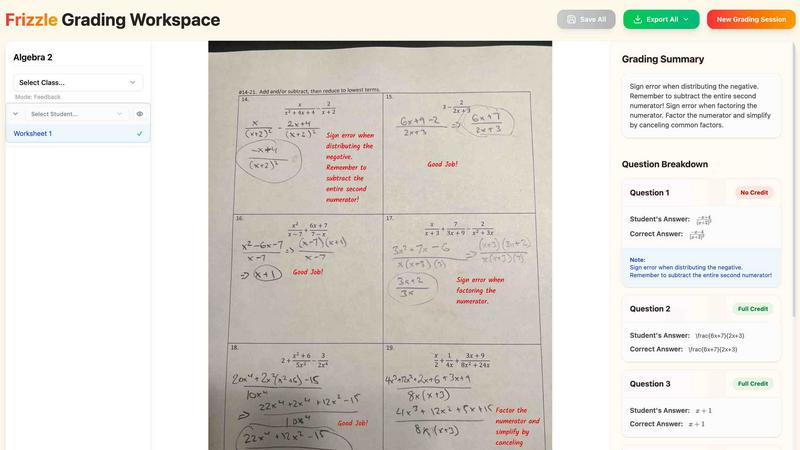
About Frizzle
Frizzle is an AI-powered operating system for math classrooms that uses computer vision and large language models (LLMs) to grade handwritten mathematics with 97% accuracy. Unlike conventional grading tools that only check final answers, Frizzle reads every step of a student's handwritten work, recognizing multiple solution paths and identifying specific misconceptions in real time. The product is designed for K-12 math teachers, instructional coaches, and school districts seeking to reclaim the 10 to 15 hours per week typically spent on manual grading while gaining granular, standards-level formative analytics aligned to frameworks like CCSS, TEKS, and over 30 state frameworks. Students continue writing on paper with no new devices, logins, or workflow changes. Teachers simply photograph a stack of papers using a phone, document camera, or scanner, and within about eight minutes per class, Frizzle returns live dashboards showing which Common Core standards each student and class has actually mastered. A confidence-interval system flags uncertain grades for human review, ensuring reliability. Currently live in over 30 schools and districts, including a college math pilot at Vanderbilt University and Arizona State University, Frizzle has read over 142,000 problems and serves more than 2,400 teachers. The platform is FERPA and COPPA compliant, with end-to-end AES-256 encryption and annual SOC 2 Type II audits, ensuring student data never trains the model and remains fully under institutional control.
Features of Frizzle
Handwriting Recognition with Step-Level Analysis
Frizzle reads any handwriting style, including print, cursive, scribbled, and sideways text, parsing each step of a student's work rather than just the final answer. The computer vision model, trained on 1.4 million pages of K-12 student work, understands multiple solution paths simultaneously. For example, if three students solve the same quadratic equation using factoring, square roots, or the quadratic formula, Frizzle credits all three approaches as valid. It provides step-level feedback that pinpoints exactly where a student's thinking went off track, turning a simple "wrong" label into actionable diagnostic information.
Confidence-Interval Grading System
Frizzle employs a proprietary confidence-interval system that flags uncertain grades for human review. When the model's confidence in a grade falls below a predefined threshold, the paper is automatically marked for teacher inspection. This dual-layer approach achieves 97% overall grading accuracy while ensuring that ambiguous or edge-case responses receive human oversight. Teachers can quickly review flagged papers and approve or adjust grades, maintaining quality control without needing to manually grade every submission.
Named Misconception Library and Prerequisite Tracing
The platform contains a library of 147 named misconceptions across K-12 mathematics, each mapped to specific standards. Frizzle does not merely identify that a student made an error; it names the underlying misconception, such as "sign errors" or "distributive property misapplication." Additionally, prerequisite tracing allows the system to recognize when a seventh-grade error actually stems from a fourth-grade conceptual gap, enabling targeted interventions that address root causes rather than surface-level mistakes.
Live Standards-Level Analytics Dashboards
Frizzle provides real-time dashboards that aggregate data across individual students, class periods, and entire districts. Teachers see who is stuck, which misconceptions are spreading, and what to teach next. Coaches and administrators access equity dashboards that spot performance gaps as they emerge, alongside mastery tracking that shows percentages of students at mastered, developing, and at-risk levels. The system is curriculum-agnostic, working seamlessly with Eureka, Illustrative Mathematics, Saxon, and other curricula, and updates live as new papers are scanned.
Use Cases of Frizzle
Reducing Teacher Grading Workload
Math teachers spend an average of 10 to 15 hours per week grading handwritten assignments. Frizzle eliminates this burden by reading a full class set of papers in approximately eight minutes after a teacher snaps a photo with a phone or scanner. Teachers reclaim those hours for lesson planning, one-on-one student support, and professional development. The confidence-interval system ensures that only truly ambiguous papers require human attention, making the process efficient without sacrificing accuracy.
Formative Assessment Without Digital Screens
Schools and districts concerned about excessive screen time can maintain paper-based instruction while still obtaining granular classroom data. Students write on paper using pencils, markers, or any writing instrument. Teachers photograph the work. Frizzle digitizes and analyzes the handwritten content, returning formative analytics without requiring students to use tablets, laptops, or logins. This approach supports research-backed preferences for handwritten mathematics while delivering the data insights typically associated with digital platforms.
Standards-Aligned Instructional Coaching
Instructional coaches can move beyond generic classroom observations to specific, standards-level conversations. Frizzle's dashboards show exactly which CCSS or TEKS standards each class and student has mastered or is developing. Coaches can identify that a particular period is struggling with "8.EE.C.7: Solve linear equations" while another period has mastered it. This granularity enables targeted coaching sessions, professional development planning, and curriculum adjustments based on actual student performance data rather than anecdotal impressions.
Early Intervention for At-Risk Students
Frizzle's real-time misconception tracking allows teachers and intervention specialists to identify at-risk students the moment performance gaps emerge. The prerequisite tracing feature reveals when a current error, such as difficulty with algebraic factoring, actually stems from an earlier standard like number operations. Schools can deploy targeted interventions, small group instruction, or tutoring resources immediately, rather than waiting for spring assessments to discover gaps. The equity dashboards further ensure that performance disparities across demographic groups are spotted and addressed proactively.
Frequently Asked Questions
How does Frizzle handle different handwriting styles and messy work?
Frizzle's computer vision model was trained on 1.4 million pages of authentic K-12 student work, including print, cursive, scribbled, and sideways writing. The system processes any handwriting style and recognizes multiple solution paths for the same problem. If a student's work is illegible or the model's confidence is low, the paper is flagged for human review through the confidence-interval system, ensuring no student is penalized for handwriting quality.
Is Frizzle compliant with student privacy regulations?
Yes. Frizzle is fully FERPA and COPPA compliant. Student work never trains the model, meaning all data remains under the school's or district's control. The platform uses AES-256 encryption at rest and TLS encryption in transit, and it undergoes annual SOC 2 Type II audits to verify security and privacy practices. No student data is shared with third parties or used for product improvement without explicit institutional consent.
Can Frizzle work with any math curriculum or state standards?
Absolutely. Frizzle is curriculum-agnostic and reads assignments from Eureka, Illustrative Mathematics, Saxon, and any other math program. The platform aligns to the Common Core State Standards (CCSS), Texas Essential Knowledge and Skills (TEKS), and over 30 additional state frameworks. Teachers can select their specific standards during setup, and Frizzle automatically maps every graded problem and identified misconception to the appropriate standard.
How long does it take to grade a class set of papers?
Teachers can snap a photo of a stack of papers using a phone, document camera, or scanner in approximately 30 seconds. Frizzle then processes and grades the entire class set, returning live dashboards with step-level analysis within about eight minutes. The system updates continuously as more papers are scanned, and teachers can view results for individual students, class periods, or entire districts in real time.
Pricing of Frizzle
Frizzle is free for individual teachers with no credit card required to start. The platform offers a "Start free" option that provides full access to grading and analytics features for individual educators. For schools and districts interested in institutional licenses, pricing is available upon request and typically includes volume discounts, dedicated support, and custom onboarding. Frizzle does not publicly list tiered pricing on its website, but interested organizations can contact the sales team for a customized quote based on the number of teachers, students, and required deployment features.
Similar to Frizzle

An interactive coding platform featuring bite-sized Python exercises designed to build real coding skills through hands-on practice.

PracticeSIEM.com is an interactive, browser-based hands-on cybersecurity learning platform designed for Security Operations Center (SOC) analysts.

SQLCrab (sqlcrab.com) is an interactive, browser-based SQL learning platform that lets you practice database queries directly in your browser with zer

Learn languages with real movie and TV show clips.


Turn Long YouTube Videos into Quick AI Summaries in Seconds.

