
TaleHug AI Story Generator for Kids
TaleHug turns a child’s voice, drawing, or idea into a short AI-illustrated storybook for safe parent-child reading.
Visit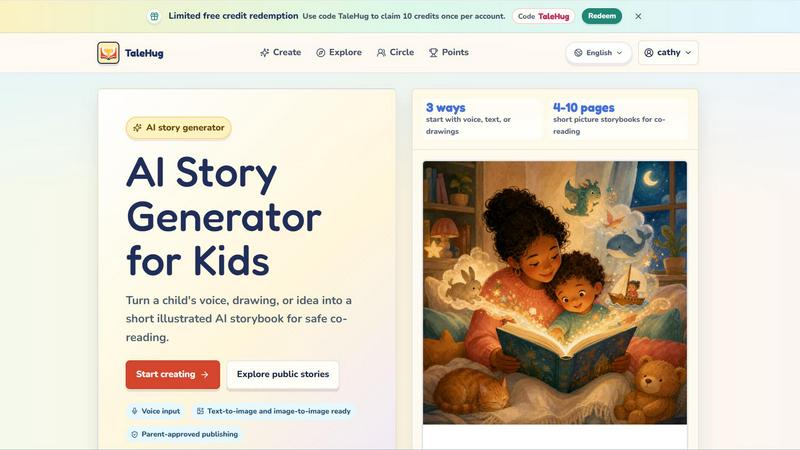
About TaleHug AI Story Generator for Kids
TaleHug is an AI-powered storytelling platform specifically designed for children to create their own illustrated storybooks. Unlike generic AI writing tools, TaleHug is built from the ground up with a focus on kid-friendly interaction, safety, and creative empowerment. The platform transforms a child's voice, drawing, or simple idea into a short, illustrated AI storybook suitable for co-reading between parents and children. TaleHug targets preschool and kindergarten-aged children (ages 3-6) and produces picture storybooks that are 4-10 pages in length, making them ideal for short attention spans and shared reading sessions. The core value proposition is its three-input approach: children can start with voice input, text prompts, or even upload their own drawings, which the AI then uses to generate cohesive narratives with colorful illustrations. Safety is a foundational design principle. All story drafts are private by default, and any publication to a "Circle" (a private group of approved family members) or the public gallery requires explicit adult approval. The platform does not collect personal data such as full names, school names, addresses, or contact details, and public comments are disabled in the MVP. This makes TaleHug a research-backed solution for parents and educators seeking a safe, creative, and engaging introduction to AI-assisted storytelling for young children, fostering literacy, imagination, and digital literacy in a controlled environment.
Features of TaleHug AI Story Generator for Kids
Three Input Methods: Voice, Text, or Drawing
TaleHug offers three distinct ways for a child to start a story, accommodating different developmental stages and preferences. A child can speak their story idea aloud, type a simple text prompt, or upload a physical drawing they have made. This multimodal input is designed to lower the barrier to entry for young children who may not yet be proficient writers but have rich imaginations. The AI processes these inputs to generate a story narrative and accompanying illustrations, ensuring every child can participate regardless of their literacy level.
AI-Powered Illustrated Storybook Generation
The platform generates a complete picture storybook of 4-10 pages from a single input. Each page features a strong, colorful illustration generated by the AI alongside one short, age-appropriate sentence. The system stores a prompt for each page, allowing parents or children to regenerate specific pages if desired. This feature ensures that the output is visually engaging and textually simple, perfectly suited for co-reading between a parent and a child, and it supports the development of early literacy skills through picture-text association.
Parent-Approved Publishing with Three Visibility Modes
Safety is central to TaleHug's design. All story drafts are created as private by default. Before a story can be shared, it requires adult approval. The platform offers three distinct visibility modes: Private, Circle, and Public. "Private" means only the creator can see it. "Circle" allows sharing with a pre-approved group of family members or friends. "Public" makes the story visible in the TaleHug public gallery, but only after a parent has reviewed and approved it. This layered approach ensures that children can create freely while adults maintain control over what is shared and with whom.
Safe and Privacy-First Design Architecture
TaleHug is built with a privacy-first architecture that minimizes data collection and exposure. The platform uses safe display names instead of full child names. It does not request or store school names, addresses, or any child contact details. Public comments are completely disabled in the MVP to prevent any form of online interaction or harassment. The public gallery features only pre-approved examples created by the team, not user-generated content, to ensure a safe browsing experience. This design aligns with COPPA (Children's Online Privacy Protection Act) principles, making it a trustworthy tool for parents and educators.
Use Cases of TaleHug AI Story Generator for Kids
Bedtime Story Creation for Co-Reading
Parents can use TaleHug to create personalized bedtime stories for their children. A child can simply say "a friendly moon rabbit who doesn't want to sleep," and the AI will generate a 4-10 page storybook with soft, soothing illustrations and simple text. This turns the bedtime routine into an interactive, creative activity. The resulting story can be read together, with the parent guiding the reading and the child enjoying the personalized narrative and pictures. This use case leverages the platform's voice input feature, making it easy for even very young children to participate.
Classroom Social Story Development for Kindergarten
Teachers can use TaleHug to create social stories that address specific classroom situations, such as sharing toys, taking turns, or managing first-day jitters. By inputting a prompt like "sharing the red truck," the AI generates a story that models positive social behavior in a relatable, illustrated format. This is a powerful tool for early childhood educators who need quick, customized resources to teach emotional regulation and social skills. The private and circle visibility modes allow teachers to share these stories only with their class's approved families.
Art-to-Story Integration for Creative Expression
Children who love to draw can upload their own artwork into TaleHug, and the AI will generate a story based on that image. For example, a child's drawing of a "soldier and a star witch" can be transformed into a full storybook where the AI creates a narrative about bravery and friendship. This feature validates the child's own creative output and uses it as a springboard for further storytelling. It bridges the gap between visual art and written narrative, encouraging a holistic approach to creative expression.
Language Learning and Literacy Development at Home
Parents of bilingual or multilingual children can use TaleHug to generate stories in different languages, as the platform supports multiple languages (e.g., Chinese). A parent can create a story in their native language to reinforce language skills at home. The combination of simple text and matching illustrations provides strong contextual clues, aiding comprehension. This use case is particularly valuable for families who want to maintain a heritage language or introduce a second language in a fun, low-pressure way through personalized story creation.
Frequently Asked Questions
Is TaleHug safe for my child to use without supervision?
TaleHug is designed with safety as a core principle. All story drafts are private by default, and any sharing requires adult approval. The platform does not collect full names, addresses, school names, or any child contact details. Public comments are disabled in the MVP, and the public gallery only shows pre-approved examples. While the platform is safe, we recommend that parents co-use the tool with their children, especially during the story creation and publishing process, to maximize the educational and safety benefits.
How does the voice input feature work for young children?
The voice input feature allows a child to speak their story idea directly into the device's microphone. The AI then transcribes the speech and uses it as the basis for generating the storybook. This is designed for children who may not yet be able to type or write fluently. The system is optimized for clear, simple speech and can handle common childhood phrases and ideas. For best results, a quiet environment and a clear speaking voice are recommended, but the AI is robust enough to handle typical preschool speech patterns.
Can I edit or regenerate pages after the story is created?
Yes, TaleHug stores a prompt for each page of the generated storybook. This allows parents or children to regenerate specific pages if they are not satisfied with the illustration or the text. This feature gives users creative control over the final output. However, the platform is designed for simplicity, so editing is limited to regenerating pages rather than free-form text editing. This ensures the output remains age-appropriate and visually consistent.
How many pages are in a typical TaleHug storybook?
TaleHug generates picture storybooks that are between 4 and 10 pages in length. This range is specifically chosen to match the attention span of preschool and kindergarten-aged children (ages 3-6). Shorter stories (4-5 pages) are ideal for very young children or bedtime reading, while longer stories (8-10 pages) can be used for more developed narratives or classroom activities. The AI automatically determines the optimal page count based on the complexity of the input idea.
Pricing of TaleHug AI Story Generator for Kids
TaleHug operates on a credit-based system. New users can redeem a limited number of free credits upon signup. Specifically, using the code "TaleHug" allows a user to claim 10 free credits once per account. Each credit likely corresponds to the generation of a single storybook, though the exact credit cost per story is not detailed in the provided context. Beyond the initial free credits, additional credits or subscription plans may be available, but specific pricing tiers or costs are not provided in the current information. For the most accurate and up-to-date pricing, users should visit the official TaleHug website and check the account or subscription settings after logging in.
Similar to TaleHug AI Story Generator for Kids

Master networking with interactive, hands-on practice directly in your browser. Solve real terminal challenges, debug routes, and build core IT skills

Free AI video generator to turn text prompts and photos into clips with Sora 2, Veo 3.1, Wan and more. Free starter credits, no watermark downloads.

AI social listening agent: finds people on Reddit and X describing the problem you solve, scores buying intent and drafts a reply your team approves.


Verla is an AI academic assistant for university and college students, combining AI essay writing, academic research, AI detection, AI humanization

An interactive coding platform featuring bite-sized Python exercises designed to build real coding skills through hands-on practice.

PracticeSIEM.com is an interactive, browser-based hands-on cybersecurity learning platform designed for Security Operations Center (SOC) analysts.

SQLCrab (sqlcrab.com) is an interactive, browser-based SQL learning platform that lets you practice database queries directly in your browser with zer