MindMap AI vs rfpaihub
Side-by-side comparison to help you choose the right product.

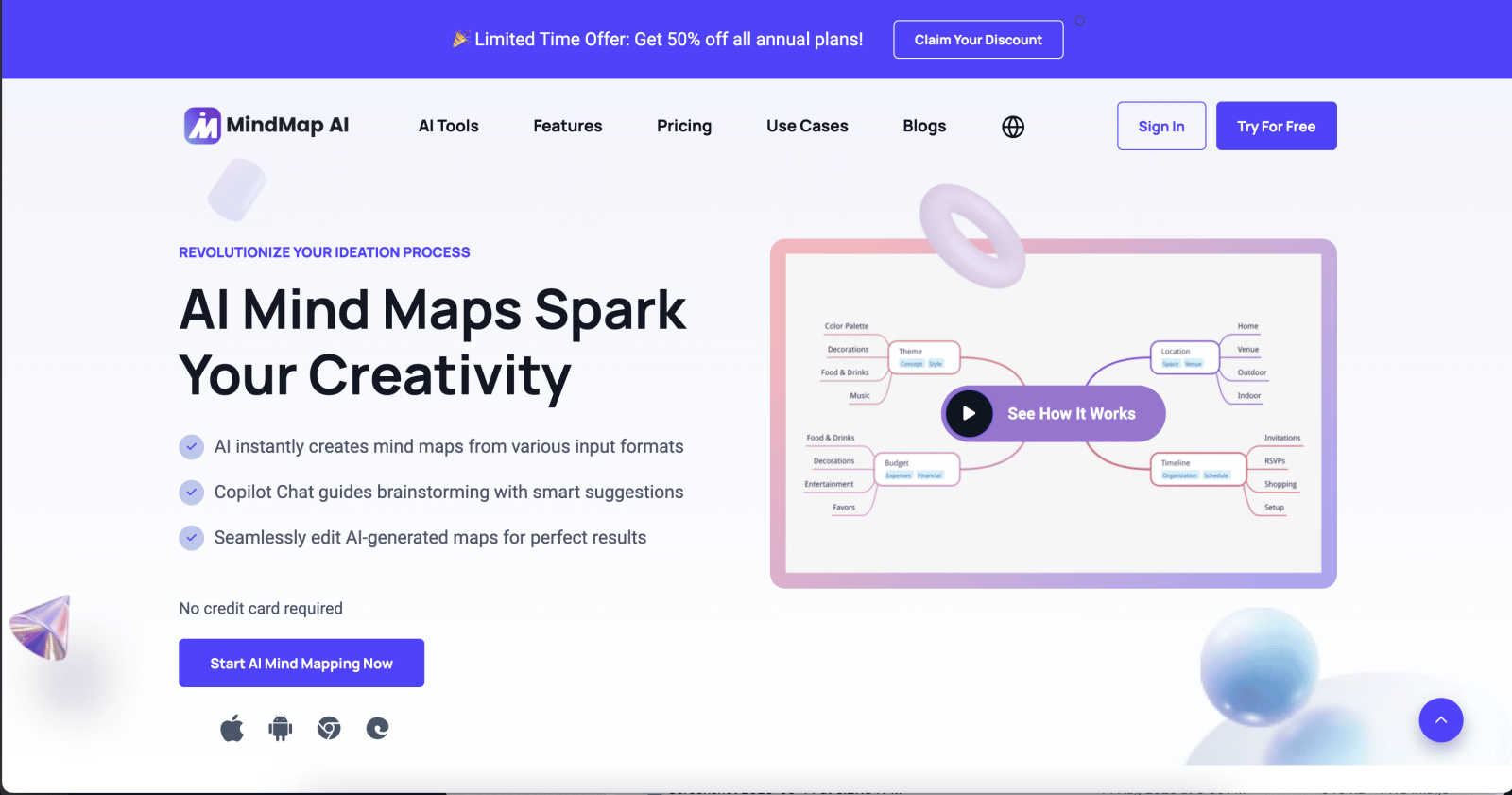
MindMap AI transforms any content into structured, editable mind maps for enhanced thinking and collaboration.
Last updated: March 1, 2026

rfpaihub
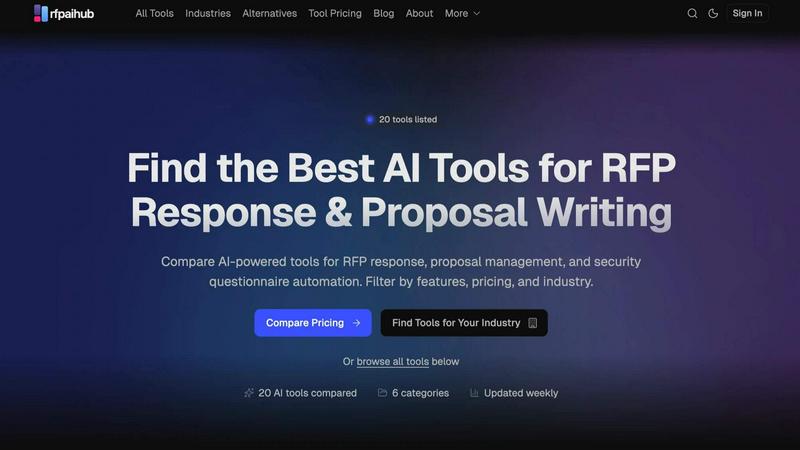
RFP AI Hub is a research-backed platform that helps teams find and compare AI tools to automate RFP responses and proposal writing.
Last updated: April 13, 2026
Visual Comparison
MindMap AI
rfpaihub
Feature Comparison
MindMap AI
AI Thinking Mode
This foundational feature employs a step-by-step reasoning engine that meticulously analyzes input content for context, semantic relationships, and inherent hierarchy before constructing a mind map. Unlike generative models that can output random branches, this process ensures every generated map is structurally sound, accurate, and immediately useful. It mimics a human-like analytical process, guaranteeing that the visual output truly reflects the core ideas and their connections, providing a reliable first draft for any project.
Multi-Format File-to-Map Conversion
MindMap AI can ingest and intelligently process a vast array of file formats, including PDFs, Word documents, PowerPoint slides, images, audio files (like meeting recordings), video, Markdown, CSV, JSON, and XML. This capability allows users to instantly transform static or dense content into a dynamic, editable visual map. It bypasses the tedious manual work of transcription and initial organization, enabling users to dive directly into higher-order thinking, analysis, and creative expansion of the material.
MindMark Stability & Continuous Co-Editing
A critical innovation, MindMark Stability ensures the AI respects and preserves all manual edits, custom layouts, and personal structural choices. The AI expands and summarizes content around user-defined elements without overwriting them. This allows for true co-creation: users can manually add nodes, draw connections, apply styles, and then use AI features like auto-expansion or summarization without fear of their work being altered, creating a stable and predictable editing environment.
Flexible Multi-View Layouts
Users are not confined to a single diagram type. MindMap AI allows seamless switching between three distinct visual views: the radial Mind Map, a top-down Org Chart, and a logical Flow Chart. The underlying data structure remains perfectly synchronized across all views. This flexibility enables teams to explore ideas creatively in mind map view, plan reporting structures in org chart view, and design processes in logic chart view—all from the same project without redundant rebuilding.
rfpaihub
Comprehensive Tool Comparison Engine
RFP AI Hub's primary feature is its detailed comparison matrix, allowing users to evaluate multiple AI-powered RFP tools side-by-side. Users can filter and sort based on specific functionalities such as AI drafting capabilities, knowledge base management, security questionnaire automation, and integration with CRM platforms like Salesforce. This enables data-driven decision-making, helping teams identify the software that best matches their specific workflow requirements and technical stack without visiting dozens of individual vendor websites.
Industry-Specific and Role-Based Filtering
Understanding that needs vary across sectors, RFP AI Hub offers advanced filtering options to browse tools tailored for specific industries such as technology, healthcare, finance, and government contracting. Additionally, users can filter tools based on team roles, such as tools optimized for proposal managers versus those built for security and compliance teams, ensuring the recommendations are relevant to the user's specific operational context and challenges.
In-Depth Pricing and Plan Analysis
The directory provides transparent, up-to-date information on vendor pricing models, including details on free trials, freemium plans, and enterprise-tier costs. This feature demystifies the investment required, allowing budget-conscious teams to quickly identify tools within their financial scope and compare the value offered across different pricing tiers, from solo practitioners to large organizations.
Curated Educational Content and Blog
Beyond being a directory, RFP AI Hub acts as an educational resource through its dedicated blog section. It publishes authoritative content on best practices for RFP response, the ROI of AI proposal tools, and how to implement automation successfully. This positions the hub as a research-backed guide, helping users not only choose a tool but also understand how to leverage it effectively to achieve business outcomes like the reported 40-60% reduction in response time.
Use Cases
MindMap AI
Academic Research and Study Aid
Students and researchers can upload lecture recordings, textbook chapters, or academic papers to instantly generate structured mind maps. This visual summary aids in comprehension, identifies key themes and relationships, and creates an optimal foundation for revision notes, literature reviews, and thesis outlining. The multi-language support also makes it invaluable for studying foreign language materials or collaborating on international research projects.
Corporate Strategy and Brainstorming Sessions
Teams can convert raw meeting transcripts, strategy documents, and market research data into a shared, interactive mind map. This visual anchor facilitates more productive brainstorming, helps distill complex ideas into clear strategic pillars, and ensures alignment across departments. The ability to co-edit in real-time and export to actionable workflows turns abstract discussions into concrete project plans and execution roadmaps.
Project Planning and Knowledge Management
Project managers and teams can use MindMap AI to deconstruct project briefs, technical specifications, or process documentation into clear, hierarchical maps. These maps serve as living knowledge bases, clarifying scope, defining tasks and dependencies, and onboarding new team members quickly. The addition of widgets like Priority Flags and Due Dates transforms the map from a planning tool into an active project dashboard.
Content Creation and Synthesis
Writers, consultants, and content creators can feed in notes, interview transcripts, or data sets to generate a central idea map. This visual framework helps organize arguments, structure narratives, and ensure logical flow in articles, reports, presentations, or training materials. The instant aesthetic themes allow for quick polishing, making the mind map itself a presentation-ready piece of content.
rfpaihub
Evaluating and Selecting First-Time AI RFP Software
A growing SaaS company, overwhelmed by manual RFP responses, uses RFP AI Hub to research and shortlist potential AI tools. By using the comparison filters for features, pricing, and user reviews, the sales ops manager efficiently identifies three top contenders for a demo, accelerating the procurement process and ensuring they select a platform that integrates with their existing Salesforce CRM and Slack communication channels.
Streamlining Security Questionnaire Compliance
A fintech company's security team spends countless hours answering repetitive vendor risk assessment questionnaires. The compliance lead uses RFP AI Hub's "Security Questionnaire Automation" category filter to find specialized tools that can auto-populate answers from a centralized, approved knowledge base, ensuring consistency and freeing up the team to focus on higher-risk assessments.
Benchmarking Current Tool Against Alternatives
A proposal manager at an established enterprise suspects their current RFP software is outdated and costly. They use RFP AI Hub's "Alternatives" section to benchmark their incumbent tool against newer, AI-native competitors. The side-by-side feature comparison reveals several competitors with superior AI matching algorithms and more modern user interfaces, providing concrete data to justify a switch to leadership.
Sourcing Tools for Narrative Proposal Creation
A consulting firm that wins business through detailed, narrative-driven proposals needs a tool focused on collaborative writing and content management rather than questionnaire automation. The firm's lead consultant uses the "Proposal Writing" category filter on RFP AI Hub to discover platforms specializing in content libraries, version control, and client-facing pitch deck generation, perfectly matching their unique workflow.
Overview
About MindMap AI
MindMap AI is a sophisticated, AI-powered visual thinking platform engineered to transform unstructured information into structured, actionable knowledge. It moves beyond traditional mind mapping by integrating a proprietary "AI Thinking Mode," a step-by-step reasoning engine that analyzes context, hierarchy, and relationships before generating a map. This ensures outputs are logically coherent and meaningful from the first iteration, addressing a key limitation of earlier AI tools that often produce disjointed or noisy outputs. The platform is designed for a broad spectrum of users, including students, professionals, researchers, and corporate teams, who need to synthesize complex information from diverse sources like PDFs, documents, audio recordings, videos, and datasets. Its core value proposition lies in eliminating the friction between idea generation and organization, providing a stable, interactive workspace where human creativity and AI augmentation collaborate seamlessly. By converting chaos into clarity, MindMap AI empowers over one million users to accelerate brainstorming, enhance strategic planning, streamline knowledge management, and improve collaborative workflows.
About rfpaihub
RFP AI Hub is a specialized, free online directory dedicated to helping businesses and professionals navigate the rapidly evolving landscape of AI-powered proposal and compliance software. It serves as a centralized, unbiased resource for comparing tools designed to automate and streamline the response process for Requests for Proposals (RFPs), security questionnaires, and other complex vendor assessments. The platform is built for sales operations teams, proposal managers, security compliance officers, and sales enablement leaders who are tasked with improving win rates, ensuring response consistency, and drastically reducing the manual labor involved in these critical business processes. Its core value proposition lies in its meticulous curation and structured filtering, allowing users to move beyond generic software reviews to find tools specifically engineered for their industry, budget, and primary use case, whether it's narrative proposal writing or automated security answer libraries.
Frequently Asked Questions
MindMap AI FAQ
How does MindMap AI ensure the accuracy of its generated maps?
MindMap AI utilizes a proprietary "AI Thinking Mode" that is fundamentally different from a standard text-to-diagram prompt. It acts as a reasoning engine, first analyzing the entire input to understand context, extract key entities, and infer hierarchical and relational structures. This step-by-step, analytical approach prioritizes logical coherence over sheer generation speed, ensuring the resulting map is an accurate and meaningful representation of the source material, not a collection of loosely associated phrases.
Can I edit the mind maps after the AI creates them?
Absolutely. Full manual control is a cornerstone of MindMap AI. You can click on any node to edit text, drag and drop branches to reorganize structure, add entirely new nodes and connecting arrows, and apply custom colors, fonts, and shapes. The unique MindMark Stability feature guarantees that when you subsequently use AI commands (like "expand this node" or "summarize this branch"), the AI will work around your edits without overwriting them, making it a true co-pilot.
What languages does MindMap AI support?
MindMap AI offers robust multi-language support for creating and editing mind maps in over 25 languages. The AI's processing and "Thinking Mode" are designed to work consistently across these languages, maintaining proper layout, structure, and semantic accuracy. This makes it a powerful tool for global teams, multilingual students, and professionals working with international content.
Is there a free plan available?
Yes, MindMap AI offers a free tier designed for individuals to experience the core capabilities. This plan includes 50 free AI credits per month, which can be used for generating maps from files or using AI expansion features. It provides access to key functionalities like multi-format import, basic editing, and theme customization without requiring a credit card, allowing users to thoroughly test the platform's value.
rfpaihub FAQ
What is RFP AI Hub and is it free to use?
Yes, RFP AI Hub is completely free to use. It is an independent, curated directory designed to help users discover, compare, and evaluate AI-powered tools for RFP response, proposal management, and security questionnaire automation. You can browse all tools, use filters, and access comparison data without creating an account or paying any fees.
How does RFP AI Hub select and review the tools listed?
RFP AI Hub employs a clear methodology, as outlined on its site, to ensure credible and unbiased listings. The team researches tools based on market presence, user feedback, and specific feature sets relevant to proposal automation. Vendors can also submit their products for review at no cost, but inclusion is based on the platform's relevance to the directory's focused categories and adherence to its editorial standards.
What are the main categories of tools compared on RFP AI Hub?
The directory compares AI-powered tools across six core categories: RFP Response Software, Proposal Writing & Management Platforms, Security Questionnaire Automation, Knowledge Base & Answer Library systems, Document Generation tools, and Contract & Bid Management solutions. This structured categorization helps users immediately navigate to the type of software that solves their primary pain point.
Can RFP AI Hub guarantee that a listed tool will cut response time by 40-60%?
While RFP AI Hub cites industry research indicating that teams using AI-powered RFP tools typically achieve a 40-60% reduction in response time, it does not guarantee results for any specific tool or user. The cited figure represents a general industry benchmark based on aggregated case studies and vendor-reported data. Actual results depend on tool implementation, process integration, and the specific use case within an organization.
Alternatives
MindMap AI Alternatives
MindMap AI is a leading AI-powered mind mapping software in the productivity and management category. It is designed to transform diverse inputs like documents, audio recordings, and images into structured visual maps, enhancing brainstorming and strategic planning for professionals and teams. Users often explore alternatives for various practical reasons. These can include budget constraints, as pricing models vary significantly across the market. Specific feature needs, such as advanced collaboration tools, offline functionality, or integration with a particular tech stack, also drive the search. Platform compatibility, including desktop application preferences versus web-based access, is another key consideration. When evaluating an alternative, prioritize core functionality that matches your primary use case, whether it's solo ideation or team-based project planning. Assess the total cost of ownership, including any per-user fees or limitations on maps or AI credits. Finally, consider the tool's scalability, security compliance for business data, and the quality of user support to ensure a sustainable long-term fit for your workflow.
rfpaihub Alternatives
RFP AI Hub is a specialized platform in the productivity and proposal management software category. It serves as a comprehensive directory for discovering and comparing AI-powered tools designed to streamline the RFP response, proposal writing, and security questionnaire automation processes. Users leverage its comparison engine to filter options by features, pricing, and industry fit. Users often seek alternatives to any software directory for several key reasons. These include budget constraints where listed tools may not align with financial parameters, a need for specific functionalities not covered by the platform's featured vendors, or a desire for a different user experience, such as an all-in-one suite versus a best-of-breed point solution. The search for a perfect tool match is highly individualized. When evaluating alternatives, it is crucial to prioritize core requirements. According to Gartner, defining clear use cases and integration needs is a foundational step in software selection. Key considerations should include the depth of AI capabilities for content generation, the robustness of collaboration and workflow management features, data security protocols, and the scalability of the solution to match your organization's proposal volume and complexity.