MentionDrop vs Pursuit
Side-by-side comparison to help you choose the right product.

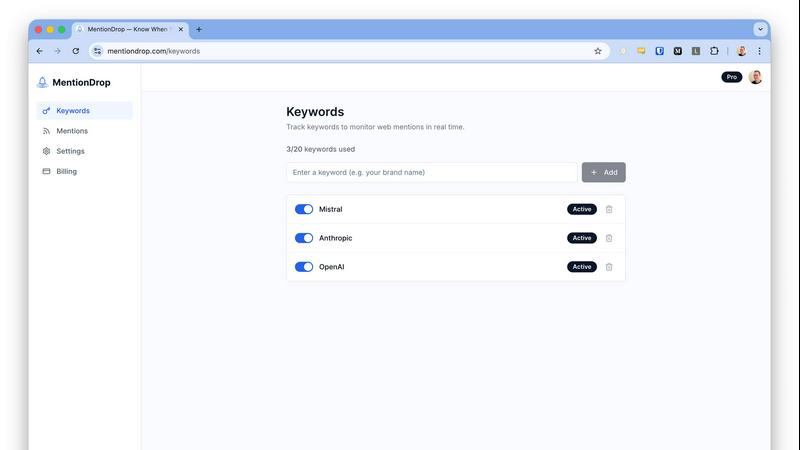
MentionDrop instantly finds and analyzes brand mentions across the web, delivering AI summaries and sentiment to your inbox.
Last updated: April 4, 2026

Pursuit
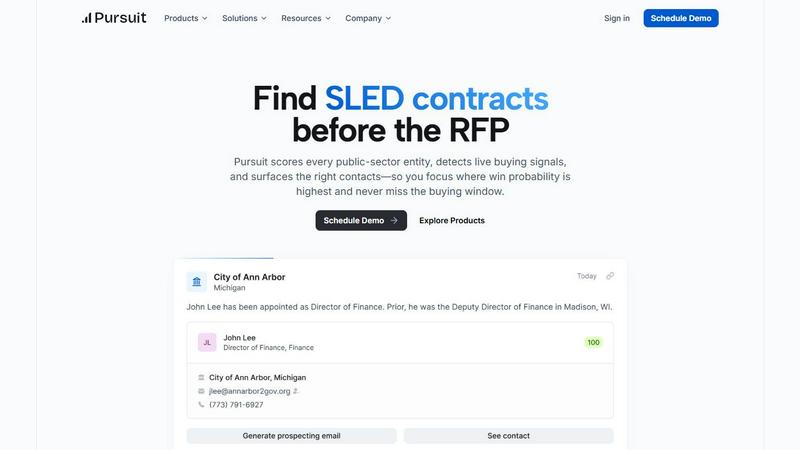
Pursuit uses AI to identify high-probability SLED sales opportunities before RFPs are issued.
Last updated: February 28, 2026
Visual Comparison
MentionDrop
Pursuit
Feature Comparison
MentionDrop
Real-Time Web Monitoring at Scale
MentionDrop's core engine performs real-time monitoring of over 8 billion web pages daily, a data foundation powered by Ahrefs. This extensive crawl goes far beyond standard search engine indexes to include niche forums, review sites, and digital publications, ensuring comprehensive coverage. The system is designed to detect a new mention of your tracked keywords within an average of four minutes, providing a critical speed advantage for time-sensitive reputation management and sales opportunities.
AI-Powered Mention Analysis
Every mention captured is processed through an AI analysis layer that delivers immediate, actionable insights. The AI generates a concise English summary of the content, assesses its sentiment as positive, neutral, or negative, and suggests a contextual next step (e.g., "share," "respond"). This feature eliminates the need to manually click through every link, transforming raw data into prioritized intelligence and significantly reducing the time to action for users.
Simple, Noise-Free Alerting
The platform prioritizes user efficiency with streamlined, intelligent alerting. Users can receive notifications via their preferred channel—email, Slack, or webhook—within minutes of a mention being detected. To maintain a clean signal, MentionDrop includes a one-click domain blocking feature, allowing users to permanently filter out irrelevant or spammy sources from their feed, ensuring that only high-quality, relevant mentions demand attention.
Multi-Language Support & Translation
MentionDrop monitors content in over 40 languages, providing truly global coverage for brands operating in international markets. When a mention is detected in a foreign language, the system automatically translates the key content into English for the alert and summary. This breaks down language barriers, enabling teams to manage global brand perception and engage in conversations worldwide without requiring multilingual staff.
Pursuit
Pre-RFP Signal Detection
Pursuit’s proprietary AI engine continuously monitors and analyzes public data sources from over 110,000 SLED entities to identify live buying signals. These signals, extracted from budget documents, meeting agendas, and contract postings, surface actionable opportunities 6 to 18 months before a formal Request for Proposal is released. This early intelligence allows sales teams to position themselves as informed partners rather than reactive bidders, fundamentally changing the entry point for SLED engagements.
Entity and Contact Database with Continuous Enrichment
The platform maintains a constantly updated database of over 90,000 entities and 4 million contacts within the SLED ecosystem. Pursuit ensures 94% data accuracy through automated, continuous enrichment, tracking organizational changes, role transitions, and new hires. This eliminates the fragility of static contact lists and personal networks, providing a single source of truth that persists despite staff turnover.
Native CRM and MarTech Integrations
Pursuit offers bi-directional synchronization with core go-to-market systems like Salesforce and HubSpot. Enriched account data, contact information, and identified buying signals flow automatically into these platforms, eliminating manual data entry and ensuring intelligence is actionable within existing workflows. This seamless integration is credited with reducing data enrichment time by 68% according to user case studies.
Role-Specific Intelligence Delivery
Intelligence is delivered through persona-specific interfaces. Account Executives receive instant meeting prep via a Chrome extension, BDRs get daily prioritized call lists, Marketing can build ABM campaigns around budget cycles, and Customer Success receives configurable renewal alerts. This ensures every team member gets the right information in the right format to drive their specific function, from prospecting to renewal.
Use Cases
MentionDrop
Proactive Brand Reputation Management
Founders and PR teams use MentionDrop for instant detection of brand conversations, especially critical for identifying and addressing negative sentiment. For example, if a customer posts a complaint on a niche forum, MentionDrop can flag the negative mention within minutes. This allows for a swift, public response to resolve the issue, potentially turning a detractor into a brand advocate who may update their original post with praise for the company's responsive support.
Sales Intelligence and Lead Generation
Sales and marketing professionals leverage the tool to identify direct sales opportunities and buying intent across the web. MentionDrop can detect discussions where people are actively seeking alternatives to a competitor or asking for recommendations in your product category. By being the first to respond with a helpful answer, teams can directly engage potential customers, guide them to their solution, and convert public interest into qualified leads.
SEO and Digital PR Backlink Tracking
SEO specialists and digital PR agencies utilize MentionDrop to monitor for unlinked brand mentions, competitor coverage, and industry round-ups. When a blogger publishes a list of industry tools and includes a competitor but not your brand, MentionDrop alerts you. This creates an opportunity to outreach to the author, provide additional value, and request inclusion, successfully earning a valuable editorial backlink to improve domain authority and search rankings.
Competitive Intelligence and Market Analysis
Product and strategy teams employ MentionDrop to track mentions of key competitors, industry trends, and relevant keywords. By monitoring the sentiment and context around competitor launches, funding news, or public criticisms, companies can gain real-time market insights. This intelligence informs competitive positioning, product development priorities, and marketing messaging, allowing for agile strategic responses to market movements.
Pursuit
Accelerating New Sales Pipeline Generation
Business Development Representatives use Pursuit to move beyond cold calling based on hunches. The platform provides daily, prioritized lists of accounts exhibiting concrete buying signals, such as recent budget approvals for relevant initiatives or upcoming contract expirations. This signal-driven approach has been shown to increase qualified SLED pipeline by 47% and achieve cold call conversion rates as high as 20%, according to published case studies.
Improving Account Executive Win Rates
Account Executives leverage Pursuit’s intelligence to prepare for meetings and craft compelling proposals. The Chrome extension provides immediate context on the account’s procurement history, incumbent vendors, contract values, and recent buying committee discussions. Showing up with this depth of knowledge builds credibility and allows AEs to tailor their solution effectively, leading to a documented 32% improvement in win rates.
Enabling Signal-Based Account-Based Marketing (ABM)
Marketing teams utilize Pursuit to build highly targeted ABM campaigns grounded in real-time intelligence. Instead of targeting accounts based on firmographics alone, they can create audiences based on active signals like new technology initiatives or leadership changes tied to budget cycles. Syncing these audiences to platforms like LinkedIn Ads and Marketo has resulted in a 2.4x lift in campaign conversion rates.
Proactive Customer Success and Renewal Management
Customer Success managers configure Pursuit to monitor their existing customer base for both renewal and churn signals. Alerts for contract expirations (90-180 days in advance), budget cuts, leadership changes, or competitor RFPs allow for proactive outreach and risk mitigation. This early signal identification enables teams to identify renewal opportunities 3x faster and protect revenue.
Overview
About MentionDrop
MentionDrop is an AI-powered web monitoring platform designed to track brand, product, competitor, and keyword mentions across the internet in real-time. It addresses the critical shortcomings of traditional tools like Google Alerts by offering vastly superior speed, coverage, and intelligence. The platform scans over 8 billion web pages daily—including blogs, forums, news sites, and documents in over 40 languages—to detect new mentions within minutes, not days. Each mention is automatically analyzed by AI to provide a concise summary, sentiment score (positive, neutral, or negative), and suggested next actions, enabling users to cut through the noise and focus on what truly matters. Alerts are delivered directly via email, Slack, or webhook. Built for simplicity, it requires no complex query syntax or dashboard training, allowing setup in under two minutes. MentionDrop is engineered for founders safeguarding brand reputation, marketers measuring campaign impact, sales teams identifying buying intent, and agencies managing client visibility, all at a fraction of the cost of legacy monitoring solutions.
About Pursuit
Pursuit is an AI-powered sales intelligence platform engineered specifically for businesses selling to state, local, and education (SLED) government entities. It directly addresses the unique and formidable challenges of public-sector sales, which include navigating over 110,000 distinct entities, complex procurement rules, and elongated budget cycles that can span fiscal years. The platform serves sales, business development, marketing, and customer success teams at government technology vendors, contractors, and consultants. Its core mission is to transform the traditionally opaque and relationship-dependent SLED market into a data-driven, proactive sales process. Pursuit achieves this by continuously analyzing public data from a vast network of entities and contacts, applying proprietary artificial intelligence to detect genuine buying signals from documents like budget approvals, council meeting minutes, and contract expirations—often 6-18 months before a formal RFP is issued. This pre-RFP intelligence allows teams to identify opportunities earlier, understand the procurement path, and engage with the right stakeholders at the optimal time. The platform's ultimate value proposition is a significant increase in win rates and pipeline velocity by ensuring sales efforts are focused on entities with the highest verified propensity to buy, effectively ensuring teams never miss the critical buying window.
Frequently Asked Questions
MentionDrop FAQ
How fast does MentionDrop find new mentions?
MentionDrop is engineered for speed, with an average detection time of approximately four minutes from when a mention is published online to when you receive an alert. This is a stark contrast to traditional tools like Google Alerts, which can take hours or even days to notify users, by which time the opportunity to engage meaningfully may have passed.
What kind of websites and sources does it monitor?
The platform monitors a vast array of sources across the entire web, scanning over 8 billion pages daily. This includes major news outlets, blogs, digital publications, forums (like Reddit and niche communities), review sites, and other publicly accessible documents. Its coverage extends beyond what is indexed by standard search engines, ensuring no conversation slips through the cracks.
How does the AI analysis work?
When a mention is detected, MentionDrop's AI processes the content to extract key information. It generates a short, readable summary in English, classifies the sentiment (positive, neutral, negative) to indicate the tone of the conversation, and suggests a relevant action based on the context, such as "share" for positive news or "respond" for a critical question. This automation saves hours of manual reading and analysis.
Can I track mentions in languages other than English?
Yes, MentionDrop supports monitoring for mentions in over 40 languages. When a mention is found in a supported foreign language, the system will automatically translate the relevant content into English for the alert summary and analysis. This allows you to manage your global brand presence effectively without needing to understand every language in which you are discussed.
Pursuit FAQ
What types of buying signals does Pursuit detect?
Pursuit’s AI is trained to identify a wide range of non-RFP signals indicative of future procurement. This includes budget line-item approvals for specific projects, discussions in city council or school board meeting minutes, the expiration dates of existing vendor contracts, the posting of RFIs (Requests for Information), and leadership changes in relevant departments. These signals collectively paint a picture of budgetary intent and project planning long before a formal bid is solicited.
How does Pursuit ensure data accuracy and relevance?
The platform employs a multi-layered approach to data integrity. First, it aggregates data from primary, public sources. Second, proprietary AI and machine learning models clean, deduplicate, and contextualize this information. Third, continuous automated enrichment processes run to update records for contact changes, role transitions, and organizational updates. This results in a documented 94% data accuracy rate, ensuring teams are working with current and actionable intelligence.
Can Pursuit integrate with our existing tech stack (CRM, marketing automation)?
Yes, Pursuit is built with integration as a core principle. It offers native, bi-directional integrations with major CRM platforms like Salesforce and HubSpot, allowing enriched account/contact data and buying signals to sync automatically. For marketing teams, Pursuit can push segmented audiences and intent signals directly into platforms such as Marketo, HubSpot, and LinkedIn Campaign Manager, enabling seamless signal-based campaign execution.
Is Pursuit only for large enterprises selling to SLED?
No, Pursuit is designed for any business that sells products or services to state, local, or education government entities. This includes technology vendors of all sizes, contractors, consultants, and professional services firms. The platform is particularly valuable for companies looking to scale their SLED sales operations efficiently, as it reduces the heavy research burden and levels the playing field by providing intelligence that was previously only accessible through vast personal networks.
Alternatives
MentionDrop Alternatives
MentionDrop is a modern media monitoring and brand mention tracking tool. It operates within the competitive landscape of online reputation management and social listening software, leveraging AI to provide fast summaries and sentiment analysis from scanning billions of web pages daily. Users seek these platforms to maintain brand health, measure campaign impact, and engage with their audience across the digital sphere. Businesses often evaluate alternatives to find the optimal balance of cost, specific feature sets, and integration capabilities. Common drivers include budget constraints, the need for more advanced analytics or reporting dashboards, requirements for monitoring additional channels like broadcast TV or print, or the necessity for deeper team collaboration tools beyond basic alerts. The search for a platform that aligns with evolving business scale is a frequent catalyst for comparison. When assessing different solutions, key considerations should include the comprehensiveness and real-time speed of data coverage, the accuracy and actionable intelligence provided by AI analysis, the flexibility and cost-effectiveness of pricing plans, and the overall ease of use. The ideal tool should seamlessly fit into existing workflows, delivering clear insights without creating complexity, thereby turning data into a strategic asset rather than an operational burden.
Pursuit Alternatives
Pursuit is an AI-powered sales intelligence platform within the business intelligence category, specifically designed for companies selling to state, local, and education (SLED) government agencies. It transforms the traditionally opaque public sector sales process by using artificial intelligence to detect early buying signals and prioritize high-probability opportunities, thereby increasing pipeline velocity and win rates. Users may explore alternatives to Pursuit for various reasons, including budget constraints, specific feature requirements not addressed by the platform, or a need for a different sales methodology. Some organizations might seek tools with a broader market focus beyond SLED, require deeper integration with a particular tech stack, or prefer a different pricing model, such as per-user subscriptions versus enterprise-wide contracts. When evaluating an alternative, key considerations should include the depth and accuracy of public sector data coverage, the sophistication of AI in identifying genuine buying intent, and the platform's ability to integrate actionable intelligence directly into existing CRM workflows. The ideal solution should demonstrably reduce time spent on manual research and provide clear, timely insights that enable sales teams to engage prospects proactively, well before a formal RFP is issued.