
Dividend Data
Access 30+ years of dividend data and financial metrics instantly in Google Sheets or Excel with our free add-in for investors.
Visit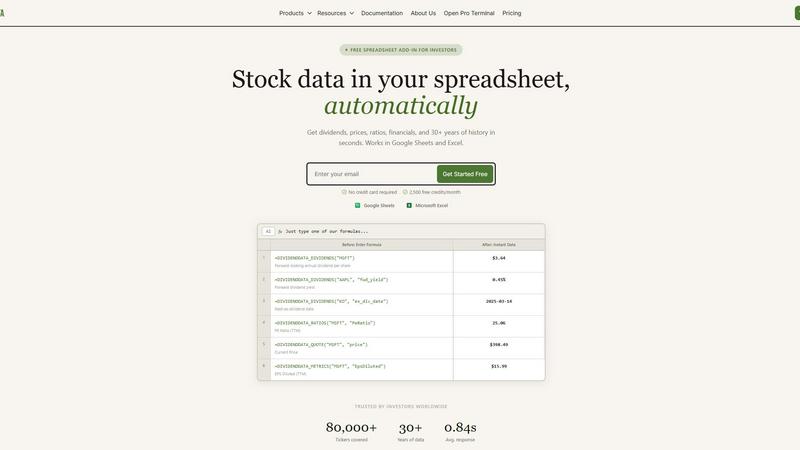
About Dividend Data
Dividend Data is an innovative tool designed specifically for dividend and fundamental investors, providing unprecedented access to over 30 years of stock market data for more than 80,000 tickers. This powerful software integrates directly into Google Sheets and Microsoft Excel, eliminating the need for API keys, coding, or tedious manual data entry. Users can gain instant insights into critical metrics such as dividends, yields, payout ratios, growth rates, financial statements, earnings, ratios, and price history through simple custom formulas. The platform is built by a dividend investor for dividend investors, ensuring that it meets the specific needs of its users. With a free tier that offers 2,500 monthly credits and no trial expiration, Dividend Data is ideal for both novice and experienced investors seeking institutional-grade data without incurring high costs.
Features of Dividend Data
Free Tier with Generous Credits
Dividend Data offers a free tier that includes 2,500 monthly credits with no expiration for trial usage. This feature allows users to explore the platform and utilize its capabilities without any upfront financial commitment, making it accessible to everyone from beginners to seasoned investors.
Custom Functions for Comprehensive Analysis
The software includes 16 custom functions that cover all essential aspects of dividend investing. These functions simplify the process of retrieving data, allowing users to perform analyses such as calculating forward dividend yields, payout ratios, and other crucial investment metrics effortlessly.
Extensive Historical Data Access
With over 30 years of historical data available, Dividend Data enables users to conduct in-depth analyses and comparisons over time. This extensive dataset empowers investors to make informed decisions based on long-term trends and patterns in stock performance.
Compatibility with Major Spreadsheet Platforms
Dividend Data seamlessly integrates with both Google Sheets and Microsoft Excel, providing users with flexibility and convenience. This compatibility ensures that investors can easily access and analyze their data in the software they are most comfortable using, enhancing their overall experience.
Use Cases of Dividend Data
Dividend Growth Analysis
Investors can utilize Dividend Data to analyze the growth of dividends over time for specific stocks. By accessing historical data, users can identify trends and make informed predictions about future dividend payments, aiding in portfolio management decisions.
Portfolio Tracking and Management
Dividend Data allows users to track their dividend income and overall portfolio performance automatically. By linking their portfolios to the platform, investors can view aggregate statistics, which helps in assessing the health and performance of their investments.
Real-Time Stock Analysis
With just a few keystrokes, users can retrieve real-time stock data, allowing for quick decision-making during trading hours. This feature is crucial for active investors looking to capitalize on market movements as they happen.
Financial Ratios Evaluation
The platform provides access to key financial ratios, which are essential for evaluating a company's financial health. Investors can analyze metrics such as Price-to-Earnings (PE) ratios and earnings per share (EPS), facilitating a deeper understanding of potential investment opportunities.
Frequently Asked Questions
How does Dividend Data integrate with Google Sheets and Excel?
Dividend Data integrates seamlessly with both Google Sheets and Microsoft Excel through add-ons, allowing users to access stock market data directly within their spreadsheets. This eliminates the need for separate applications or manual data entry.
Is there a cost associated with using Dividend Data?
Yes, Dividend Data offers a free tier with 2,500 monthly credits, allowing users to explore its features without any upfront cost. Additional usage may require a subscription plan, depending on the user's needs.
What types of data can I access with Dividend Data?
Users can access a wide range of data, including dividends, yields, payout ratios, growth rates, financial statements, earnings, ratios, price history, and over 100 other metrics essential for dividend and fundamental investing.
Can I use Dividend Data for automated portfolio tracking?
Yes, Dividend Data includes features for automated portfolio tracking, enabling users to link their investment portfolios to the platform. This allows for real-time updates and performance statistics, streamlining the investment management process.
Explore more in this category:
Similar to Dividend Data

All-in-One POS, Inventory & Accounting Software for Bangladeshi Businesses


IZIPAY is a virtual and physical crypto card service that lets users top up with digital assets and pay online like with a regular card.

SnapPChart grades a trading chart screenshot A+ to F, with an entry, stop, targets, and risk/reward. Works on stocks, forex, crypto, futures.

Venduris is a renewal intelligence platform that gives mid-size companies control over SaaS & AI contract renewals before leverage disappears.
