Pursuit vs Storydoc
Side-by-side comparison to help you choose the right product.

Pursuit
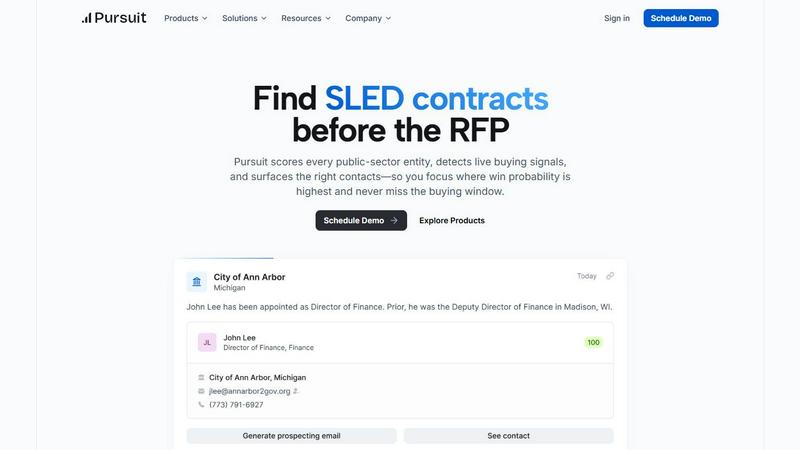
Pursuit uses AI to identify high-probability SLED sales opportunities before RFPs are issued.
Last updated: February 28, 2026

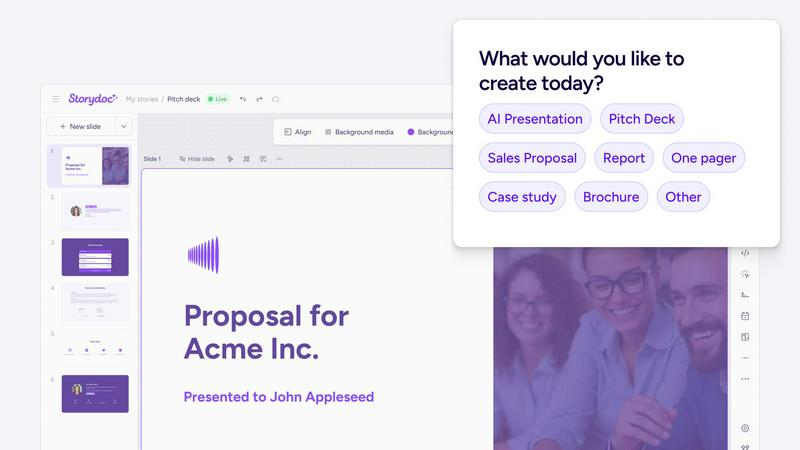
Storydoc is an AI-native platform that automates the creation of interactive, data-driven business presentations and documents to enhance engagement.
Last updated: March 26, 2026
Visual Comparison
Pursuit
Storydoc
Feature Comparison
Pursuit
Pre-RFP Signal Detection
Pursuit’s proprietary AI engine continuously monitors and analyzes public data sources from over 110,000 SLED entities to identify live buying signals. These signals, extracted from budget documents, meeting agendas, and contract postings, surface actionable opportunities 6 to 18 months before a formal Request for Proposal is released. This early intelligence allows sales teams to position themselves as informed partners rather than reactive bidders, fundamentally changing the entry point for SLED engagements.
Entity and Contact Database with Continuous Enrichment
The platform maintains a constantly updated database of over 90,000 entities and 4 million contacts within the SLED ecosystem. Pursuit ensures 94% data accuracy through automated, continuous enrichment, tracking organizational changes, role transitions, and new hires. This eliminates the fragility of static contact lists and personal networks, providing a single source of truth that persists despite staff turnover.
Native CRM and MarTech Integrations
Pursuit offers bi-directional synchronization with core go-to-market systems like Salesforce and HubSpot. Enriched account data, contact information, and identified buying signals flow automatically into these platforms, eliminating manual data entry and ensuring intelligence is actionable within existing workflows. This seamless integration is credited with reducing data enrichment time by 68% according to user case studies.
Role-Specific Intelligence Delivery
Intelligence is delivered through persona-specific interfaces. Account Executives receive instant meeting prep via a Chrome extension, BDRs get daily prioritized call lists, Marketing can build ABM campaigns around budget cycles, and Customer Success receives configurable renewal alerts. This ensures every team member gets the right information in the right format to drive their specific function, from prospecting to renewal.
Storydoc
AI-Powered Document Creation
Storydoc's core AI engine allows users to generate complete, professionally structured business documents in seconds. By simply inputting a topic or goal, the platform produces a beautiful first draft complete with narrative flow and visual placeholders, eliminating the need for design or copywriting expertise. This feature democratizes high-quality content creation, enabling teams to move from concept to client-ready material with unprecedented speed and consistency.
Interactive & Dynamic Elements
Documents are transformed from static pages into engaging experiences. Users can embed live components such as Calendly schedulers, YouTube videos, clickable buttons, dynamic CTAs, and data capture forms directly within the document. This interactivity guides the viewer through a narrative, reduces friction for next steps, and turns a passive review into an active conversation, directly contributing to higher conversion rates.
Personalization & Automation at Scale
Storydoc enables mass personalization through smart workflows and integrations. Using connectors via Zapier and Make, teams can pull live data from their CRM or other databases to dynamically populate fields like company name, metrics, or tailored recommendations. This allows for the scalable creation of personalized documents for every lead or deal stage without manual rebuilding, ensuring relevance and impact.
Deep Engagement Analytics
The platform provides granular insights into how documents are consumed. Creators can track every open, scroll depth, time spent on sections, and click on embedded elements. This data, as cited in internal case studies, reveals what content resonates and what gets skipped, enabling data-driven optimizations to messaging and strategy to improve performance continuously.
Use Cases
Pursuit
Accelerating New Sales Pipeline Generation
Business Development Representatives use Pursuit to move beyond cold calling based on hunches. The platform provides daily, prioritized lists of accounts exhibiting concrete buying signals, such as recent budget approvals for relevant initiatives or upcoming contract expirations. This signal-driven approach has been shown to increase qualified SLED pipeline by 47% and achieve cold call conversion rates as high as 20%, according to published case studies.
Improving Account Executive Win Rates
Account Executives leverage Pursuit’s intelligence to prepare for meetings and craft compelling proposals. The Chrome extension provides immediate context on the account’s procurement history, incumbent vendors, contract values, and recent buying committee discussions. Showing up with this depth of knowledge builds credibility and allows AEs to tailor their solution effectively, leading to a documented 32% improvement in win rates.
Enabling Signal-Based Account-Based Marketing (ABM)
Marketing teams utilize Pursuit to build highly targeted ABM campaigns grounded in real-time intelligence. Instead of targeting accounts based on firmographics alone, they can create audiences based on active signals like new technology initiatives or leadership changes tied to budget cycles. Syncing these audiences to platforms like LinkedIn Ads and Marketo has resulted in a 2.4x lift in campaign conversion rates.
Proactive Customer Success and Renewal Management
Customer Success managers configure Pursuit to monitor their existing customer base for both renewal and churn signals. Alerts for contract expirations (90-180 days in advance), budget cuts, leadership changes, or competitor RFPs allow for proactive outreach and risk mitigation. This early signal identification enables teams to identify renewal opportunities 3x faster and protect revenue.
Storydoc
Sales Proposals & Pitch Decks
Sales teams use Storydoc to create interactive proposals and pitch decks that stand out. By embedding demo videos, live pricing calculators, and instant meeting booking links, they reduce follow-up friction. Engagement tracking shows which parts of the pitch capture attention, allowing reps to tailor their follow-up conversations, leading to reported increases in closed-won deals and faster sales cycles.
Marketing & Lead Generation Collateral
Marketing professionals leverage the platform for high-conversion one-pagers, case studies, and interactive reports. By turning static content into engaging assets with embedded forms for gated content or newsletter sign-ups, they capture leads directly within the document. The interactive format significantly increases reported reading time and information retention compared to traditional PDFs.
Investor & Board Reporting
Startups and enterprises utilize Storydoc to create compelling quarterly business reviews and investor updates. The ability to weave together financial charts, video messages from executives, and interactive data visualizations tells a more powerful story of performance and trajectory, making complex information accessible and engaging for key stakeholders.
Recruitment & Employer Branding
HR and recruiting teams, as demonstrated by clients like Teach For America, build interactive recruiting pitch decks and company profiles. These documents showcase culture through embedded team videos, link directly to application forms, and provide an immersive view of career opportunities, helping to attract and win over top talent in competitive markets.
Overview
About Pursuit
Pursuit is an AI-powered sales intelligence platform engineered specifically for businesses selling to state, local, and education (SLED) government entities. It directly addresses the unique and formidable challenges of public-sector sales, which include navigating over 110,000 distinct entities, complex procurement rules, and elongated budget cycles that can span fiscal years. The platform serves sales, business development, marketing, and customer success teams at government technology vendors, contractors, and consultants. Its core mission is to transform the traditionally opaque and relationship-dependent SLED market into a data-driven, proactive sales process. Pursuit achieves this by continuously analyzing public data from a vast network of entities and contacts, applying proprietary artificial intelligence to detect genuine buying signals from documents like budget approvals, council meeting minutes, and contract expirations—often 6-18 months before a formal RFP is issued. This pre-RFP intelligence allows teams to identify opportunities earlier, understand the procurement path, and engage with the right stakeholders at the optimal time. The platform's ultimate value proposition is a significant increase in win rates and pipeline velocity by ensuring sales efforts are focused on entities with the highest verified propensity to buy, effectively ensuring teams never miss the critical buying window.
About Storydoc
Storydoc is an AI-native platform that fundamentally transforms how businesses create and share critical documents. It moves beyond static PDFs and slides by enabling the creation of interactive, data-driven presentations, pitch decks, proposals, and reports. Designed for sales, marketing, and business development professionals, its core value proposition is turning passive document reads into actionable, engaging experiences that accelerate decision-making. By centralizing creation, personalization, and analytics, Storydoc empowers teams to produce on-brand collateral 10x faster while embedding elements like calendars, videos, and forms directly into the content. This interactivity, backed by deep engagement tracking, has been shown to significantly increase meeting bookings and deal velocity. Trusted by over 400,000 users, including enterprises like Meta and Gong, Storydoc prioritizes enterprise-grade security with ISO 27001 compliance and GDPR adherence, making it a scalable solution for companies of all sizes.
Frequently Asked Questions
Pursuit FAQ
What types of buying signals does Pursuit detect?
Pursuit’s AI is trained to identify a wide range of non-RFP signals indicative of future procurement. This includes budget line-item approvals for specific projects, discussions in city council or school board meeting minutes, the expiration dates of existing vendor contracts, the posting of RFIs (Requests for Information), and leadership changes in relevant departments. These signals collectively paint a picture of budgetary intent and project planning long before a formal bid is solicited.
How does Pursuit ensure data accuracy and relevance?
The platform employs a multi-layered approach to data integrity. First, it aggregates data from primary, public sources. Second, proprietary AI and machine learning models clean, deduplicate, and contextualize this information. Third, continuous automated enrichment processes run to update records for contact changes, role transitions, and organizational updates. This results in a documented 94% data accuracy rate, ensuring teams are working with current and actionable intelligence.
Can Pursuit integrate with our existing tech stack (CRM, marketing automation)?
Yes, Pursuit is built with integration as a core principle. It offers native, bi-directional integrations with major CRM platforms like Salesforce and HubSpot, allowing enriched account/contact data and buying signals to sync automatically. For marketing teams, Pursuit can push segmented audiences and intent signals directly into platforms such as Marketo, HubSpot, and LinkedIn Campaign Manager, enabling seamless signal-based campaign execution.
Is Pursuit only for large enterprises selling to SLED?
No, Pursuit is designed for any business that sells products or services to state, local, or education government entities. This includes technology vendors of all sizes, contractors, consultants, and professional services firms. The platform is particularly valuable for companies looking to scale their SLED sales operations efficiently, as it reduces the heavy research burden and levels the playing field by providing intelligence that was previously only accessible through vast personal networks.
Storydoc FAQ
How does Storydoc's AI creation work?
Storydoc's AI uses advanced language models trained on business communication best practices. You provide a brief description of your document's purpose, target audience, and key points. The AI then generates a complete narrative structure with relevant sections, persuasive copy, and a visual layout optimized for engagement, serving as a professional first draft you can then customize and enhance with interactive elements.
What kind of integrations does Storydoc support?
Storydoc offers native and no-code integrations to fit into existing tech stacks. Key integrations include live data pulls from CRMs like Salesforce and HubSpot via Zapier and Make, embedded scheduling with Calendly and Google Calendar, and multimedia from YouTube and Vimeo. For security and access, it supports secure SSO (Single Sign-On) and can integrate with cloud storage platforms.
Is Storydoc secure for sensitive business data?
Yes, Storydoc is built with enterprise-grade security. It is ISO 27001 certified, demonstrating a robust international standard for information security management. It complies with GDPR for data privacy and offers secure SSO authentication. Documents and data are protected with encryption in transit and at rest, making it suitable for handling sensitive sales, financial, and client information.
Can I use Storydoc with my team for collaboration?
Absolutely. Storydoc includes powerful collaboration tools that allow teams to work seamlessly. Multiple users can edit, comment, and provide feedback on documents in real-time within a centralized workspace. This ensures content consistency, streamlines the approval process, and maintains brand control across all departments, from marketing to sales to leadership.
Alternatives
Pursuit Alternatives
Pursuit is an AI-powered sales intelligence platform within the business intelligence category, specifically designed for companies selling to state, local, and education (SLED) government agencies. It transforms the traditionally opaque public sector sales process by using artificial intelligence to detect early buying signals and prioritize high-probability opportunities, thereby increasing pipeline velocity and win rates. Users may explore alternatives to Pursuit for various reasons, including budget constraints, specific feature requirements not addressed by the platform, or a need for a different sales methodology. Some organizations might seek tools with a broader market focus beyond SLED, require deeper integration with a particular tech stack, or prefer a different pricing model, such as per-user subscriptions versus enterprise-wide contracts. When evaluating an alternative, key considerations should include the depth and accuracy of public sector data coverage, the sophistication of AI in identifying genuine buying intent, and the platform's ability to integrate actionable intelligence directly into existing CRM workflows. The ideal solution should demonstrably reduce time spent on manual research and provide clear, timely insights that enable sales teams to engage prospects proactively, well before a formal RFP is issued.
Storydoc Alternatives
Storydoc is an AI-powered platform in the interactive content and presentation software category. It automates the creation of dynamic business documents like proposals and pitch decks, moving beyond static files to embed interactive elements and track engagement. Users may explore alternatives for various reasons, including budget constraints, specific feature requirements like advanced design control or native CRM integrations, or a need for a platform better suited to their company's existing tech stack and workflow preferences. When evaluating alternatives, key considerations include the core functionality for document creation and automation, the level of interactivity and personalization offered, integration capabilities with essential business tools, robust analytics for tracking performance, and enterprise-grade security and compliance certifications.