
Interactive Circle of Fifths vs Polym
Side-by-side comparison to help you choose the right product.

Interactive Circle of Fifths
Master music theory with an interactive Circle of Fifths for scales, chords, and harmonization.
Last updated: March 1, 2026

Polym is an audio app that uses proven cognitive science to help you actively learn and remember foundational knowledge.
Last updated: March 1, 2026
Visual Comparison
Interactive Circle of Fifths
Polym
Feature Comparison
Interactive Circle of Fifths
Dynamic Circle Visualization
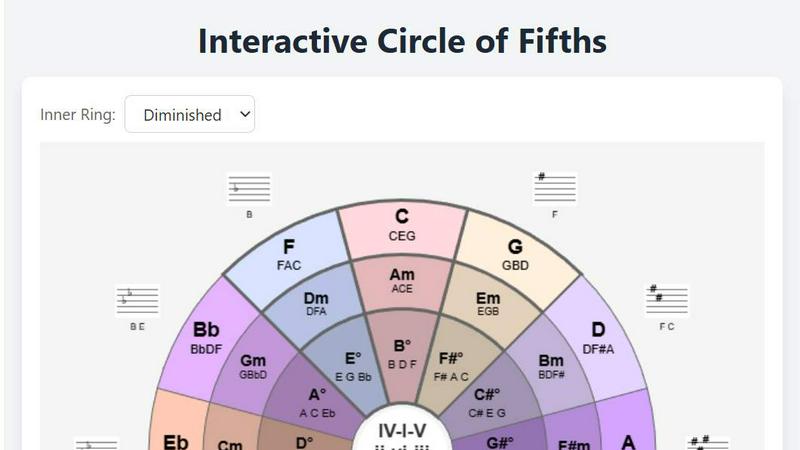
The core of the tool is a fully interactive Circle of Fifths that responds to user input. Selecting any key instantly updates the entire interface to display its related chords and scales. This dynamic visualization helps users intuitively grasp the geometric relationships between keys, understanding concepts like relative minors, key signatures, and the proximity of closely related keys, which is fundamental for modulation and composition as outlined in standard music theory pedagogy.
Integrated Instrument Visualizers (Piano & Guitar)
This feature provides immediate, practical application by displaying chord shapes and scale patterns on virtual piano and guitar fretboard interfaces. When a chord or scale is selected, the visualizer highlights the correct notes and recommended fingerings. This direct translation from theory to instrument is crucial for muscle memory and technical skill development, allowing learners to see and hear the theoretical concepts in the context of their primary instrument.
Comprehensive Scale & Chord Library
The tool offers an extensive library of musical constructs accessible through its inner ring and panel. Users can explore not only standard major and minor scales but also pentatonic, blues, diatonic, and diminished scales. Each scale can be harmonized, revealing its related chord family. This allows for deep analytical study, such as understanding why certain chords (like the V or vii°) create tension that resolves to the tonic, a cornerstone of Western harmonic function.
Chord Sequencer & Functional Analysis Panel
The dedicated panel displays the harmonized scale (e.g., C, Dm, Em, F, G, Am, B° for the key of C Major) alongside their Roman numeral analysis (I, ii, iii, etc.). This "Chord Sequencer" enables users to build and audition chord progressions while the "Function" information (Scale Degree, Resolves To) provides insight into the role each chord plays, teaching the principles of cadence and harmonic movement that define countless musical genres.
Polym
Scientifically-Backed Active Learning Framework
Polym's pedagogy is built on a foundation of robust cognitive science. It systematically employs retrieval practice, forcing the brain to actively recall information, which strengthens memory pathways more effectively than passive review. This is complemented by spaced repetition algorithms that schedule review sessions at optimal intervals to combat the forgetting curve, and interleaving, which mixes related topics to improve discrimination and application of concepts. This integrated approach is proven to significantly enhance long-term retention and recall.
Curated Medium-Form Audio Courses
The app provides in-depth, medium-form audio courses on a wide range of foundational subjects selected for their broad relevance. These courses distill complex topics like logical fallacies, statistical principles, and economic theories into digestible audio segments. Each course focuses on concepts and examples, offering a substantive learning experience that goes beyond simple definitions, making it ideal for deepening understanding during commutes, workouts, or downtime.
Audio Flashcards & Term Reviews
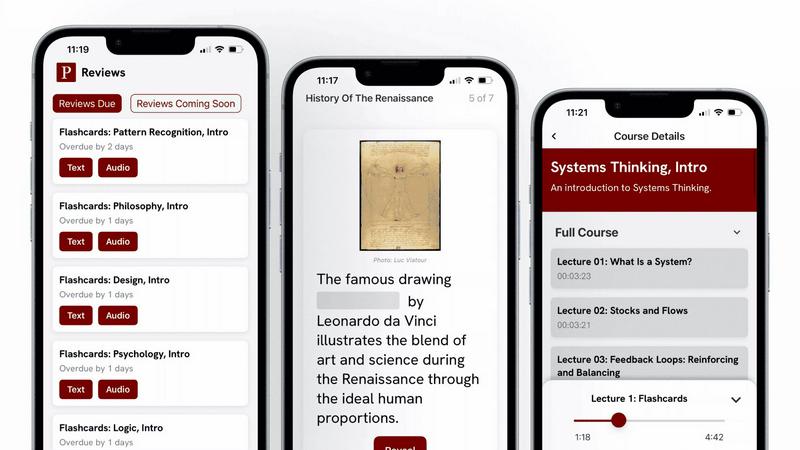
Beyond full courses, Polym features audio flashcards and abbreviated "term-only" courses. These tools are designed for efficient, focused review. Users can test their recall of key definitions, theorems, and concepts without narrative fluff, enabling rapid reinforcement of knowledge. This feature directly leverages the testing effect, a core component of retrieval practice, to cement information in memory through repeated, active recall attempts.
Audio-Optimized Technical & Mathematical Content
Recognizing that written technical material often fails in audio translation, Polym meticulously curates and adapts content for the listening medium. It focuses on the subset of technical and mathematical concepts—particularly the abstract principles—that are suitable for audio explanation. This unique approach helps learners grasp the fundamental ideas behind complex fields, strengthening their ability to apply concepts contextually rather than just memorizing formulas.
Use Cases
Interactive Circle of Fifths
Music Theory Education for Students
Ideal for classroom or self-directed learning, students can interact with the circle to understand key signatures, chord construction, and scale degrees in a hands-on manner. The visual and auditory feedback reinforces lessons on relative majors/minors and the cycle of fifths itself, transforming passive memorization into an active discovery process that enhances retention and comprehension of foundational concepts.
Songwriting and Composition Aid
Composers and songwriters can use the tool to break out of creative ruts. By experimenting with the chord sequencer in different keys, they can discover novel progressions and understand the functional relationships between chords. The ability to quickly switch keys and hear how a progression transforms is invaluable for arranging and developing musical ideas with coherent harmonic structure.
Instrumental Skill Development
Guitarists and pianists can use the instrument visualizers to learn new chord voicings, scale patterns, and their positions across the neck or keyboard. A guitarist, for example, can select the "Blues Scale" in A and see all applicable box patterns on the fretboard, facilitating targeted practice that directly improves improvisation and technical fluency on the instrument.
Music Analysis and Practice Planning
Advanced musicians and teachers can analyze songs by inputting their chord progressions into the tool to determine the key and understand the functional harmony at play. This analysis can then inform targeted practice sessions, such as focusing on the V-I cadence in various positions or practicing the diatonic arpeggios of a less familiar key, making practice time more efficient and effective.
Polym
Professional Skill Augmentation
Professionals in data science, finance, engineering, and management use Polym to reinforce the core theoretical knowledge underpinning their fields. A data scientist can solidify their grasp of probability distributions and statistical inference through spaced audio reviews, ensuring these critical concepts are readily accessible for real-world problem-solving and decision-making, thereby enhancing job performance and analytical confidence.
Academic Study & Test Preparation
Students at university or those preparing for standardized tests (like the GRE, GMAT, or LSAT) utilize Polym as a complementary study tool. By interleaving reviews of logic, cognitive biases, and quantitative reasoning concepts via audio flashcards during their daily routine, they engage in additional, efficient practice sessions that improve retention beyond traditional textbook study, leading to better exam performance.
Lifelong Learning & Intellectual Curiosity
Aspiring polymaths and curious individuals committed to lifelong learning engage with Polym's broad curriculum to build a robust, interdisciplinary knowledge base. Listening to courses on philosophy, history, and AI ethics during daily commutes allows them to continuously explore new domains and connect ideas across subjects, fostering a more nuanced and comprehensive worldview without requiring dedicated reading time.
Knowledge Maintenance & Recall Strengthening
Individuals who have learned foundational subjects in the past but struggle with recall use Polym as a maintenance system. The app's spaced repetition algorithm automatically prompts users to review key terms and concepts from courses like economics or computer science at strategically timed intervals, effectively combating knowledge decay and keeping essential information fresh and accessible for years.
Overview
About Interactive Circle of Fifths
The Interactive Circle of Fifths is a sophisticated digital music theory tool designed to demystify the complex relationships between keys, chords, and scales. Moving far beyond a static diagram, it provides a dynamic, multi-sensory learning environment where users can visually explore and audibly experience core musical concepts. Its primary value proposition lies in translating abstract theory into practical, instrument-specific knowledge, making it an indispensable resource for a wide range of users. From beginners taking their first steps in understanding key signatures to advanced composers analyzing chord function and scale harmonization, the tool adapts to various skill levels. By integrating real-time piano and guitar visualizers, it bridges the gap between theoretical knowledge and physical application, showing exact finger positions and chord voicings. The tool's comprehensive coverage of musical constructs—including major and minor keys, diminished chords, and essential scales like pentatonic, blues, and diatonic—ensures a holistic approach to music education. Ultimately, it serves as a centralized platform for deepening harmonic understanding, crafting compelling progressions, and accelerating instrumental proficiency, solidifying its role as a foundational pillar for modern musical study and practice.
About Polym
Polym is a revolutionary audio learning application engineered to fundamentally enhance how foundational knowledge is acquired, retained, and recalled. It is designed specifically for lifelong learners, aspiring polymaths, and professionals seeking to solidify their understanding of essential subjects that underpin critical thinking across disciplines. The app's core value proposition lies in its deliberate integration of three powerful, evidence-based cognitive science techniques: retrieval practice, spaced repetition, and interleaving. Unlike passive listening platforms, Polym transforms audio into an active learning medium through structured courses and audio flashcards. It offers medium-form content on a curated curriculum including Statistics, Probability, Logic, Economics, Computer Science, AI, Philosophy, and History. By focusing on abstract concepts and tailoring technical content for the audio format, Polym ensures that users can engage in effective, scientifically-backed study sessions anytime, anywhere, turning idle moments into opportunities for profound intellectual reinforcement and long-term memory consolidation.
Frequently Asked Questions
Interactive Circle of Fifths FAQ
What is the Circle of Fifths and why is it important?
The Circle of Fifths is a visual representation of the relationships between the 12 tones of the chromatic scale, their corresponding key signatures, and their associated major and minor keys. It is a fundamental music theory tool because it organizes keys by the number of sharps or flats they contain, reveals closely related keys for modulation, and illustrates the foundational harmonic relationships (like the dominant-tonic connection) that underpin most Western music. This interactive tool brings that static diagram to life.
Can I use this tool if I'm a complete beginner?
Absolutely. The Interactive Circle of Fifths is designed with a gentle learning curve. Beginners can start by simply clicking on a key like C Major and hearing its scale or primary chords. The clear visual layout and instant auditory feedback help demystify basic concepts. It's recommended to start with the "Major" scale and the "Harmonized Scale" panel to first understand how basic triads are built within a key before exploring more advanced features.
How do the piano and guitar visualizers help me learn?
The visualizers translate abstract musical notes into concrete finger positions on your instrument. When you select a chord, you don't just see the note names (e.g., C, E, G); you see where to place your fingers on a piano keyboard or guitar fretboard to play that chord in a standard voicing. This bridges the gap between knowing a chord theoretically and being able to play it physically, which is essential for practical skill development and improvisation.
What is the "Function" information (Scale Degree, Resolves To) used for?
This information teaches you about harmonic function—the role a chord plays in a progression. "Scale Degree" (like I, IV, V) identifies the chord's position in the key. "Resolves To" indicates the chord's natural tendency (e.g., the V chord strongly resolves to the I chord). Understanding this is key to writing progressions that sound purposeful and emotionally directed, and for analyzing why the chords in your favorite songs work so well together.
Polym FAQ
What research supports the learning strategies Polym uses?
The methodologies in Polym are grounded in decades of cognitive psychology research. Retrieval practice (the testing effect) and spaced repetition are extensively documented for dramatically improving long-term retention compared to passive study. Interleaving has been shown to enhance the ability to discriminate between concepts and apply knowledge flexibly. A comprehensive entry point into this research is available through resources like the National Center for Biotechnology Information (NCBI), which reviews these evidence-based learning techniques (e.g., https://www.ncbi.nlm.nih.gov/pmc/articles/PMC9781761/).
What subjects does Polym cover?
Polym offers a curated curriculum focused on foundational, cross-disciplinary knowledge. Core subjects include Logic and Logical Fallacies, Cognitive Biases, Statistics, Probability, Scientific Research Methods, Algorithms, Economics, Philosophy, and History. This selection is designed to be relevant across a wide range of professional fields and personal intellectual pursuits, providing the conceptual tools for critical thinking and informed decision-making.
Who is the primary audience for Polym?
Polym is designed for a broad audience of motivated learners. This includes professionals seeking to reinforce job-relevant knowledge, students augmenting their academic studies, and lifelong learners or aspiring polymaths who are intellectually curious and want to build a durable understanding of essential subjects. It is for anyone who values the retention of foundational knowledge and prefers an efficient, audio-based learning modality integrated into their daily life.
How does Polym handle technical or mathematical content in audio format?
Polym addresses this challenge directly by focusing on the subset of technical and mathematical material that is suitable for audio presentation. Instead of attempting to convey dense equations or complex notation, courses emphasize abstract concepts, principles, definitions, and applied examples. This approach helps listeners grasp the fundamental "why" and "how" behind the math, strengthening conceptual understanding and application ability, which is often more valuable than rote calculation.
Alternatives
Interactive Circle of Fifths Alternatives
The Interactive Circle of Fifths is a sophisticated digital music theory tool within the education and learning software category. It is designed to provide an interactive, multi-instrumental approach to understanding key relationships, chord progressions, and scale patterns through dynamic visual and auditory feedback. Users may seek alternatives for various practical reasons. These can include budget constraints, a need for platform-specific applications (like mobile-first tools), or a desire for features tailored to a different learning style or specific instrument focus beyond piano and guitar. Some may also look for software that integrates directly with digital audio workstations for composition. When evaluating alternatives, key considerations should be the depth of music theory covered, the quality of instrument-specific visualizers, the range of scales and modes included, and the overall user experience. The goal is to find a tool that effectively bridges theoretical knowledge with practical application, supporting the user's specific musical journey and instrumental goals.
Polym Alternatives
Polym is an audio-based learning application designed to enhance knowledge retention and recall. It falls within the education technology category, specifically focusing on foundational subjects for lifelong learners through active learning techniques like retrieval practice and spaced repetition. Users may seek alternatives for various reasons, including budget constraints, a preference for different content formats like video or text, the need for platform-specific apps, or a desire for a broader or more niche subject library. The search often stems from a need to find a tool that aligns more closely with individual learning styles and practical requirements. When evaluating alternatives, key considerations should include the scientific backing of the learning methodology, the quality and depth of the content library, the flexibility of the platform across devices, and the overall cost structure. The most effective tool will be one that not only delivers information but also employs proven strategies to ensure that knowledge is durably retained.