Miget vs MVPable
Side-by-side comparison to help you choose the right product.

Miget
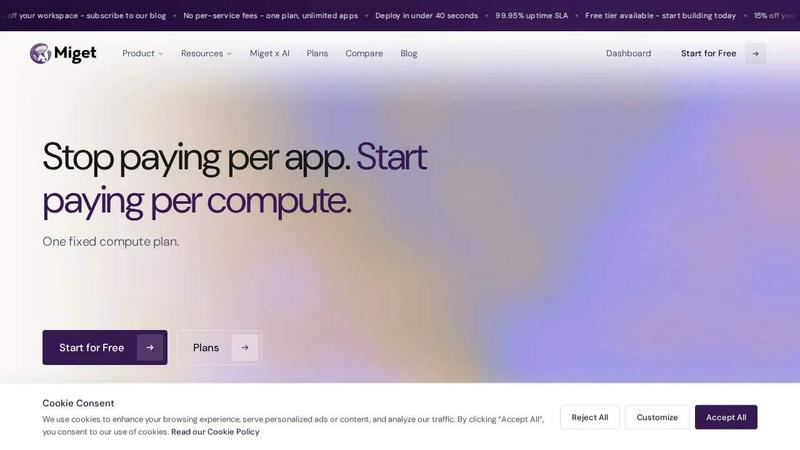
Miget offers unlimited app deployments on one flat-rate compute plan, eliminating per-service fees and enabling rapid scaling.
Last updated: April 13, 2026

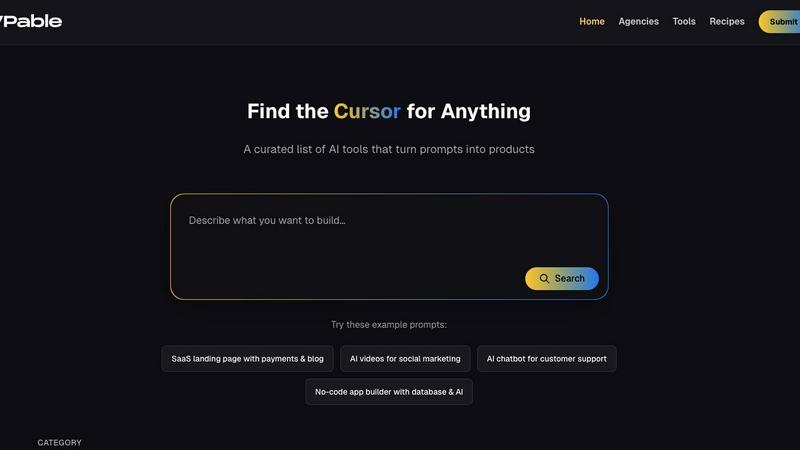
MVPable instantly creates your MVP plan and connects you with the right tools or vetted builders.
Last updated: February 28, 2026
Visual Comparison
Miget
MVPable
Feature Comparison
Miget
Predictable, Capacity-Based Pricing
Miget's primary feature is its revolutionary billing model. Instead of charging for each individual app, database, or worker, you purchase a block of compute resources. Within that fixed-cost plan, you can deploy an unlimited number of services. This model, as highlighted by industry analysis, directly counters the "bill shock" common in traditional PaaS offerings, providing financial predictability and removing barriers to deploying new features, microservices, or preview environments.
Zero-Config Git and GitHub Deployments
The platform offers seamless integration with Git and GitHub, enabling true push-to-deploy workflows. Upon connecting a repository, Miget automatically handles building, caching, and shipping code with no manual CI/CD configuration required. Every push to the main branch triggers a production deploy, and every pull request generates an isolated, full-stack preview environment with a unique URL, streamlining development and review cycles significantly.
Managed Data Services Within Compute Budget
Miget includes managed databases like PostgreSQL and in-memory stores like Valkey (a Redis-compatible solution) as integral components of its platform, not as add-on services with separate fees. These data services run within your purchased compute allocation, ensuring you get a complete application stack—compute, database, and cache—without the per-component billing typical of other platforms, which research shows can constitute over 50% of a standard PaaS invoice.
Full-Stack Preview Environments
For every pull request, Miget automatically spins up a complete, isolated clone of your application stack, including the application code, database schema, and data. This allows developers and stakeholders to test features against real conditions without affecting production. This capability, often a costly premium feature elsewhere, is included standard, enhancing software quality and team collaboration without impacting the monthly bill.
MVPable
AI-Powered MVP Plan Generator
This core feature allows users to input their product idea in plain English and receive an instant, structured build plan. The system analyzes the concept against a database of proven patterns and tools to recommend the optimal "vibe tool" (e.g., Bubble, Softr, Glide) and generates specific, high-leverage prompts to kickstart development. This eliminates the need for endless market research and tool comparisons, providing a validated starting point in seconds, entirely without requiring a signup.
Curated Vibe Tools Directory
MVPable maintains a rigorously curated library of over 69 no-code and low-code tools, each evaluated for its specific strengths in building particular types of products like SaaS, marketplaces, or mobile apps. This directory is not a generic list; it is contextually matched to user ideas to recommend the single most efficient platform for the job, ensuring founders select technology that aligns with their MVP's functional requirements and scalability needs.
Network of Vetted Builders & Agencies
For users who prefer to delegate execution, MVPable provides access to a selective network of over 10 pre-vetted development agencies and expert builders specializing in MVP development. These partners are familiar with the platform's methodology and tool recommendations, allowing for a seamless handoff of the generated plan. This reduces the friction and risk typically involved in hiring freelance or agency talent for early-stage projects.
Comprehensive Product Implementation Guides
Beyond tool recommendations, MVPable offers detailed, step-by-step guides for building specific product archetypes. Guides such as the "B2B SaaS MVP" or "Lightweight Marketplace MVP" provide proven scoping frameworks, architectural outlines, and best practices. These resources translate high-level plans into executable tasks, educating founders on lean development principles and helping them avoid common over-engineering pitfalls.
Use Cases
Miget
Indie Hackers and Solo Developers
For solo builders and indie hackers, Miget provides a fast, affordable launchpad. They can deploy a full application with a backend, database, and background workers on a single, predictable plan. The fixed monthly cost eliminates budgeting uncertainty, while the GitHub-native deployment and preview apps per PR enable rapid iteration and professional-grade development practices typically associated with larger teams, all from day one.
Growing Startups and Product Teams
Startups experiencing growth can scale their application architecture—adding new microservices, internal tools, or staging environments—without constantly re-evaluating infrastructure costs. Miget allows them to stay within a known cost envelope while benefiting from horizontal autoscaling within their allocation. Features like team roles, audit logs, and SSO support the transition from a small team to a more structured organization.
Enterprise Development and Internal Platforms
Enterprises can leverage Miget to standardize developer experience and control cloud spend across departments. The platform supports bringing your own cloud (BYOC) or bare metal, and offers tools like Helm charts and Terraform for custom orchestration. This provides the governance, security, and compliance required by large organizations while giving development teams a simple, Heroku-like interface for productivity.
AI and Prototype Development
Developers working with AI-generated code or rapid prototypes benefit immensely from Miget's instant deployment capabilities. The ability to deploy from a prompt or a simple push, coupled with one-click infrastructure setup via skills.md files, allows for immediate validation of ideas. Preview URLs can be shared instantly with collaborators or stakeholders, making it an ideal platform for hackathons and experimental projects.
MVPable
Validating a B2B SaaS Concept
A founder aiming to replace manual spreadsheet workflows with an automated SaaS solution can use MVPable to define a lean, multi-tenant product scope. The platform would recommend a tool like Bubble or Xano for the core workflow and database, generate prompts for user authentication and team workspaces, and provide a guide to build only the essential features needed for initial customer validation, preventing months of unnecessary development.
Launching a Niche Two-Sided Marketplace
An entrepreneur looking to connect freelancers with local businesses can utilize MVPable to blueprint a lightweight marketplace MVP. The system would advise on tools like Sharetribe or a Softr-Airtable stack for managing listings and transactions, outline a limited scope focused on core discovery and contact features, and offer a clear path to launch without building complex escrow or messaging systems prematurely.
Creating a Mobile App for Daily Use Validation
A developer or small team with an idea for a habit-tracking or community mobile app can get a plan focused on iOS/Android delivery. MVPable would likely suggest a tool like Glide or FlutterFlow, emphasize a fast core user workflow and robust push notifications, and guide the scoping to validate daily user behavior before investing in a fully native, custom-coded application.
Developing Internal Tools for Operational Efficiency
A startup needing an internal CRM or project management tool can leverage MVPable to build a custom solution quickly. The platform would identify tools like Retool or Budibase that are optimized for internal dashboards and data manipulation, generate prompts for connecting to existing data sources, and provide a methodology to ship a functional tool that improves team productivity without the cost of enterprise software.
Overview
About Miget
Miget is a modern Platform-as-a-Service (PaaS) that fundamentally rethinks cloud pricing and deployment for developers and engineering teams. It addresses a critical pain point in traditional PaaS models, where costs scale linearly with each new application, database, or background worker, creating financial friction for experimentation and growth. Miget's core innovation is its capacity-based billing model: users select a fixed compute plan and can then deploy an unlimited number of services—including web apps, managed databases (PostgreSQL, Redis/Valkey), and workers—within that reserved allocation. This approach eliminates per-service fees and surprise billing, offering predictable monthly costs. Built on Kubernetes with robust tenant isolation, Miget provides a production-ready platform featuring GitHub-native deployments with zero-config builds, automatic TLS for custom domains, and full-stack preview environments for every pull request. It is designed for a broad spectrum of users, from indie hackers and solo developers launching side projects to growing startups and enterprises requiring scalable, cost-controlled infrastructure without operational overhead. By decoupling cost from the number of deployed components, Miget empowers teams to build and scale more freely.
About MVPable
MVPable is a strategic platform engineered to de-risk and accelerate the journey from concept to a functional Minimum Viable Product (MVP). It directly addresses a critical failure point for early-stage ventures: the paralysis and waste caused by pre-build indecision on scope, technology, and execution methodology. The platform serves founders, indie hackers, and small teams by providing a data-driven, structured ecosystem that replaces guesswork with a clear, actionable blueprint. Its core value proposition lies in its ability to analyze a user's idea and instantly generate a tailored MVP plan. This plan includes a curated, high-leverage "vibe tool" recommendation—a no-code or low-code platform proven for the specific product type—along with precise implementation prompts and a step-by-step build path. Furthermore, MVPable connects users with a vetted network of specialized builders and agencies, offering a seamless transition from planning to execution. By centralizing tools, guided workflows, and expert talent, MVPable significantly reduces the time, budget, and technical uncertainty traditionally associated with early product development, empowering creators to validate their ideas with confidence and speed.
Frequently Asked Questions
Miget FAQ
How does Miget's pricing differ from traditional PaaS?
Traditional PaaS platforms like Heroku employ a component-based pricing model, where you are billed separately for each "dyno" (web/worker), database, cache, and add-on. Academic and industry analyses, including studies on cloud cost management, show this leads to complex, unpredictable invoices. Miget uses a capacity-based model: you pay for a block of compute (e.g., vCPU and RAM) and can run an unlimited number of apps, databases, and workers within that resource pool, resulting in one predictable, fixed monthly bill.
What is included in the "unlimited services" within a plan?
"Unlimited services" means you can deploy as many distinct applications, containerized services, managed PostgreSQL/MySQL databases, Valkey (Redis) instances, and background worker processes as your purchased compute resources can support. There are no per-service licensing or platform fees. The only limit is the total CPU and memory capacity of your selected plan, which you allocate dynamically across your deployments via the Miget dashboard.
How does isolation and security work on a shared platform?
Miget is built on Kubernetes and enforces strict multi-tenant isolation. Each customer's workspace and services run in fully isolated namespaces with dedicated network policies. According to Kubernetes security best practices documented by the Cloud Native Computing Foundation (CNCF), this architecture provides strong boundaries between tenants. Furthermore, data services like PostgreSQL are managed instances dedicated to your workspace, not shared databases.
Does Miget support custom domains and SSL/TLS?
Yes, Miget fully supports custom domains. You can point your domain's DNS records to Miget, and the platform automatically provisions and renews TLS/SSL certificates for you using the ACME protocol, the same standard used by Let's Encrypt. This provides secure HTTPS connections by default without any manual certificate management, a critical feature for production applications as emphasized by web security guidelines.
MVPable FAQ
What is MVPable?
MVPable is a strategic planning and execution platform designed to help founders, indie hackers, and small teams systematically turn ideas into Minimum Viable Products (MVPs). It combines an AI-powered plan generator with a curated directory of no-code/low-code tools and a vetted network of builders to reduce pre-development uncertainty, time, and cost. Its primary goal is to provide a clear, actionable first move for product validation.
How does MVPable choose the right tech stack?
MVPable's recommendations are based on a continuously updated database of "vibe tools" and proven product archetypes. The system analyzes the user's described idea against parameters like product type (SaaS, marketplace, mobile app), required functionality, and scalability needs. It then matches the concept to the most efficient no-code or low-code platform that has a demonstrated track record for successfully building similar, lean MVPs, as evidenced in their public case studies and guides.
Is MVPable free?
Yes, the core MVP planning functionality is completely free. Users can describe their idea and generate a detailed, instant build plan without any cost or required signup. This aligns with the platform's mission to remove barriers to starting. Access to the full tool directory and guides is also free. The platform generates revenue through its partner network, connecting users who wish to hire vetted builders for execution.
Who is MVPable for?
MVPable is specifically designed for non-technical founders, indie hackers, solopreneurs, and small startup teams who have a product idea but lack the certainty or resources to begin building efficiently. It is also valuable for technical founders who want to validate a concept using the fastest possible method before committing to custom code. It serves anyone who wants to avoid the common pitfalls of overbuilding or choosing the wrong technology at the outset.
Alternatives
Miget Alternatives
Miget is a modern Platform-as-a-Service (PaaS) solution that simplifies cloud deployment by offering a flat-rate, compute-based pricing model. It falls within the broader low-code and no-code ecosystem by abstracting away infrastructure complexity, allowing developers to focus on building and shipping applications. This approach represents a significant shift from traditional per-service billing. Users often explore alternatives to any platform to find a better fit for their specific requirements. Common drivers include budget constraints, where a platform's pricing tier may not align with current needs, or a desire for specific features not offered, such as support for particular programming languages or integrated services. Some may also seek platforms with different architectural philosophies or deeper levels of infrastructure control. When evaluating alternatives, key considerations should include the total cost of ownership, especially as your application portfolio grows. Assess the platform's ease of use, deployment workflow, and the breadth of managed services it provides. Security posture, compliance certifications, and the quality of documentation and developer support are also critical factors that impact long-term success and operational efficiency.
MVPable Alternatives
MVPable is a specialized productivity and management platform designed to accelerate the journey from idea to Minimum Viable Product (MVP). It provides an integrated ecosystem of AI tools, automation workflows, and a vetted builder network, aiming to reduce development friction for founders and small teams. Users often seek alternatives for various reasons, including budget constraints, the need for a different feature mix, or a preference for a more narrowly focused tool over a unified platform. When evaluating alternatives, a strategic approach is crucial. Key considerations should include the platform's core competency—whether it's tool discovery, workflow automation, or talent connection—and how well it aligns with your specific project phase. Research from sources like Gartner highlights the importance of assessing a tool's scalability, integration capabilities, and the quality of its support community to ensure long-term viability and a strong return on investment. --- FAQ_SEPARATOR--- [
{"question": "What is MVPable?", "answer": "MVPable is a comprehensive platform that streamlines the process of turning ideas into viable Minimum Viable Products (MVPs) by connecting essential tools, workflows, and a network of builders in one unified ecosystem."},
{"question": "Who is MVPable for?", "answer": "MVPable is primarily targeted at founders, indie hackers, and small teams looking to transform their concepts into tangible products swiftly and effectively."},
{"question": "What are the main features of MVPable?", "answer": "Its core features include an AI Tools Directory for tool discovery, an n8n Workflow Library for automation, and an Agency & Builder Network to connect with verified development professionals."},
{"question": "Why choose MVPable?", "answer": "MVPable reduces the time and complexity of early-stage product development by offering a centralized location for generating tailored MVP plans and accessing vetted resources, empowering creators to execute their vision."}
]