Image to 3D AI vs Lobster Sauce
Side-by-side comparison to help you choose the right product.

Image to 3D AI
ImgTo3D.ai instantly converts any 2D image into a detailed 3D model for free, as noted by its 20,000 monthly users.
Last updated: March 1, 2026

Lobster Sauce
Lobster Sauce is the definitive, community-curated news feed delivering verified updates on the OpenClaw AI ecosystem.
Last updated: March 19, 2026
Visual Comparison
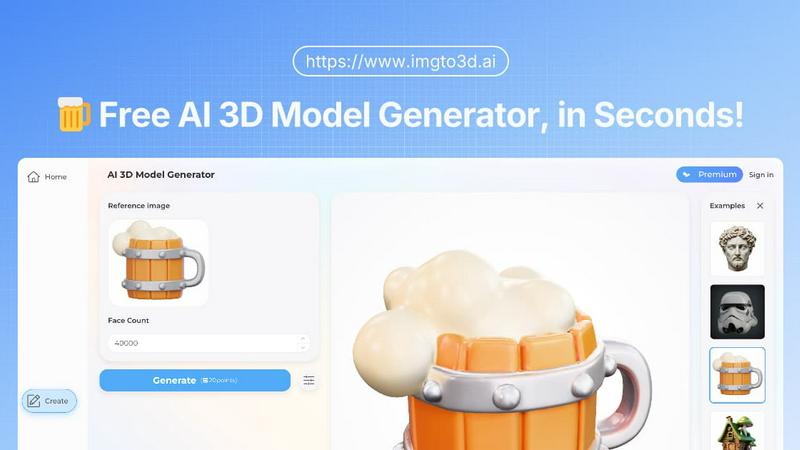
Image to 3D AI
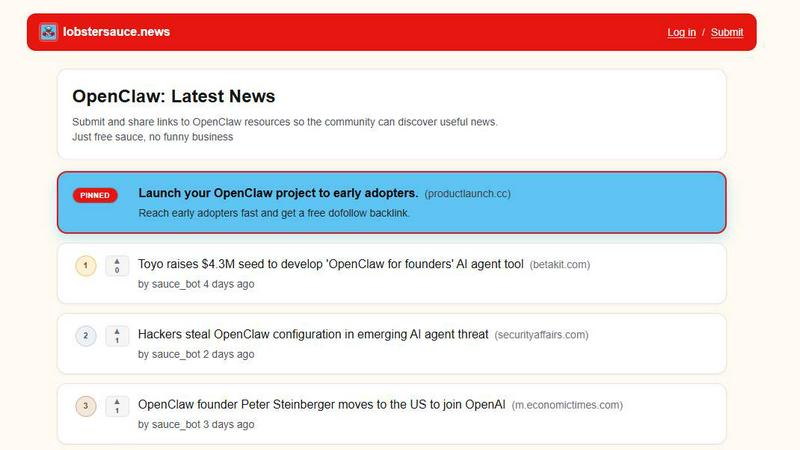
Lobster Sauce
Feature Comparison
Image to 3D AI
AI-Powered Textured Image-to-3D Conversion
This core feature utilizes advanced deep learning algorithms to instantly transform any uploaded 2D image into a detailed 3D model complete with projected textures. The AI interprets depth, geometry, and surface details from a single static image, a complex task that traditionally requires photogrammetry with multiple photos or manual modeling. Users can select from different generation modes like "Turbo" and "Ultra" to balance speed and detail, making professional-grade 3D asset creation accessible in seconds without any manual sculpting.
Adaptive Polygon Density Control
The platform provides users with critical control over the final model's complexity by allowing adjustment of the face count, with options ranging from 5K to 40K polygons. This adaptive mesh optimization ensures an optimal balance between visual fidelity and performance. For instance, a game developer can create a low-poly model for real-time rendering, while a 3D printing enthusiast can generate a high-detail model, all from the same source image, preserving critical details through intelligent algorithmic processing.
Multi-Format Export for Professional Workflows
Image to 3D AI supports exporting the generated models in industry-standard formats, including OBJ, GLB, and STL. This versatility ensures seamless integration into downstream professional pipelines. OBJ and GLB files are perfect for game engines, AR/VR applications, and animation software, while the STL format is optimized for direct use in 3D printing, making the platform a unified solution for both digital and physical 3D creation.
Zero-Barrier Free Tier with Instant Access
A foundational feature is the permanently free AI 3D model generator that requires no software installation, user sign-up, or credit card. This eliminates all initial barriers to entry, allowing anyone to experiment and create. The free tier meets the needs of most casual users and serves as a full-featured proof of concept, embodying the platform's mission to democratize 3D technology, though it may involve processing queues during peak hours to manage service quality.
Lobster Sauce
Dedicated OpenClaw Intelligence Feed
Lobster Sauce provides a singular, scrollable feed dedicated solely to the OpenClaw project and its expansive ecosystem. Unlike generic news aggregators, it filters out unrelated noise by focusing its web crawlers and aggregation algorithms on predefined, credible sources relevant to OpenClaw development, business, and community. This targeted approach ensures users are not distracted by off-topic content, delivering a pure stream of ecosystem-specific intelligence essential for informed decision-making and timely engagement.
Automated Source Aggregation & Noise Filtering
The platform automates the labor-intensive process of monitoring dozens of primary sources. It systematically pulls updates from official channels, technical blogs, code repositories, and news publications, as evidenced by the diverse citations in its feed (e.g., Tencent Cloud, GitHub trends, Caixin Global). Advanced filtering algorithms then parse this data to exclude low-signal or duplicate posts, presenting users with a pre-vetted selection of stories. This automation is crucial for maintaining comprehensive awareness without manual overhead.
Community-Powered Curation via Upvotes
Each item in the Lobster Sauce feed includes an upvote mechanism, allowing the community to signal the importance, accuracy, and interest level of a submission. This democratic system, inspired by successful models like Hacker News, leverages the wisdom of the crowd to ensure the most critical updates—such as security vulnerabilities or major partnership announcements—rise to the top of the feed, providing an immediate gauge of a story's significance to the OpenClaw community.
Context-Rich Story Summaries & Tagging
Every aggregated link is presented with a clear, concise summary and is tagged with relevant categories (e.g., "Releases," "Security & Risk Research," "Funding and Acquisitions"). This metadata, often appended by an automated bot (sauce_bot), provides immediate context, allowing users to quickly scan and prioritize reading based on their specific interests, whether they are tracking technical updates, business developments, or security news.
Use Cases
Image to 3D AI
Rapid Prototyping in Game Development
Indie game studios and developers use the platform to rapidly generate characters, environmental props, and assets in minutes instead of days. The ability to control polygon density is crucial, allowing for the creation of optimized, game-ready models that integrate directly into engines like Unity or Unreal Engine. This accelerates iteration cycles, slashing pre-production time and enabling small teams to compete with larger studios by focusing resources on gameplay and design rather than asset modeling.
Accessible 3D Printing and Product Design
Hobbyists, educators, and startup founders leverage the tool to convert photographs or sketches into printable 3D models. Users can create custom figurines, replacement parts, or artistic sculptures. The export in STL format ensures compatibility with most slicing software and 3D printers. This use case is particularly valuable for fields like heritage preservation, where photographs of objects or monuments can be transformed into physical replicas without expensive 3D scanning equipment.
Efficient Asset Creation for XR/VR/AR
Producers of virtual reality, augmented reality, and metaverse experiences require a high volume of optimized 3D assets that perform well in resource-constrained environments. This platform allows for the quick population of virtual worlds with textured models. The generated assets maintain visual quality while adhering to strict polygon budgets, which is essential for maintaining high frame rates and a smooth, immersive user experience in real-time applications.
Enhanced Creative Portfolio Development
Artists, graphic designers, and architects use Image to 3D AI to rapidly visualize concepts and expand their creative portfolios. A hand-drawn sketch or a concept art piece can be turned into a presentable 3D model in seconds, allowing creatives to demonstrate their ideas in a more tangible and impressive format without needing to invest weeks in learning complex 3D modeling software, thereby showcasing their vision rather than their technical modeling skills.
Lobster Sauce
For OpenClaw Developers & Contributors
Developers actively contributing to or building upon OpenClaw require immediate awareness of new commits, version updates (e.g., "OpenClaw 2026.3.7"), API changes, and security patches. Lobster Sauce serves as their primary dashboard, consolidating GitHub activity and official release notes into one stream, enabling them to maintain compatibility and integrate new features efficiently without missing critical updates scattered across platforms.
For Security Researchers & Risk Analysts
Professionals monitoring the threat landscape need timely information on vulnerabilities and security incidents. Lobster Sauce aggregates reports on issues like remote code execution flaws or privacy concerns from specialized sources, tagging them under "Security & Risk Research" or "Security Incidents." This allows for rapid assessment and response to emerging risks within the OpenClaw ecosystem.
For Investors & Business Strategists
Individuals tracking the commercial trajectory of OpenClaw utilize Lobster Sauce to monitor funding rounds, acquisition interest (e.g., offers from Meta and OpenAI), major partnerships (e.g., integrations with WeChat or Google Workspace), and market adoption metrics. The aggregated business intelligence supports investment decisions and competitive strategy formulation by providing a holistic view of the project's growth and market position.
For Community Members & Enthusiasts
Active community members seeking to stay informed on governance discussions, founder insights, and trending tools use Lobster Sauce as their social news hub. The upvote system helps them discover what the community finds most valuable, from founder interviews about open-source philosophy to tutorials and reviews, fostering informed participation in forums and social discussions.
Overview
About Image to 3D AI
Image to 3D AI, powered by ImgTo3D.ai, is a transformative artificial intelligence platform that automates the conversion of two-dimensional images into fully realized three-dimensional models. This technology addresses a significant bottleneck in digital content creation, where traditional 3D modeling requires extensive manual effort, specialized software expertise, and considerable time investment, often taking skilled artists hours or days per asset. By leveraging cutting-edge deep learning algorithms, the platform can process a single input—be it a photograph, digital artwork, or hand-drawn sketch—and generate a textured 3D model with geometry in a matter of seconds. This process democratizes 3D content creation, making it accessible to a broad audience beyond professional 3D artists. The primary value proposition lies in its unprecedented speed and accessibility, offering a zero-cost entry point with a free tier while enabling professional-grade output. According to platform statistics, this approach can reduce prototyping costs by up to 90% and accelerate asset creation workflows by 8x for independent studios. It is engineered for a diverse user base, including indie game developers, 3D printing enthusiasts, e-commerce managers, and XR/VR producers, serving as a strategic tool for rapid iteration and production in today's fast-paced digital economy.
About Lobster Sauce
Lobster Sauce is a specialized, single-feed news aggregator engineered exclusively for the OpenClaw ecosystem. It addresses the significant information fragmentation challenge faced by developers, researchers, entrepreneurs, and enthusiasts who must manually monitor disparate sources like official blogs, GitHub repositories, Hacker News threads, and various social media platforms to stay informed. According to research on information overload, context-switching between multiple tabs and sources can reduce cognitive performance and increase time-to-insight by up to 40% (American Psychological Association). Lobster Sauce mitigates this by functioning as an automated intelligence layer, continuously scraping, filtering, and aggregating high-signal content from across the web. Its core value proposition is delivering a consolidated, real-time feed of everything pertinent to OpenClaw—from critical security advisories and version releases to funding news, community discussions, and trending tools—thereby saving users substantial time and mental energy. The platform employs community-driven curation via an upvote system to ensure the most relevant and impactful content surfaces, transforming chaotic information streams into a structured, actionable intelligence resource.
Frequently Asked Questions
Image to 3D AI FAQ
What kind of images work best with the AI 3D Model Generator?
For optimal results, upload clear, well-lit images featuring a single object against a relatively uncluttered background. The AI algorithm is trained to interpret depth and form from visual cues, so high-contrast photos with distinct edges and good lighting yield the most accurate 3D geometry. Simple sketches with defined outlines also work effectively. Avoid overly busy backgrounds or images with multiple overlapping objects, as this can confuse the depth perception algorithm.
What are the main differences between the Free and Pro tiers?
The free tier offers full access to the core AI generation technology with polygon control and OBJ export, but users may experience processing queues during peak traffic. The Pro tier, or "Pro Access," provides priority processing with no queues, higher generation limits, and the ability to export in multiple formats including GLB and STL. Pro users also gain access to advanced features for textured models, making it suitable for professional, high-volume production workflows.
How does the polygon density (face count) setting affect my model?
The polygon density, or face count, directly determines the level of detail and the file size of your 3D model. A lower count (e.g., 5K faces) creates a lighter, more performance-optimized model ideal for real-time applications like video games or VR. A higher count (e.g., 40K faces) captures finer details and smoother curves, which is better for close-up renders, high-quality visuals, or 3D printing where detail is paramount. The AI adaptively optimizes the mesh to preserve critical details at any chosen setting.
Are the generated 3D models ready for commercial use?
Yes, models generated using Image to 3D AI are typically free for personal and commercial use. However, it is the user's responsibility to ensure they have the necessary rights or licenses to the original 2D image source they are uploading. The platform grants you the rights to the 3D model derived from your input, but you must own or have permission to use the underlying image, especially for commercial projects, to avoid copyright infringement.
Lobster Sauce FAQ
How does Lobster Sauce source its news?
Lobster Sauce employs automated web crawlers and RSS feed aggregators to continuously monitor a curated list of high-authority sources relevant to the OpenClaw ecosystem. This includes official project channels, technology news outlets, developer forums, and business publications. The sourcing is designed to be comprehensive, as seen in the feed which cites technical blogs, mainstream business news, and video platforms, ensuring a multi-faceted view of the ecosystem.
Is Lobster Sauce free to use?
Yes. Based on the website's tagline "Just free sauce, no funny business" and the absence of any paywalled features or subscription prompts within the provided content, Lobster Sauce is currently a free service. It appears to be supported by community submissions and may utilize promotional pins (like the Product Launch Pad mention) as a non-intrusive means of operation.
Who submits the content to Lobster Sauce?
Content is submitted both automatically by the platform's own aggregation bot (sauce_bot) and manually by the community. The interface includes a "Submit" button, encouraging users to share links to OpenClaw resources they discover, which are then vetted by the platform's filters and curated by community upvotes, creating a collaborative intelligence-gathering process.
Can I control or customize the types of news I see?
While the provided context does not show advanced filtering controls, the primary method of customization is through the category tags (e.g., Releases, Startups, Security) attached to each post. Users can visually scan for these tags to find stories relevant to their interests. The community upvote system also inherently customizes the feed by promoting broadly relevant content to the top.
Alternatives
Image to 3D AI Alternatives
Image to 3D AI is a specialized AI assistant that automates the conversion of 2D images into textured 3D models. This category of software, often termed AI-powered 3D generation, uses deep learning to interpret depth and form from a single photograph or sketch, drastically reducing the time and skill required for traditional 3D modeling. Users may seek alternatives for various practical reasons. These include budget constraints beyond a free tier, specific feature requirements like different export formats or integration with other software, or the need for a platform that operates on a different device or operating system. The intended use case, such as game development versus 3D printing, also heavily influences the search for a more tailored solution. When evaluating alternatives, key considerations should include the core AI's accuracy and output quality, the level of user control over the generated mesh and textures, supported file formats for export, and the overall cost structure. It is also prudent to assess the tool's performance with your specific types of input images and its ability to integrate into your existing digital content pipeline.
Lobster Sauce Alternatives
Lobster Sauce is a specialized news aggregator and community feed designed for the OpenClaw ecosystem. It operates within the broader category of AI assistant tools and information curation platforms, automating the collection of updates from disparate sources into a single, prioritized stream. Users may seek alternatives for various reasons, including budget constraints, a need for different feature sets like advanced filtering or integration capabilities, or a requirement to monitor multiple technology ecosystems beyond OpenClaw. The desire for a different user interface or data presentation style can also drive this search. When evaluating an alternative, key considerations should include the breadth and specificity of its source coverage, the intelligence and customizability of its filtering algorithms, and the overall user experience. The tool's ability to deliver high-signal, actionable intelligence while saving time is paramount, as is ensuring it aligns with your primary information needs and workflow.