
Agent to Agent Testing Platform vs Image to 3D AI
Side-by-side comparison to help you choose the right product.

Agent to Agent Testing Platform
Validate AI agent performance and compliance across chat, voice, and phone interactions with dynamic testing scenarios.
Last updated: February 27, 2026

Image to 3D AI
ImgTo3D.ai instantly converts any 2D image into a detailed 3D model for free, as noted by its 20,000 monthly users.
Last updated: March 1, 2026
Visual Comparison
Agent to Agent Testing Platform
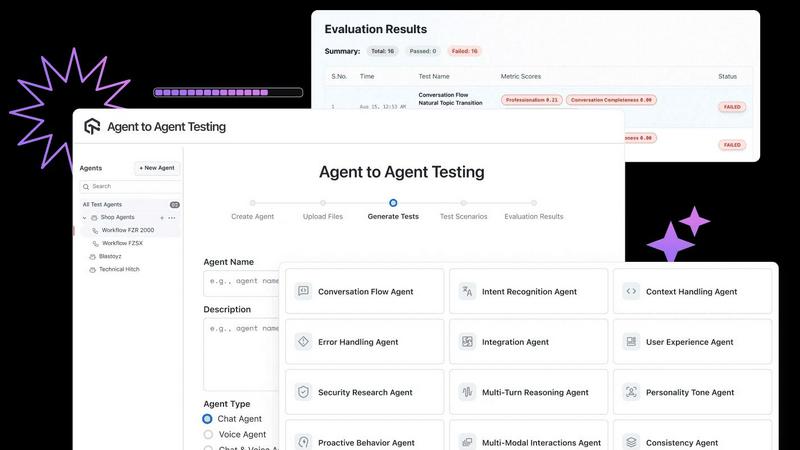
Image to 3D AI
Feature Comparison
Agent to Agent Testing Platform
Automated Scenario Generation
The platform features automated scenario generation that creates a wide range of diverse test cases for AI agents, simulating interactions across chat, voice, and phone calls. This capability ensures that the agents can handle varied scenarios, enhancing their robustness and reliability.
True Multi-Modal Understanding
Agent to Agent Testing allows for multi-modal input analysis, enabling users to define detailed requirements or upload product requirements documents (PRDs) that include images, audio, and videos. This feature ensures that AI agents are evaluated under conditions that closely mirror real-world usage.
Autonomous Test Scenario Generation
Users can access a library of hundreds of pre-defined test scenarios or create custom scenarios tailored to specific needs. This includes testing personality tones, data privacy protocols, and intent recognition, allowing for a comprehensive assessment of the agent's capabilities.
Regression Testing with Risk Scoring
The platform facilitates end-to-end regression testing, providing insights into risk scoring that highlights potential areas of concern. This feature allows teams to prioritize critical issues and optimize their testing efforts, ensuring that the AI agents remain effective over time.
Image to 3D AI
AI-Powered Textured Image-to-3D Conversion
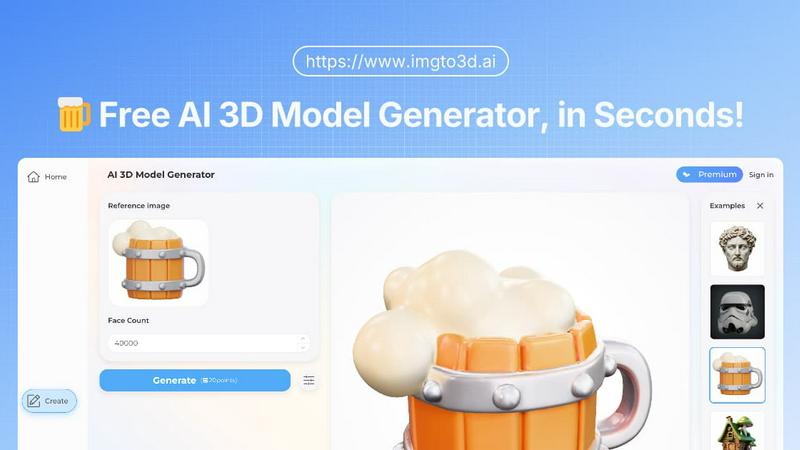
This core feature utilizes advanced deep learning algorithms to instantly transform any uploaded 2D image into a detailed 3D model complete with projected textures. The AI interprets depth, geometry, and surface details from a single static image, a complex task that traditionally requires photogrammetry with multiple photos or manual modeling. Users can select from different generation modes like "Turbo" and "Ultra" to balance speed and detail, making professional-grade 3D asset creation accessible in seconds without any manual sculpting.
Adaptive Polygon Density Control
The platform provides users with critical control over the final model's complexity by allowing adjustment of the face count, with options ranging from 5K to 40K polygons. This adaptive mesh optimization ensures an optimal balance between visual fidelity and performance. For instance, a game developer can create a low-poly model for real-time rendering, while a 3D printing enthusiast can generate a high-detail model, all from the same source image, preserving critical details through intelligent algorithmic processing.
Multi-Format Export for Professional Workflows
Image to 3D AI supports exporting the generated models in industry-standard formats, including OBJ, GLB, and STL. This versatility ensures seamless integration into downstream professional pipelines. OBJ and GLB files are perfect for game engines, AR/VR applications, and animation software, while the STL format is optimized for direct use in 3D printing, making the platform a unified solution for both digital and physical 3D creation.
Zero-Barrier Free Tier with Instant Access
A foundational feature is the permanently free AI 3D model generator that requires no software installation, user sign-up, or credit card. This eliminates all initial barriers to entry, allowing anyone to experiment and create. The free tier meets the needs of most casual users and serves as a full-featured proof of concept, embodying the platform's mission to democratize 3D technology, though it may involve processing queues during peak hours to manage service quality.
Use Cases
Agent to Agent Testing Platform
Quality Assurance for AI Chatbots
Enterprises can leverage the platform to conduct thorough quality assurance testing for AI chatbots, ensuring that they perform accurately and consistently across various customer interactions.
Voice Assistant Performance Evaluation
Organizations can utilize the platform to evaluate the performance of voice assistants, assessing their ability to understand commands, respond appropriately, and maintain a natural conversational flow.
Multi-Persona Testing
The platform enables testing scenarios that simulate interactions with diverse personas, ensuring that AI agents can cater to different user needs and behaviors—crucial for applications in customer service and support.
Compliance and Risk Management
Using the risk scoring feature, companies can conduct compliance testing to ensure that AI agents adhere to relevant regulations and internal policies, significantly reducing the risk associated with AI deployment.
Image to 3D AI
Rapid Prototyping in Game Development
Indie game studios and developers use the platform to rapidly generate characters, environmental props, and assets in minutes instead of days. The ability to control polygon density is crucial, allowing for the creation of optimized, game-ready models that integrate directly into engines like Unity or Unreal Engine. This accelerates iteration cycles, slashing pre-production time and enabling small teams to compete with larger studios by focusing resources on gameplay and design rather than asset modeling.
Accessible 3D Printing and Product Design
Hobbyists, educators, and startup founders leverage the tool to convert photographs or sketches into printable 3D models. Users can create custom figurines, replacement parts, or artistic sculptures. The export in STL format ensures compatibility with most slicing software and 3D printers. This use case is particularly valuable for fields like heritage preservation, where photographs of objects or monuments can be transformed into physical replicas without expensive 3D scanning equipment.
Efficient Asset Creation for XR/VR/AR
Producers of virtual reality, augmented reality, and metaverse experiences require a high volume of optimized 3D assets that perform well in resource-constrained environments. This platform allows for the quick population of virtual worlds with textured models. The generated assets maintain visual quality while adhering to strict polygon budgets, which is essential for maintaining high frame rates and a smooth, immersive user experience in real-time applications.
Enhanced Creative Portfolio Development
Artists, graphic designers, and architects use Image to 3D AI to rapidly visualize concepts and expand their creative portfolios. A hand-drawn sketch or a concept art piece can be turned into a presentable 3D model in seconds, allowing creatives to demonstrate their ideas in a more tangible and impressive format without needing to invest weeks in learning complex 3D modeling software, thereby showcasing their vision rather than their technical modeling skills.
Overview
About Agent to Agent Testing Platform
The Agent to Agent Testing Platform is a pioneering AI-native framework tailored for validating the behaviors of AI agents in real-world scenarios. As AI systems grow increasingly autonomous and their operations become less predictable, traditional quality assurance (QA) methods—designed for static software—become inadequate. This platform transcends basic prompt-level evaluations, enabling comprehensive assessments of multi-turn conversations across various mediums, such as chat, voice, and multimodal interactions. It is especially beneficial for enterprises seeking to ensure their AI agents perform reliably before they are deployed in production environments. By employing a specialized assurance layer, the platform utilizes over 17 unique AI agents to identify long-tail failures, edge cases, and interaction patterns often overlooked by manual testing. Autonomous synthetic user testing allows for the simulation of thousands of production-like interactions, ensuring that key compliance and performance metrics are met, including bias, toxicity, and hallucination detection.
About Image to 3D AI
Image to 3D AI, powered by ImgTo3D.ai, is a transformative artificial intelligence platform that automates the conversion of two-dimensional images into fully realized three-dimensional models. This technology addresses a significant bottleneck in digital content creation, where traditional 3D modeling requires extensive manual effort, specialized software expertise, and considerable time investment, often taking skilled artists hours or days per asset. By leveraging cutting-edge deep learning algorithms, the platform can process a single input—be it a photograph, digital artwork, or hand-drawn sketch—and generate a textured 3D model with geometry in a matter of seconds. This process democratizes 3D content creation, making it accessible to a broad audience beyond professional 3D artists. The primary value proposition lies in its unprecedented speed and accessibility, offering a zero-cost entry point with a free tier while enabling professional-grade output. According to platform statistics, this approach can reduce prototyping costs by up to 90% and accelerate asset creation workflows by 8x for independent studios. It is engineered for a diverse user base, including indie game developers, 3D printing enthusiasts, e-commerce managers, and XR/VR producers, serving as a strategic tool for rapid iteration and production in today's fast-paced digital economy.
Frequently Asked Questions
Agent to Agent Testing Platform FAQ
What types of AI agents can be tested using this platform?
The Agent to Agent Testing Platform supports a variety of AI agents, including chatbots, voice assistants, and phone caller agents, allowing for comprehensive testing across different modalities.
How does the platform ensure the accuracy of AI agents?
The platform employs advanced automated scenario generation and multi-agent testing to simulate a wide range of interactions, ensuring that AI agents are evaluated for accuracy and reliability under real-world conditions.
Can I create custom test scenarios?
Yes, users can create custom test scenarios tailored to specific requirements, in addition to accessing a library of pre-defined scenarios. This flexibility allows for targeted testing according to unique business needs.
What metrics can be evaluated using the platform?
The platform evaluates a variety of metrics, including bias, toxicity, hallucination, effectiveness, accuracy, empathy, and professionalism, providing a comprehensive assessment of AI agent performance.
Image to 3D AI FAQ
What kind of images work best with the AI 3D Model Generator?
For optimal results, upload clear, well-lit images featuring a single object against a relatively uncluttered background. The AI algorithm is trained to interpret depth and form from visual cues, so high-contrast photos with distinct edges and good lighting yield the most accurate 3D geometry. Simple sketches with defined outlines also work effectively. Avoid overly busy backgrounds or images with multiple overlapping objects, as this can confuse the depth perception algorithm.
What are the main differences between the Free and Pro tiers?
The free tier offers full access to the core AI generation technology with polygon control and OBJ export, but users may experience processing queues during peak traffic. The Pro tier, or "Pro Access," provides priority processing with no queues, higher generation limits, and the ability to export in multiple formats including GLB and STL. Pro users also gain access to advanced features for textured models, making it suitable for professional, high-volume production workflows.
How does the polygon density (face count) setting affect my model?
The polygon density, or face count, directly determines the level of detail and the file size of your 3D model. A lower count (e.g., 5K faces) creates a lighter, more performance-optimized model ideal for real-time applications like video games or VR. A higher count (e.g., 40K faces) captures finer details and smoother curves, which is better for close-up renders, high-quality visuals, or 3D printing where detail is paramount. The AI adaptively optimizes the mesh to preserve critical details at any chosen setting.
Are the generated 3D models ready for commercial use?
Yes, models generated using Image to 3D AI are typically free for personal and commercial use. However, it is the user's responsibility to ensure they have the necessary rights or licenses to the original 2D image source they are uploading. The platform grants you the rights to the 3D model derived from your input, but you must own or have permission to use the underlying image, especially for commercial projects, to avoid copyright infringement.
Alternatives
Agent to Agent Testing Platform Alternatives
The Agent to Agent Testing Platform is an innovative AI-native quality assurance framework that specializes in validating the behavior of AI agents across various communication modalities, including chat, voice, and phone. As enterprises increasingly adopt AI solutions, ensuring these agents behave as intended in real-world environments has become critical. However, the complexities and nuances of agent interactions often lead users to seek alternatives that better match their specific needs, whether due to pricing constraints, feature sets, or compatibility with existing platforms. When searching for alternatives to the Agent to Agent Testing Platform, users should consider the scalability of the testing solution, the comprehensiveness of its testing capabilities, and the level of support offered. It's crucial to evaluate how well an alternative can simulate authentic user behavior and detect potential compliance or security risks, ensuring it effectively addresses the unique challenges posed by autonomous AI systems.
Image to 3D AI Alternatives
Image to 3D AI is a specialized AI assistant that automates the conversion of 2D images into textured 3D models. This category of software, often termed AI-powered 3D generation, uses deep learning to interpret depth and form from a single photograph or sketch, drastically reducing the time and skill required for traditional 3D modeling. Users may seek alternatives for various practical reasons. These include budget constraints beyond a free tier, specific feature requirements like different export formats or integration with other software, or the need for a platform that operates on a different device or operating system. The intended use case, such as game development versus 3D printing, also heavily influences the search for a more tailored solution. When evaluating alternatives, key considerations should include the core AI's accuracy and output quality, the level of user control over the generated mesh and textures, supported file formats for export, and the overall cost structure. It is also prudent to assess the tool's performance with your specific types of input images and its ability to integrate into your existing digital content pipeline.