
iGPT vs Pursuit
Side-by-side comparison to help you choose the right product.

iGPT is an enterprise API that transforms email data into secure, contextual insights for agents.
Last updated: March 1, 2026

Pursuit
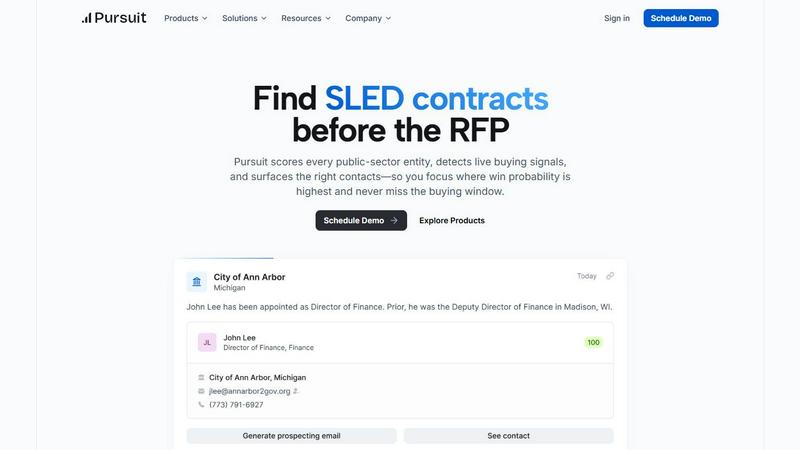
Pursuit uses AI to identify high-probability SLED sales opportunities before RFPs are issued.
Last updated: February 28, 2026
Visual Comparison
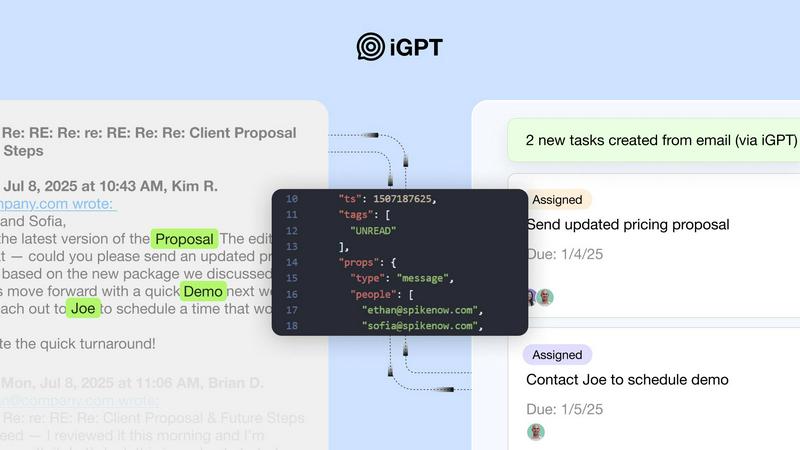
iGPT
Pursuit
Feature Comparison
iGPT
Unified Intelligence Endpoint
iGPT consolidates the entire process of email intelligence into a single API call. This eliminates the need for developers to build and maintain separate systems for retrieval, context shaping, and reasoning, a common challenge noted in complex RAG implementations. A user simply submits a natural language query, and the API handles deep indexing, hybrid retrieval, and optimized context preparation automatically, returning a structured response with citations in approximately 3 seconds to the first token.
Deep Contextual Understanding & Thread Reconstruction
The API goes beyond simple keyword matching by semantically understanding email content and its relational context. It automatically reconstructs fragmented email threads across time, participants, and related attachments, rebuilding the complete narrative of a conversation. This capability is crucial for accurate understanding, as critical information is often distributed across multiple messages and replies, a nuance that standard search fails to capture.
Advanced Attachment Processing
iGPT extracts and indexes text, data, and structural information from a wide array of attachments, including documents, PDFs, and spreadsheets. This processing is performed in the context of the surrounding email thread and its participants, allowing the system to answer questions about contract clauses, invoice details, or report figures as they were discussed, turning static files into queryable knowledge assets.
Enterprise-Grade Security & Compliance Framework
Built for regulated industries, iGPT enforces a strict security model. It guarantees zero data training or retention, with all inferences processed in memory. Access is controlled via OAuth-only processing with Role-Based Access Control (RBAC), and every response includes a full audit trail, linking answers directly to source messages. This ensures data sovereignty and compliance with stringent data protection standards.
Pursuit
Pre-RFP Signal Detection
Pursuit’s proprietary AI engine continuously monitors and analyzes public data sources from over 110,000 SLED entities to identify live buying signals. These signals, extracted from budget documents, meeting agendas, and contract postings, surface actionable opportunities 6 to 18 months before a formal Request for Proposal is released. This early intelligence allows sales teams to position themselves as informed partners rather than reactive bidders, fundamentally changing the entry point for SLED engagements.
Entity and Contact Database with Continuous Enrichment
The platform maintains a constantly updated database of over 90,000 entities and 4 million contacts within the SLED ecosystem. Pursuit ensures 94% data accuracy through automated, continuous enrichment, tracking organizational changes, role transitions, and new hires. This eliminates the fragility of static contact lists and personal networks, providing a single source of truth that persists despite staff turnover.
Native CRM and MarTech Integrations
Pursuit offers bi-directional synchronization with core go-to-market systems like Salesforce and HubSpot. Enriched account data, contact information, and identified buying signals flow automatically into these platforms, eliminating manual data entry and ensuring intelligence is actionable within existing workflows. This seamless integration is credited with reducing data enrichment time by 68% according to user case studies.
Role-Specific Intelligence Delivery
Intelligence is delivered through persona-specific interfaces. Account Executives receive instant meeting prep via a Chrome extension, BDRs get daily prioritized call lists, Marketing can build ABM campaigns around budget cycles, and Customer Success receives configurable renewal alerts. This ensures every team member gets the right information in the right format to drive their specific function, from prospecting to renewal.
Use Cases
iGPT
Intelligent Email Assistants & Copilots
Organizations can build AI agents that draft, prioritize, summarize, and act on email with full historical and contextual awareness. For support teams, this means a copilot that can instantly reconstruct a customer's entire issue history across long email chains and attachments, enabling faster, more informed responses and reducing handle times significantly.
Automated Workflow & Task Orchestration
iGPT automates the extraction of actionable items from communication streams. It can automatically parse email threads to identify decisions, action items, owners, and deadlines, then feed this structured data into project management tools like Asana or Jira. This transforms unstructured conversations into tracked tasks and approvals, flagging stalled items for follow-up.
CRM Enrichment & Deal Intelligence
Sales and account management teams can use iGPT to extract critical deal momentum, customer sentiment, and decision rationale directly from email exchanges. The API can summarize key points from lengthy negotiation threads or identify all pending approvals mentioned in communications with a client, providing real-time insights that keep CRM data accurate and actionable.
Compliance Auditing & Legal Discovery
For legal, finance, and compliance departments, iGPT provides a powerful tool for tracing feedback, approvals, and contractual agreements back to their original source emails and attachments. This creates a verifiable audit trail, streamlining internal reviews, e-discovery processes, and ensuring that corporate decisions are fully documented and easily retrievable.
Pursuit
Accelerating New Sales Pipeline Generation
Business Development Representatives use Pursuit to move beyond cold calling based on hunches. The platform provides daily, prioritized lists of accounts exhibiting concrete buying signals, such as recent budget approvals for relevant initiatives or upcoming contract expirations. This signal-driven approach has been shown to increase qualified SLED pipeline by 47% and achieve cold call conversion rates as high as 20%, according to published case studies.
Improving Account Executive Win Rates
Account Executives leverage Pursuit’s intelligence to prepare for meetings and craft compelling proposals. The Chrome extension provides immediate context on the account’s procurement history, incumbent vendors, contract values, and recent buying committee discussions. Showing up with this depth of knowledge builds credibility and allows AEs to tailor their solution effectively, leading to a documented 32% improvement in win rates.
Enabling Signal-Based Account-Based Marketing (ABM)
Marketing teams utilize Pursuit to build highly targeted ABM campaigns grounded in real-time intelligence. Instead of targeting accounts based on firmographics alone, they can create audiences based on active signals like new technology initiatives or leadership changes tied to budget cycles. Syncing these audiences to platforms like LinkedIn Ads and Marketo has resulted in a 2.4x lift in campaign conversion rates.
Proactive Customer Success and Renewal Management
Customer Success managers configure Pursuit to monitor their existing customer base for both renewal and churn signals. Alerts for contract expirations (90-180 days in advance), budget cuts, leadership changes, or competitor RFPs allow for proactive outreach and risk mitigation. This early signal identification enables teams to identify renewal opportunities 3x faster and protect revenue.
Overview
About iGPT
iGPT is an advanced email intelligence API engineered to transform unstructured email data into structured, actionable insights for enterprise workflows and AI agents. It directly addresses the critical gap where traditional AI models fail: understanding the complex, contextual, and often messy nature of real-world email communication, which includes long threads, multiple participants, and diverse attachments. The platform serves a diverse range of industries, including customer support, legal, finance, and operations, by providing a secure, auditable gateway for AI systems to access and comprehend email data. Its core value proposition lies in its unified endpoint that replaces the need for complex, multi-step retrieval-augmented generation (RAG) pipelines. Organizations can bypass the burdens of parsing, chunking, indexing, and prompt tuning, instead sending a single natural language request to receive a context-aware, cited answer in seconds. With a foundational commitment to security—featuring zero data training, zero data retention, and full audit trails—iGPT empowers teams to automate tasks, enhance decision-making, and build sophisticated agents that operate with the full context of an organization's communication history.
About Pursuit
Pursuit is an AI-powered sales intelligence platform engineered specifically for businesses selling to state, local, and education (SLED) government entities. It directly addresses the unique and formidable challenges of public-sector sales, which include navigating over 110,000 distinct entities, complex procurement rules, and elongated budget cycles that can span fiscal years. The platform serves sales, business development, marketing, and customer success teams at government technology vendors, contractors, and consultants. Its core mission is to transform the traditionally opaque and relationship-dependent SLED market into a data-driven, proactive sales process. Pursuit achieves this by continuously analyzing public data from a vast network of entities and contacts, applying proprietary artificial intelligence to detect genuine buying signals from documents like budget approvals, council meeting minutes, and contract expirations—often 6-18 months before a formal RFP is issued. This pre-RFP intelligence allows teams to identify opportunities earlier, understand the procurement path, and engage with the right stakeholders at the optimal time. The platform's ultimate value proposition is a significant increase in win rates and pipeline velocity by ensuring sales efforts are focused on entities with the highest verified propensity to buy, effectively ensuring teams never miss the critical buying window.
Frequently Asked Questions
iGPT FAQ
How does iGPT's performance compare to building a custom RAG pipeline?
iGPT is designed to outperform and simplify custom RAG pipelines. While a custom pipeline requires significant engineering effort for parsing, chunking, embedding, vector store management, and prompt optimization, iGPT delivers a production-ready solution through a single API call. Benchmarks indicate it provides ~200ms retrieval and ~3s to first token across large email datasets, a performance level that typically requires extensive tuning in a custom setup.
What makes email a uniquely difficult data source for AI?
Email is inherently unstructured, conversational, and context-dependent. Critical information is dispersed across long threads with multiple participants, nested replies, and various file attachments. Traditional AI and search tools struggle with thread reconstruction, understanding tone shifts, and connecting data in attachments to the discussion about them. iGPT is specifically engineered to solve these "last-mile" context problems that break general-purpose LLMs.
Is my company's email data secure and private with iGPT?
Yes, iGPT is built with a foundational principle of data security. It employs a zero-data retention policy, meaning your inputs, prompts, and outputs are never stored after processing. The company also adheres to a strict zero-data training policy, ensuring your proprietary communications are never used to train or improve any AI models. All access is governed by OAuth and RBAC, keeping data under your organization's control.
How quickly can I integrate iGPT and start getting value?
Integration is designed for immediacy. iGPT provides a live playground for testing, comprehensive SDKs (including Python), and connectors for platforms like LangChain. Developers can connect email sources, test queries with different Context Engineering Framework (CEF) tiers, and receive structured, cited answers without any upfront data pipeline development, allowing teams to prototype and ship agents in days, not months.
Pursuit FAQ
What types of buying signals does Pursuit detect?
Pursuit’s AI is trained to identify a wide range of non-RFP signals indicative of future procurement. This includes budget line-item approvals for specific projects, discussions in city council or school board meeting minutes, the expiration dates of existing vendor contracts, the posting of RFIs (Requests for Information), and leadership changes in relevant departments. These signals collectively paint a picture of budgetary intent and project planning long before a formal bid is solicited.
How does Pursuit ensure data accuracy and relevance?
The platform employs a multi-layered approach to data integrity. First, it aggregates data from primary, public sources. Second, proprietary AI and machine learning models clean, deduplicate, and contextualize this information. Third, continuous automated enrichment processes run to update records for contact changes, role transitions, and organizational updates. This results in a documented 94% data accuracy rate, ensuring teams are working with current and actionable intelligence.
Can Pursuit integrate with our existing tech stack (CRM, marketing automation)?
Yes, Pursuit is built with integration as a core principle. It offers native, bi-directional integrations with major CRM platforms like Salesforce and HubSpot, allowing enriched account/contact data and buying signals to sync automatically. For marketing teams, Pursuit can push segmented audiences and intent signals directly into platforms such as Marketo, HubSpot, and LinkedIn Campaign Manager, enabling seamless signal-based campaign execution.
Is Pursuit only for large enterprises selling to SLED?
No, Pursuit is designed for any business that sells products or services to state, local, or education government entities. This includes technology vendors of all sizes, contractors, consultants, and professional services firms. The platform is particularly valuable for companies looking to scale their SLED sales operations efficiently, as it reduces the heavy research burden and levels the playing field by providing intelligence that was previously only accessible through vast personal networks.
Alternatives
iGPT Alternatives
iGPT is an advanced email intelligence API that falls within the Business Intelligence category. It specializes in transforming enterprise email data into secure, contextual insights to streamline agent workflows and automate decision-making processes. By providing a secure gateway for AI agents to understand email conversations and attachments, it helps organizations unlock the operational value of their communication data. Users may explore alternatives to iGPT for various reasons. Common drivers include budget constraints and specific pricing model needs, the requirement for different feature sets or integration capabilities with other platforms, and the desire for a solution tailored to a particular industry use case or company size. Evaluating the total cost of ownership and specific functional requirements is a standard part of the enterprise software selection process. When assessing an alternative email intelligence solution, key considerations should include the depth and security of its email data processing, the accuracy and contextual awareness of its AI responses, and the ease of integration into existing tech stacks. Compliance with data governance standards and the solution's ability to provide auditable, traceable insights are also critical factors for enterprise adoption, as noted in industry analyses of AI-powered workflow tools.
Pursuit Alternatives
Pursuit is an AI-powered sales intelligence platform within the business intelligence category, specifically designed for companies selling to state, local, and education (SLED) government agencies. It transforms the traditionally opaque public sector sales process by using artificial intelligence to detect early buying signals and prioritize high-probability opportunities, thereby increasing pipeline velocity and win rates. Users may explore alternatives to Pursuit for various reasons, including budget constraints, specific feature requirements not addressed by the platform, or a need for a different sales methodology. Some organizations might seek tools with a broader market focus beyond SLED, require deeper integration with a particular tech stack, or prefer a different pricing model, such as per-user subscriptions versus enterprise-wide contracts. When evaluating an alternative, key considerations should include the depth and accuracy of public sector data coverage, the sophistication of AI in identifying genuine buying intent, and the platform's ability to integrate actionable intelligence directly into existing CRM workflows. The ideal solution should demonstrably reduce time spent on manual research and provide clear, timely insights that enable sales teams to engage prospects proactively, well before a formal RFP is issued.