CloudBurn vs Perkoon
Side-by-side comparison to help you choose the right product.

CloudBurn
CloudBurn prevents costly AWS surprises by showing infrastructure cost estimates directly in pull requests.
Last updated: February 28, 2026

Perkoon offers free, unlimited peer-to-peer file transfers with no signup required.
Last updated: March 4, 2026
Visual Comparison
CloudBurn
Perkoon
Feature Comparison
CloudBurn
Real-Time Pre-Deployment Cost Estimation
CloudBurn provides immediate, accurate AWS cost projections by analyzing infrastructure changes directly within pull requests. It leverages real-time AWS Pricing APIs to calculate the monthly financial impact of new, modified, or deleted resources, presenting a clear breakdown in dollars. This feature eliminates the guesswork and manual spreadsheet modeling, giving teams precise cost visibility at the most actionable point in the development cycle.
Automated Pull Request Cost Reporting
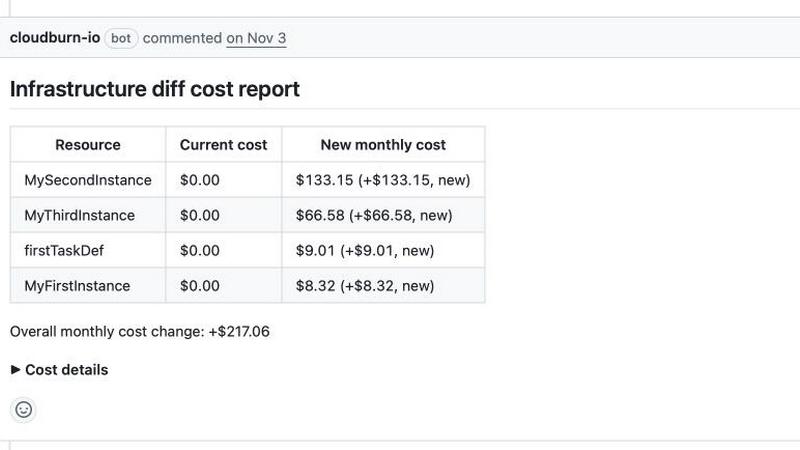
The platform seamlessly integrates with GitHub workflows to automatically post detailed cost analysis as a comment on every relevant pull request. This report includes a summary of the overall monthly cost change and a line-item breakdown for each resource, showing current versus new costs. This automation embeds FinOps directly into the existing CI/CD pipeline, making cost review a mandatory and effortless part of the standard code review process.
Infrastructure-as-Code (IaC) Native Integration
CloudBurn is built specifically for modern IaC practices, offering dedicated support for popular tools like Terraform and AWS CDK. It works by analyzing the output of terraform plan or cdk diff commands, ensuring it understands the exact infrastructure delta. This native approach guarantees that cost estimations are based on the actual declarative code changes, not speculative manual inputs.
Secure GitHub-Centric Deployment
Setup and operation are handled entirely through GitHub, requiring no separate billing setup or sensitive credential management on a third-party platform. Permissions and installation are managed via GitHub Marketplace, making it secure and incredibly easy to adopt. This model minimizes security overhead and accelerates time-to-value, as teams can start receiving cost insights within minutes of installation.
Perkoon
Unlimited Free P2P Transfers
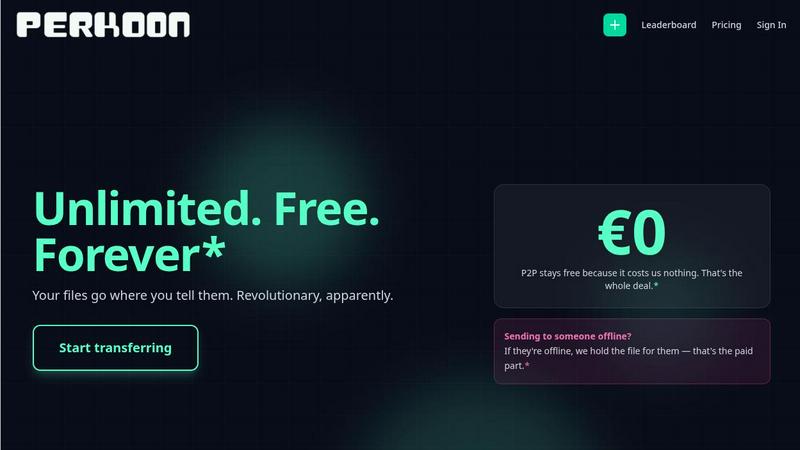
Perkoon's core feature is its unlimited, free peer-to-peer file transfer service. Utilizing WebRTC and similar technologies, it establishes a direct, encrypted connection between two web browsers. This process eliminates intermediary servers, meaning there are no file size limits, no mandatory sign-ups, and absolute privacy as Perkoon cannot access the data stream. This model is sustainably free because it incurs negligible infrastructure costs for the provider, a principle Perkoon openly communicates.
Encrypted Cloud Storage for Offline Recipients
For situations where the recipient is not immediately online, Perkoon provides encrypted cloud storage. This is a paid feature, with pricing structured transparently to cover the tangible costs of server maintenance, storage, and bandwidth. Files are encrypted on Perkoon's servers, providing a secure holding mechanism. This honest bifurcation between free P2P and paid cloud storage defines Perkoon's ethical and sustainable business approach.
Native AI and Automation Integration
Perkoon is architecturally designed for the age of automation. It exposes a dedicated JavaScript object (window.__perkoon) and provides a Command Line Interface (CLI) tool, allowing AI agents and scripts to interact with the service programmatically. This eliminates the need for unreliable DOM scraping, enabling seamless integration into automated workflows, AI-assisted tasks, and developer pipelines without human intervention.
Transparent Referral and Rewards Program
To incentivize growth, Perkoon operates a multi-tiered referral program. Users share a unique link; when a new user signs up via that link and completes 1GB of P2P transfers within seven days, both parties receive bonus cloud storage. The program extends to "chain rewards," where users also earn bonuses from the subsequent referrals made by people they invited, creating a network effect that rewards community building.
Use Cases
CloudBurn
Preventing Costly Configuration Errors
Engineering teams can use CloudBurn to catch severe and expensive misconfigurations before they deploy. For instance, accidentally specifying a cluster of xlarge instances instead of micro instances would be immediately flagged with a potential cost overrun of thousands of dollars in the PR review, allowing for correction before the code ever reaches production and impacts the AWS bill.
Enabling Developer-Led Cost Optimization
CloudBurn empowers individual developers and code reviewers to own cost efficiency. By providing immediate feedback, it allows teams to discuss and iterate on infrastructure design for optimal performance and cost. Developers can experiment with different instance types, storage options, or service configurations in their feature branch and immediately see the financial trade-offs, fostering a "cost-aware" engineering culture.
Streamlining FinOps and Engineering Collaboration
The platform serves as a single source of truth for infrastructure cost discussions, bridging the gap between FinOps/Finance teams and Engineering. Instead of monthly bill shock and retrospective blame games, CloudBurn provides a forward-looking, collaborative framework. Engineering can justify infrastructure choices with data, and FinOps can provide guidance based on actual planned changes, not historical spend.
Accelerating Safe Deployment Velocity
For organizations practicing continuous deployment, CloudBurn adds a vital safety check without slowing down development. It automates a previously manual or overlooked cost review step, allowing teams to maintain high deployment frequency with confidence. This ensures that speed does not come at the expense of uncontrolled cloud spend, supporting both agility and fiscal responsibility.
Perkoon
Sending Large Media Files Creatives
Video editors, photographers, and graphic designers frequently need to send multi-gigabyte project files, raw footage, or high-resolution assets to clients or collaborators. Perkoon's unlimited P2P transfer allows them to send these files instantly without compressing quality, waiting for uploads to third-party servers, or hitting paywalls, all while maintaining complete data privacy.
Secure Document Exchange for Professionals
Lawyers, journalists, healthcare professionals, and consultants handling sensitive documents require confidential file exchange. Perkoon's direct P2P transfer ensures documents never reside on a third-party server where they could be scanned or monetized. For asynchronous sharing, the encrypted cloud storage provides a secure, auditable option without corporate data mining.
Automated Backup and Sync Scripts
Developers and system administrators can leverage Perkoon's CLI and API access to build automated scripts. This enables use cases like scheduled backups of server logs or code repositories directly to a Perkoon cloud storage destination, or triggering file transfers as part of a CI/CD pipeline, all executed by machines without manual browser interaction.
AI Agent File Management
An AI personal assistant or agent can use Perkoon's native window.__perkoon interface to manage files on behalf of a user. For example, an agent could automatically retrieve a report generated by another tool and send it via P2P to a colleague's browser, or save a generated image to the user's Perkoon cloud storage, all through structured API calls.
Overview
About CloudBurn
CloudBurn is a specialized FinOps platform engineered to proactively manage and optimize cloud expenditure by integrating cost intelligence directly into the software development lifecycle (SDLC). It specifically targets engineering and platform teams that utilize Infrastructure-as-Code (IaC) frameworks such as Terraform and AWS Cloud Development Kit (CDK). The platform's core innovation lies in its ability to provide real-time, granular AWS cost estimates during the code review phase, effectively "shifting left" the traditionally reactive practice of cloud cost management. This directly addresses a critical industry inefficiency highlighted by Gartner, which notes that through 2024, 60% of public cloud cost optimization efforts will be wasted due to a lack of actionable insight and timely processes (Gartner, "Innovation Insight for Cloud Cost Optimization Tools"). By automatically analyzing IaC diffs against live AWS pricing APIs and posting detailed cost reports as comments on pull requests (PRs), CloudBurn transforms cloud cost from a post-deployment surprise on a monthly bill into a first-class, pre-deployment design parameter. This empowers developers to make informed, cost-conscious architectural decisions before code merges to production, preventing costly misconfigurations and fostering a culture of financial accountability within engineering teams.
About Perkoon
Perkoon is a privacy-first file transfer service designed to eliminate the friction and data exploitation common in modern digital tools. It operates on a transparent, cost-reflective model that fundamentally separates peer-to-peer (P2P) transfers from cloud-based storage. Its flagship offering is an unlimited, free P2P service that facilitates direct browser-to-browser file transfers when both sender and recipient are online. This method imposes no file size limits, requires no user accounts, and ensures privacy as data never transits Perkoon's servers. For offline transfers, Perkoon offers encrypted cloud storage as a paid feature, honestly pricing it to cover server infrastructure costs. The service is engineered for both human users and AI agents, featuring native API accessibility to prevent the need for inefficient screen-scraping. Perkoon's value proposition is clear: a straightforward, powerful tool that respects user privacy, offers genuine utility without artificial restrictions, and aligns its business model directly with the technical realities of data transfer.
Frequently Asked Questions
CloudBurn FAQ
How does CloudBurn calculate the cost estimates?
CloudBurn calculates estimates by parsing the infrastructure change plan (from terraform plan or cdk diff) and querying the official AWS Pricing APIs in real-time. It uses the resource specifications, region, and intended usage patterns defined in your IaC code to fetch the most current On-Demand pricing. The tool then computes the projected monthly cost based on 730 hours of usage (24/7 operation) to provide a standardized, comparable figure for review.
Is my code or cloud credentials exposed to CloudBurn?
No, CloudBurn follows a secure, GitHub-centric model. Your IaC code never leaves your GitHub repository. The analysis is triggered by a GitHub Action within your own workflow, which sends only the textual output of the diff/plan command (which contains resource types and configurations, not secrets) to CloudBurn's analysis engine. Your AWS credentials remain entirely within your GitHub environment and are never shared with CloudBurn.
What IaC tools and cloud providers does CloudBurn support?
Currently, CloudBurn provides native and dedicated support for the two most prevalent Infrastructure-as-Code tools: HashiCorp Terraform and AWS Cloud Development Kit (CDK). The platform is designed for AWS cloud infrastructure, as it leverages AWS's own pricing APIs. Support for additional cloud providers like Microsoft Azure or Google Cloud Platform would depend on future development and customer demand.
Can CloudBurn show cost savings from deleting or modifying resources?
Yes, absolutely. CloudBurn's analysis is based on the diff between the current and proposed infrastructure state. If a pull request modifies a resource to a cheaper alternative or deletes a resource entirely, the cost report will clearly show a negative cost change, highlighting the projected monthly savings. This makes it valuable for optimization and cleanup initiatives, not just for reviewing new deployments.
Perkoon FAQ
How can P2P transfers be completely free?
Perkoon's P2P technology establishes a direct connection between users' browsers using WebRTC. The file data streams directly from the sender's device to the recipient's without passing through or being stored on Perkoon's infrastructure. This direct transfer model incurs virtually no bandwidth or storage cost for Perkoon, allowing the service to be offered free indefinitely without compromising sustainability or resorting to data monetization.
What happens if the recipient is offline?
If the recipient is not online to accept the direct P2P transfer, Perkoon offers the option to use encrypted cloud storage. This is a paid feature. The file is uploaded, encrypted on Perkoon's servers, and a link is generated. The recipient can then download the file at their convenience. This model honestly charges users only for the service component that involves Perkoon's operational costs.
Is my data private during a P2P transfer?
Yes. During a peer-to-peer transfer, an encrypted channel is established directly between the two browsers involved. The file data never touches Perkoon's servers. According to the principle of end-to-end encryption in direct connections, Perkoon has no technical ability to access, scan, or view the content of your transfer, ensuring maximal privacy.
Can AI agents or scripts use Perkoon?
Absolutely. Perkoon is built with automation in mind. It provides a CLI tool for terminal use and exposes a dedicated JavaScript API (window.__perkoon) in its web interface. This allows AI agents, bots, and custom scripts to authenticate, upload, download, and manage files programmatically without the inefficiency and fragility of simulating human interaction through web page scraping.
Alternatives
CloudBurn Alternatives
CloudBurn is a specialized FinOps platform in the development tooling category, designed to provide proactive AWS cost estimation directly within Infrastructure-as-Code (IaC) pull requests. Its core mission is to shift cost management left, preventing the reactive discovery of budget overruns on monthly cloud bills. Users may explore alternatives for various reasons, including specific budget constraints, the need for support across multiple cloud providers beyond AWS, or a preference for different integration methods or user interfaces within their existing DevOps toolchain. The search often stems from a need to align tool capabilities with unique organizational workflows and financial governance models. When evaluating alternatives, key considerations should include the accuracy and granularity of cost forecasting, the depth of integration with your specific IaC frameworks and version control systems, and the tool's ability to provide actionable, timely insights that developers can act upon during the review cycle, as emphasized by industry analysts on the importance of timely processes in cloud cost optimization.
Perkoon Alternatives
Perkoon is a file transfer service in the productivity and management category, distinguished by its commitment to privacy and a no-frills, peer-to-peer approach. Users often seek alternatives to such services for various reasons, including specific feature requirements like advanced collaboration tools, different pricing models, or the need for guaranteed cross-platform compatibility beyond a web browser. When evaluating alternatives, key considerations should include the core transfer method—whether it uses direct P2P, cloud relay, or a hybrid model—and the associated privacy implications. Other critical factors are the true cost structure, including any hidden limits on free tiers, the long-term viability of the service, and the depth of integration with existing workflows or automation platforms. Ultimately, the best choice depends on individual priorities, such as placing the highest value on absolute data privacy, needing persistent cloud storage, or requiring robust API access for automated processes. A careful assessment of these elements against one's specific use case will lead to the most suitable solution.