Clinic Comply vs CloudBurn
Side-by-side comparison to help you choose the right product.

Clinic Comply
ClinicComply is the all-in-one platform that streamlines RACGP accreditation and vendor compliance for Australian healthcare practices.
Last updated: March 19, 2026

CloudBurn
CloudBurn prevents costly AWS surprises by showing infrastructure cost estimates directly in pull requests.
Last updated: February 28, 2026
Visual Comparison
Clinic Comply
CloudBurn
Feature Comparison
Clinic Comply
RACGP Accreditation Module
This feature provides a fully digitized and interactive checklist of the entire RACGP 5th Edition Standards. Each criterion is broken down with clear guidance, allowing practices to upload evidence documents and link them directly to specific requirements. The system automatically calculates a live, actionable compliance score and enables one-click generation of a structured evidence pack for assessor visits, transforming a traditionally manual and stressful process into a streamlined, organized workflow.
Integrated IT Vendor Portal
Clinic Comply simplifies the arduous task of collecting compliance documentation from third-party IT vendors and Managed Service Providers (MSPs). Instead of endless email threads, users can send secure, direct upload links to vendors. Documents are automatically filed into the platform's evidence library and linked to the relevant compliance criteria (e.g., data processing agreements for Privacy Act compliance), drastically reducing chase-up time and ensuring critical vendor security assessments are properly recorded.
Multi-Framework Compliance Hub
The platform is pre-loaded with over ten Australian-specific healthcare compliance frameworks, including state-based regulations like the NSW HRIP Act and VIC Health Records Act, as well as standards for dental (HDAA) and disability (NDIS) services. This native integration means the platform's checklists and scoring are mapped to the exact criteria assessors evaluate, unlike generic Governance, Risk and Compliance (GRC) tools that lack healthcare-specific context.
Real-Time Compliance Dashboard & Deadline Management
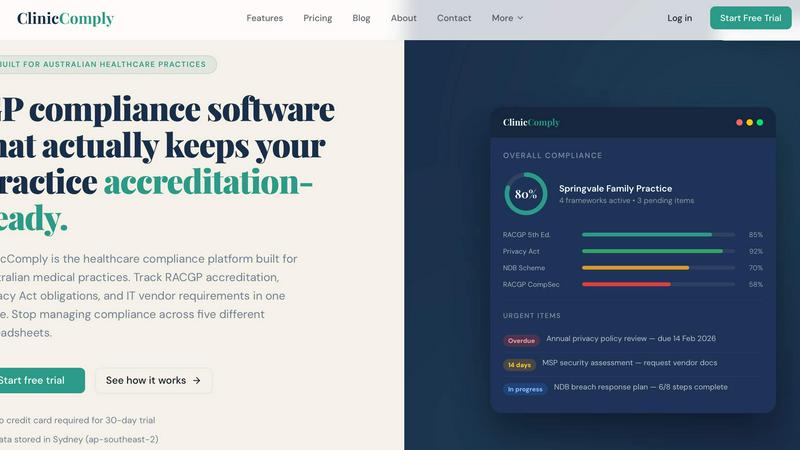
Users gain an immediate overview of their practice's compliance status through a central dashboard displaying overall scores, progress per framework, and urgent action items. The system tracks deadlines for recurring tasks (e.g., annual policy reviews) and highlights overdue items. This proactive visibility enables clinic managers to effectively delegate tasks and prioritize efforts to address compliance gaps before they become critical issues.
CloudBurn
Real-Time Pre-Deployment Cost Estimation
CloudBurn provides immediate, accurate AWS cost projections by analyzing infrastructure changes directly within pull requests. It leverages real-time AWS Pricing APIs to calculate the monthly financial impact of new, modified, or deleted resources, presenting a clear breakdown in dollars. This feature eliminates the guesswork and manual spreadsheet modeling, giving teams precise cost visibility at the most actionable point in the development cycle.
Automated Pull Request Cost Reporting
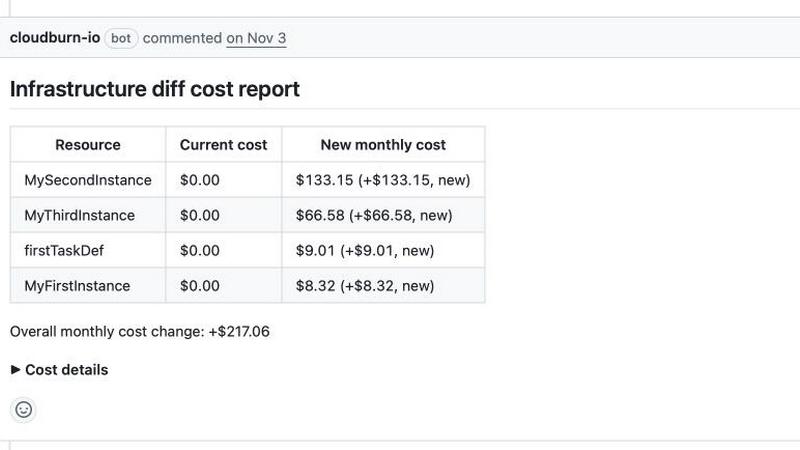
The platform seamlessly integrates with GitHub workflows to automatically post detailed cost analysis as a comment on every relevant pull request. This report includes a summary of the overall monthly cost change and a line-item breakdown for each resource, showing current versus new costs. This automation embeds FinOps directly into the existing CI/CD pipeline, making cost review a mandatory and effortless part of the standard code review process.
Infrastructure-as-Code (IaC) Native Integration
CloudBurn is built specifically for modern IaC practices, offering dedicated support for popular tools like Terraform and AWS CDK. It works by analyzing the output of terraform plan or cdk diff commands, ensuring it understands the exact infrastructure delta. This native approach guarantees that cost estimations are based on the actual declarative code changes, not speculative manual inputs.
Secure GitHub-Centric Deployment
Setup and operation are handled entirely through GitHub, requiring no separate billing setup or sensitive credential management on a third-party platform. Permissions and installation are managed via GitHub Marketplace, making it secure and incredibly easy to adopt. This model minimizes security overhead and accelerates time-to-value, as teams can start receiving cost insights within minutes of installation.
Use Cases
Clinic Comply
Preparing for RACGP Accreditation Reassessment
A GP practice facing its triennial RACGP accreditation visit uses Clinic Comply to audit its current standing against all 5th Edition Standards. The team works through the guided checklists, uploading updated policies and procedure documents directly into the system. One week before the assessor arrives, the practice manager uses the "evidence pack" feature to download a complete, organized digital portfolio, ensuring a smooth and confident assessment process.
Managing a Notifiable Data Breach Response
Following a potential privacy breach, a clinic must adhere to strict NDB Scheme timelines. The practice manager accesses the NDB framework checklist in Clinic Comply, which provides a step-by-step response plan. The platform guides the team through containment, assessment, notification, and review steps, while providing a secure repository for all documentation related to the incident, ensuring legal obligations are met comprehensively.
Streamlining IT Vendor Compliance Audits
A medical practice needs to verify the security posture of its new cloud-based practice management software provider. Using the Vendor Portal, the clinic sends a secure document request for the vendor's security policy and data processing agreement. The vendor uploads the files directly, which are automatically categorized and stored as evidence for both RACGP CompSec and Privacy Act compliance, eliminating manual filing and follow-up.
Centralizing Compliance for a Multi-Practice Group
A healthcare organization managing several clinics across different states must comply with varying regional regulations (e.g., HRIP in NSW, Health Records Act in VIC). Clinic Comply allows the corporate compliance officer to oversee all locations from a single platform, monitor framework-specific progress, and ensure standardized policies are implemented correctly while accounting for local legislative differences.
CloudBurn
Preventing Costly Configuration Errors
Engineering teams can use CloudBurn to catch severe and expensive misconfigurations before they deploy. For instance, accidentally specifying a cluster of xlarge instances instead of micro instances would be immediately flagged with a potential cost overrun of thousands of dollars in the PR review, allowing for correction before the code ever reaches production and impacts the AWS bill.
Enabling Developer-Led Cost Optimization
CloudBurn empowers individual developers and code reviewers to own cost efficiency. By providing immediate feedback, it allows teams to discuss and iterate on infrastructure design for optimal performance and cost. Developers can experiment with different instance types, storage options, or service configurations in their feature branch and immediately see the financial trade-offs, fostering a "cost-aware" engineering culture.
Streamlining FinOps and Engineering Collaboration
The platform serves as a single source of truth for infrastructure cost discussions, bridging the gap between FinOps/Finance teams and Engineering. Instead of monthly bill shock and retrospective blame games, CloudBurn provides a forward-looking, collaborative framework. Engineering can justify infrastructure choices with data, and FinOps can provide guidance based on actual planned changes, not historical spend.
Accelerating Safe Deployment Velocity
For organizations practicing continuous deployment, CloudBurn adds a vital safety check without slowing down development. It automates a previously manual or overlooked cost review step, allowing teams to maintain high deployment frequency with confidence. This ensures that speed does not come at the expense of uncontrolled cloud spend, supporting both agility and fiscal responsibility.
Overview
About Clinic Comply
Clinic Comply is a specialized healthcare compliance management platform engineered exclusively for Australian medical practices. It addresses the critical and complex challenge of maintaining ongoing accreditation and regulatory adherence, which is a significant administrative burden for clinics. The platform consolidates the management of multiple compliance frameworks—including the RACGP 5th Edition Standards, the Privacy Act 1988 (APPs), the Notifiable Data Breaches (NDB) Scheme, and IT security protocols—into a single, intuitive system. Designed for General Practitioners, practice managers, and healthcare administrators, Clinic Comply replaces error-prone, fragmented methods like spreadsheets and shared drives with a centralized "source of truth." Its core value proposition is to ensure practices remain perpetually accreditation-ready, thereby reducing audit stress, minimizing non-compliance risk, and saving substantial administrative time. This allows healthcare providers to reallocate focus from paperwork back to primary patient care, enhancing both operational efficiency and clinical service quality.
About CloudBurn
CloudBurn is a specialized FinOps platform engineered to proactively manage and optimize cloud expenditure by integrating cost intelligence directly into the software development lifecycle (SDLC). It specifically targets engineering and platform teams that utilize Infrastructure-as-Code (IaC) frameworks such as Terraform and AWS Cloud Development Kit (CDK). The platform's core innovation lies in its ability to provide real-time, granular AWS cost estimates during the code review phase, effectively "shifting left" the traditionally reactive practice of cloud cost management. This directly addresses a critical industry inefficiency highlighted by Gartner, which notes that through 2024, 60% of public cloud cost optimization efforts will be wasted due to a lack of actionable insight and timely processes (Gartner, "Innovation Insight for Cloud Cost Optimization Tools"). By automatically analyzing IaC diffs against live AWS pricing APIs and posting detailed cost reports as comments on pull requests (PRs), CloudBurn transforms cloud cost from a post-deployment surprise on a monthly bill into a first-class, pre-deployment design parameter. This empowers developers to make informed, cost-conscious architectural decisions before code merges to production, preventing costly misconfigurations and fostering a culture of financial accountability within engineering teams.
Frequently Asked Questions
Clinic Comply FAQ
Is Clinic Comply suitable for specialist practices or only GP clinics?
While Clinic Comply is optimized for General Practice against the RACGP Standards, it is highly suitable for specialist medical and dental practices. The platform includes frameworks like the HDAA Standards for dental practices and the NDIS Practice Standards, which are relevant to many specialists. Its core functionality for managing policies, evidence, and vendor compliance is universally applicable across healthcare providers.
How does Clinic Comply ensure the security of our sensitive practice data?
Clinic Comply states that all customer data is stored in Sydney-based data centres (ap-southeast-2 region), ensuring it remains within Australian jurisdiction. The platform is designed to handle sensitive healthcare information, employing robust security measures including encryption and secure access controls. It is the user's responsibility to ensure their use of the platform aligns with their own privacy and security policies.
What happens when the RACGP releases the 6th Edition Standards?
The platform is built to evolve with Australian healthcare standards. Clinic Comply explicitly states that new frameworks are added as standards evolve, including the forthcoming RACGP 6th Edition. Users can expect the platform to be updated with new checklists and guidance, ensuring a seamless transition and ongoing compliance support without the need for manual framework overhauls.
Can multiple staff members use Clinic Comply simultaneously?
Yes, Clinic Comply includes team collaboration features. Different staff members (e.g., doctors, nurses, practice managers) can be assigned specific tasks or checklist items relevant to their role. The central dashboard and deadline tracking provide visibility for managers, facilitating teamwork and ensuring accountability across the entire practice for maintaining compliance.
CloudBurn FAQ
How does CloudBurn calculate the cost estimates?
CloudBurn calculates estimates by parsing the infrastructure change plan (from terraform plan or cdk diff) and querying the official AWS Pricing APIs in real-time. It uses the resource specifications, region, and intended usage patterns defined in your IaC code to fetch the most current On-Demand pricing. The tool then computes the projected monthly cost based on 730 hours of usage (24/7 operation) to provide a standardized, comparable figure for review.
Is my code or cloud credentials exposed to CloudBurn?
No, CloudBurn follows a secure, GitHub-centric model. Your IaC code never leaves your GitHub repository. The analysis is triggered by a GitHub Action within your own workflow, which sends only the textual output of the diff/plan command (which contains resource types and configurations, not secrets) to CloudBurn's analysis engine. Your AWS credentials remain entirely within your GitHub environment and are never shared with CloudBurn.
What IaC tools and cloud providers does CloudBurn support?
Currently, CloudBurn provides native and dedicated support for the two most prevalent Infrastructure-as-Code tools: HashiCorp Terraform and AWS Cloud Development Kit (CDK). The platform is designed for AWS cloud infrastructure, as it leverages AWS's own pricing APIs. Support for additional cloud providers like Microsoft Azure or Google Cloud Platform would depend on future development and customer demand.
Can CloudBurn show cost savings from deleting or modifying resources?
Yes, absolutely. CloudBurn's analysis is based on the diff between the current and proposed infrastructure state. If a pull request modifies a resource to a cheaper alternative or deletes a resource entirely, the cost report will clearly show a negative cost change, highlighting the projected monthly savings. This makes it valuable for optimization and cleanup initiatives, not just for reviewing new deployments.
Alternatives
Clinic Comply Alternatives
Clinic Comply is a specialized productivity and management platform designed to streamline healthcare compliance for Australian medical practices. It centralizes the tracking of critical requirements like RACGP accreditation and privacy obligations, moving clinics away from inefficient, error-prone spreadsheet systems. Users may explore alternatives for various reasons, including budget constraints, the need for different feature integrations, or a preference for a platform that caters to a broader range of business types beyond healthcare. The specific compliance needs of a practice, such as the depth of vendor management or audit trail capabilities, can also drive the search for other solutions. When evaluating alternatives, key considerations should include the platform's specialization in Australian healthcare regulations, its ability to provide a real-time, centralized view of compliance status, and the quality of customer support. The ideal solution should demonstrably reduce administrative burden while ensuring robust data security and accreditation readiness.
CloudBurn Alternatives
CloudBurn is a specialized FinOps platform in the development tooling category, designed to provide proactive AWS cost estimation directly within Infrastructure-as-Code (IaC) pull requests. Its core mission is to shift cost management left, preventing the reactive discovery of budget overruns on monthly cloud bills. Users may explore alternatives for various reasons, including specific budget constraints, the need for support across multiple cloud providers beyond AWS, or a preference for different integration methods or user interfaces within their existing DevOps toolchain. The search often stems from a need to align tool capabilities with unique organizational workflows and financial governance models. When evaluating alternatives, key considerations should include the accuracy and granularity of cost forecasting, the depth of integration with your specific IaC frameworks and version control systems, and the tool's ability to provide actionable, timely insights that developers can act upon during the review cycle, as emphasized by industry analysts on the importance of timely processes in cloud cost optimization.