AskFormulas vs Miget
Side-by-side comparison to help you choose the right product.

AskFormulas
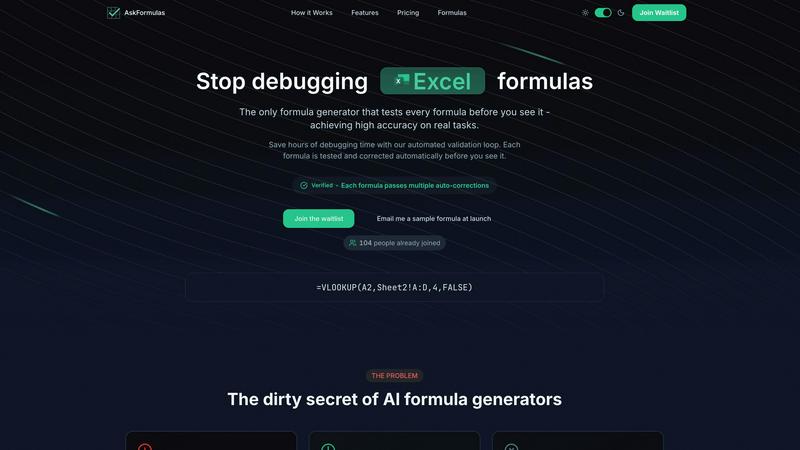
AskFormulas generates and validates Excel and Google Sheets formulas with automated testing for guaranteed accuracy.
Last updated: February 28, 2026

Miget
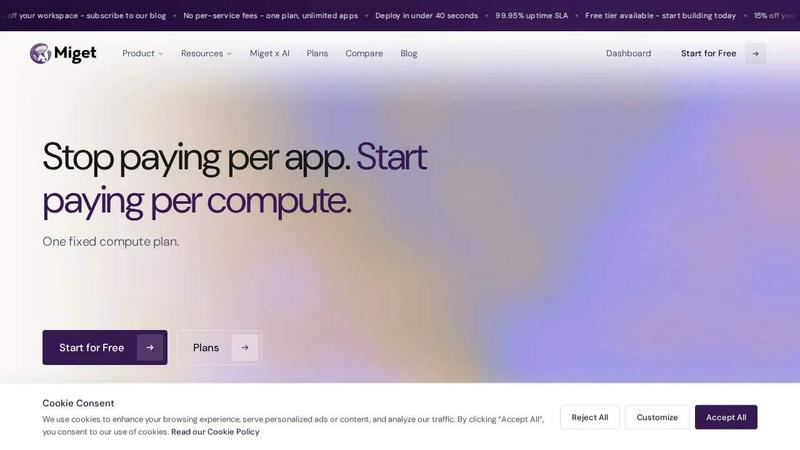
Miget offers unlimited app deployments on one flat-rate compute plan, eliminating per-service fees and enabling rapid scaling.
Last updated: April 13, 2026
Visual Comparison
AskFormulas
Miget
Feature Comparison
AskFormulas
Proprietary Validation Engine
At the core of AskFormulas is its unique validation engine, which subjects every AI-generated formula to a rigorous, three-step testing process. This involves parsing the user's natural language intent, executing the formula in a secure sandbox environment with synthetic test data, and performing iterative auto-corrections on any errors detected. This process, which other tools omit, is what guarantees the published accuracy rate of over 95%, effectively eliminating the 40-60% error rate common in conventional generators.
Natural Language to Formula Conversion
Users can bypass the need to memorize complex spreadsheet syntax entirely. By simply describing a calculation need in plain English (e.g., "Sum all values in column B where column A contains the word Sales"), AskFormulas' AI interprets the context and intent to generate the appropriate formula syntax. This dramatically lowers the barrier to entry for complex data operations, making advanced spreadsheet functionality accessible to users of all skill levels.
Cross-Platform Syntax Automation
The tool seamlessly supports both Microsoft Excel and Google Sheets with a simple one-click toggle. The system automatically adjusts the formula syntax to match the conventions and function names of the selected platform. This eliminates the need for users to manually translate formulas like VLOOKUP for Excel or ARRAYFORMULA for Sheets, ensuring correct, platform-specific output every time.
Smart Error Detection and Auto-Correction
Unlike basic generators that output formulas with errors, AskFormulas proactively identifies and fixes common spreadsheet errors. If a generated formula returns a #REF!, #VALUE!, or other error during its internal validation, the system's AI performs smart corrections, such as adjusting cell ranges or function arguments, and retests it. This loop continues until a fully functional, "Verified" formula is produced, saving the user from manual troubleshooting.
Miget
Predictable, Capacity-Based Pricing
Miget's primary feature is its revolutionary billing model. Instead of charging for each individual app, database, or worker, you purchase a block of compute resources. Within that fixed-cost plan, you can deploy an unlimited number of services. This model, as highlighted by industry analysis, directly counters the "bill shock" common in traditional PaaS offerings, providing financial predictability and removing barriers to deploying new features, microservices, or preview environments.
Zero-Config Git and GitHub Deployments
The platform offers seamless integration with Git and GitHub, enabling true push-to-deploy workflows. Upon connecting a repository, Miget automatically handles building, caching, and shipping code with no manual CI/CD configuration required. Every push to the main branch triggers a production deploy, and every pull request generates an isolated, full-stack preview environment with a unique URL, streamlining development and review cycles significantly.
Managed Data Services Within Compute Budget
Miget includes managed databases like PostgreSQL and in-memory stores like Valkey (a Redis-compatible solution) as integral components of its platform, not as add-on services with separate fees. These data services run within your purchased compute allocation, ensuring you get a complete application stack—compute, database, and cache—without the per-component billing typical of other platforms, which research shows can constitute over 50% of a standard PaaS invoice.
Full-Stack Preview Environments
For every pull request, Miget automatically spins up a complete, isolated clone of your application stack, including the application code, database schema, and data. This allows developers and stakeholders to test features against real conditions without affecting production. This capability, often a costly premium feature elsewhere, is included standard, enhancing software quality and team collaboration without impacting the monthly bill.
Use Cases
AskFormulas
Financial Reporting and Analysis
Financial analysts and accountants can use AskFormulas to quickly generate complex formulas for quarterly reports, profit & loss statements, and variance analyses. By describing logic like "calculate year-over-year growth percentage for column C," they receive a validated, error-free formula, ensuring the accuracy of critical financial data and saving hours otherwise spent debugging intricate nested functions.
Sales and Revenue Operations Management
Revenue operations managers and sales analysts can automate data consolidation from multiple sources. They can request formulas to "VLOOKUP the contract value from Sheet2 based on the client ID in column A" or "sum all sales in the Central region for Q1" and get a guaranteed-working formula. This accelerates the creation of accurate dashboards and forecasts, directly impacting strategic decision-making.
Small Business Bookkeeping and Inventory
Small business owners without dedicated finance teams can manage their books and inventory more efficiently. Describing tasks such as "total monthly expenses from this list" or "count how many items have inventory below the reorder threshold" yields ready-to-use formulas. This empowers them to maintain accurate records without needing to learn advanced spreadsheet programming.
Academic Research and Data Compilation
Researchers, students, and academics compiling data for papers or theses can use AskFormulas to perform statistical calculations and data transformations. Requesting a formula to "calculate the standard deviation for this data set" or "find the correlation between these two columns" provides a reliable result, allowing them to focus on analysis rather than formula syntax errors.
Miget
Indie Hackers and Solo Developers
For solo builders and indie hackers, Miget provides a fast, affordable launchpad. They can deploy a full application with a backend, database, and background workers on a single, predictable plan. The fixed monthly cost eliminates budgeting uncertainty, while the GitHub-native deployment and preview apps per PR enable rapid iteration and professional-grade development practices typically associated with larger teams, all from day one.
Growing Startups and Product Teams
Startups experiencing growth can scale their application architecture—adding new microservices, internal tools, or staging environments—without constantly re-evaluating infrastructure costs. Miget allows them to stay within a known cost envelope while benefiting from horizontal autoscaling within their allocation. Features like team roles, audit logs, and SSO support the transition from a small team to a more structured organization.
Enterprise Development and Internal Platforms
Enterprises can leverage Miget to standardize developer experience and control cloud spend across departments. The platform supports bringing your own cloud (BYOC) or bare metal, and offers tools like Helm charts and Terraform for custom orchestration. This provides the governance, security, and compliance required by large organizations while giving development teams a simple, Heroku-like interface for productivity.
AI and Prototype Development
Developers working with AI-generated code or rapid prototypes benefit immensely from Miget's instant deployment capabilities. The ability to deploy from a prompt or a simple push, coupled with one-click infrastructure setup via skills.md files, allows for immediate validation of ideas. Preview URLs can be shared instantly with collaborators or stakeholders, making it an ideal platform for hackathons and experimental projects.
Overview
About AskFormulas
AskFormulas is a revolutionary AI-powered tool engineered to solve the critical and widespread problem of broken spreadsheet formulas. While traditional AI formula generators are notorious for producing error rates between 40-60%, leaving users to manually debug complex syntax, AskFormulas introduces a paradigm shift with its proprietary validation engine. This system rigorously tests every single generated formula on real, synthetic data before it is ever presented to the user, ensuring an industry-leading accuracy rate of over 95% (AskFormulas, 2024). The tool operates on a simple yet powerful principle: users describe their calculation needs in plain English, and the AI not only generates the correct formula syntax for Excel or Google Sheets but also runs it through an automated validation loop. This loop identifies and auto-corrects common errors like #REF! and #VALUE! until a verified, working solution is achieved. Designed for professionals who depend on data integrity, such as financial analysts and revenue operations managers, as well as small business owners and individuals lacking deep technical expertise, AskFormulas delivers an unequivocal core value proposition. It transforms users from formula debuggers into productive data analysts by saving hours of weekly frustration and guaranteeing that every formula works upon receipt.
About Miget
Miget is a modern Platform-as-a-Service (PaaS) that fundamentally rethinks cloud pricing and deployment for developers and engineering teams. It addresses a critical pain point in traditional PaaS models, where costs scale linearly with each new application, database, or background worker, creating financial friction for experimentation and growth. Miget's core innovation is its capacity-based billing model: users select a fixed compute plan and can then deploy an unlimited number of services—including web apps, managed databases (PostgreSQL, Redis/Valkey), and workers—within that reserved allocation. This approach eliminates per-service fees and surprise billing, offering predictable monthly costs. Built on Kubernetes with robust tenant isolation, Miget provides a production-ready platform featuring GitHub-native deployments with zero-config builds, automatic TLS for custom domains, and full-stack preview environments for every pull request. It is designed for a broad spectrum of users, from indie hackers and solo developers launching side projects to growing startups and enterprises requiring scalable, cost-controlled infrastructure without operational overhead. By decoupling cost from the number of deployed components, Miget empowers teams to build and scale more freely.
Frequently Asked Questions
AskFormulas FAQ
How accurate are the generated formulas?
AskFormulas achieves an industry-leading accuracy rate of over 95% for formulas that work correctly on real tasks. This is made possible by our proprietary validation engine, which tests and auto-corrects every formula in a simulated spreadsheet environment before you see it. This contrasts sharply with conventional AI formula generators, which studies suggest have error rates between 40-60% due to a lack of validation.
Does it work with both Excel and Google Sheets?
Yes, AskFormulas provides full, seamless support for both Microsoft Excel and Google Sheets. A simple toggle within the interface allows you to switch between platforms. The AI automatically adjusts the formula syntax to use the correct function names and conventions for your selected spreadsheet software, whether it's Excel's XLOOKUP or Sheets' ARRAYFORMULA.
How does the validation loop work?
The validation loop is a 3-step automated process. First, your natural language request is parsed into formula intent. Second, the generated formula is executed in a secure sandbox with synthetic test data designed to mimic real-world scenarios. Third, if any errors (like #REF!) are found, the system performs smart auto-corrections and retests the formula. This loop continues until a "Verified" formula is produced.
What happens if my formula is complex and still fails validation?
The AskFormulas system is engineered to handle complexity through multiple iterative correction attempts. If a highly complex formula encounters a persistent issue during the automated validation, the system is designed to provide the most robust corrected version possible. For edge cases beyond full automation, the tool provides clear insights, and priority support is available for Pro and Team plan users to help resolve unique challenges.
Miget FAQ
How does Miget's pricing differ from traditional PaaS?
Traditional PaaS platforms like Heroku employ a component-based pricing model, where you are billed separately for each "dyno" (web/worker), database, cache, and add-on. Academic and industry analyses, including studies on cloud cost management, show this leads to complex, unpredictable invoices. Miget uses a capacity-based model: you pay for a block of compute (e.g., vCPU and RAM) and can run an unlimited number of apps, databases, and workers within that resource pool, resulting in one predictable, fixed monthly bill.
What is included in the "unlimited services" within a plan?
"Unlimited services" means you can deploy as many distinct applications, containerized services, managed PostgreSQL/MySQL databases, Valkey (Redis) instances, and background worker processes as your purchased compute resources can support. There are no per-service licensing or platform fees. The only limit is the total CPU and memory capacity of your selected plan, which you allocate dynamically across your deployments via the Miget dashboard.
How does isolation and security work on a shared platform?
Miget is built on Kubernetes and enforces strict multi-tenant isolation. Each customer's workspace and services run in fully isolated namespaces with dedicated network policies. According to Kubernetes security best practices documented by the Cloud Native Computing Foundation (CNCF), this architecture provides strong boundaries between tenants. Furthermore, data services like PostgreSQL are managed instances dedicated to your workspace, not shared databases.
Does Miget support custom domains and SSL/TLS?
Yes, Miget fully supports custom domains. You can point your domain's DNS records to Miget, and the platform automatically provisions and renews TLS/SSL certificates for you using the ACME protocol, the same standard used by Let's Encrypt. This provides secure HTTPS connections by default without any manual certificate management, a critical feature for production applications as emphasized by web security guidelines.
Alternatives
AskFormulas Alternatives
AskFormulas is a specialized AI-powered tool in the productivity software category, designed to generate and validate Excel and Google Sheets formulas with a verified accuracy rate exceeding 95%. Its core innovation is an automated validation engine that tests formulas against real data, ensuring they work correctly before delivery. Users may seek alternatives for various reasons, including budget constraints, a need for different feature sets like integration with other platforms, or a preference for tools with broader AI capabilities beyond formula generation. The search often stems from a desire to find the optimal balance between cost, functionality, and ease of use. When evaluating alternatives, key considerations should include the tool's accuracy rate and validation methodology, compatibility with your spreadsheet platform, the depth of error detection and correction features, and overall value for the investment. The primary goal is to minimize manual debugging time while maximizing data reliability.
Miget Alternatives
Miget is a modern Platform-as-a-Service (PaaS) solution that simplifies cloud deployment by offering a flat-rate, compute-based pricing model. It falls within the broader low-code and no-code ecosystem by abstracting away infrastructure complexity, allowing developers to focus on building and shipping applications. This approach represents a significant shift from traditional per-service billing. Users often explore alternatives to any platform to find a better fit for their specific requirements. Common drivers include budget constraints, where a platform's pricing tier may not align with current needs, or a desire for specific features not offered, such as support for particular programming languages or integrated services. Some may also seek platforms with different architectural philosophies or deeper levels of infrastructure control. When evaluating alternatives, key considerations should include the total cost of ownership, especially as your application portfolio grows. Assess the platform's ease of use, deployment workflow, and the breadth of managed services it provides. Security posture, compliance certifications, and the quality of documentation and developer support are also critical factors that impact long-term success and operational efficiency.