
Agent to Agent Testing Platform vs AgentSea
Side-by-side comparison to help you choose the right product.

Agent to Agent Testing Platform
Validate AI agent performance and compliance across chat, voice, and phone interactions with dynamic testing scenarios.
Last updated: February 27, 2026

AgentSea
Okara.ai provides secure, private chat across multiple AI models with full context awareness.
Last updated: March 1, 2026
Visual Comparison
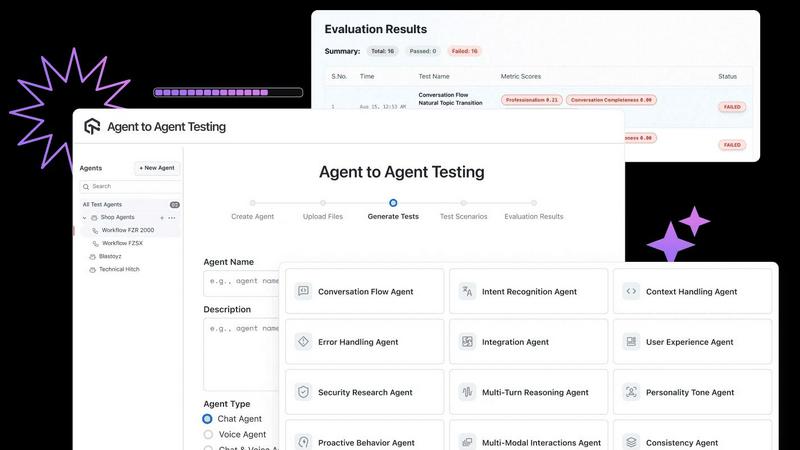
Agent to Agent Testing Platform
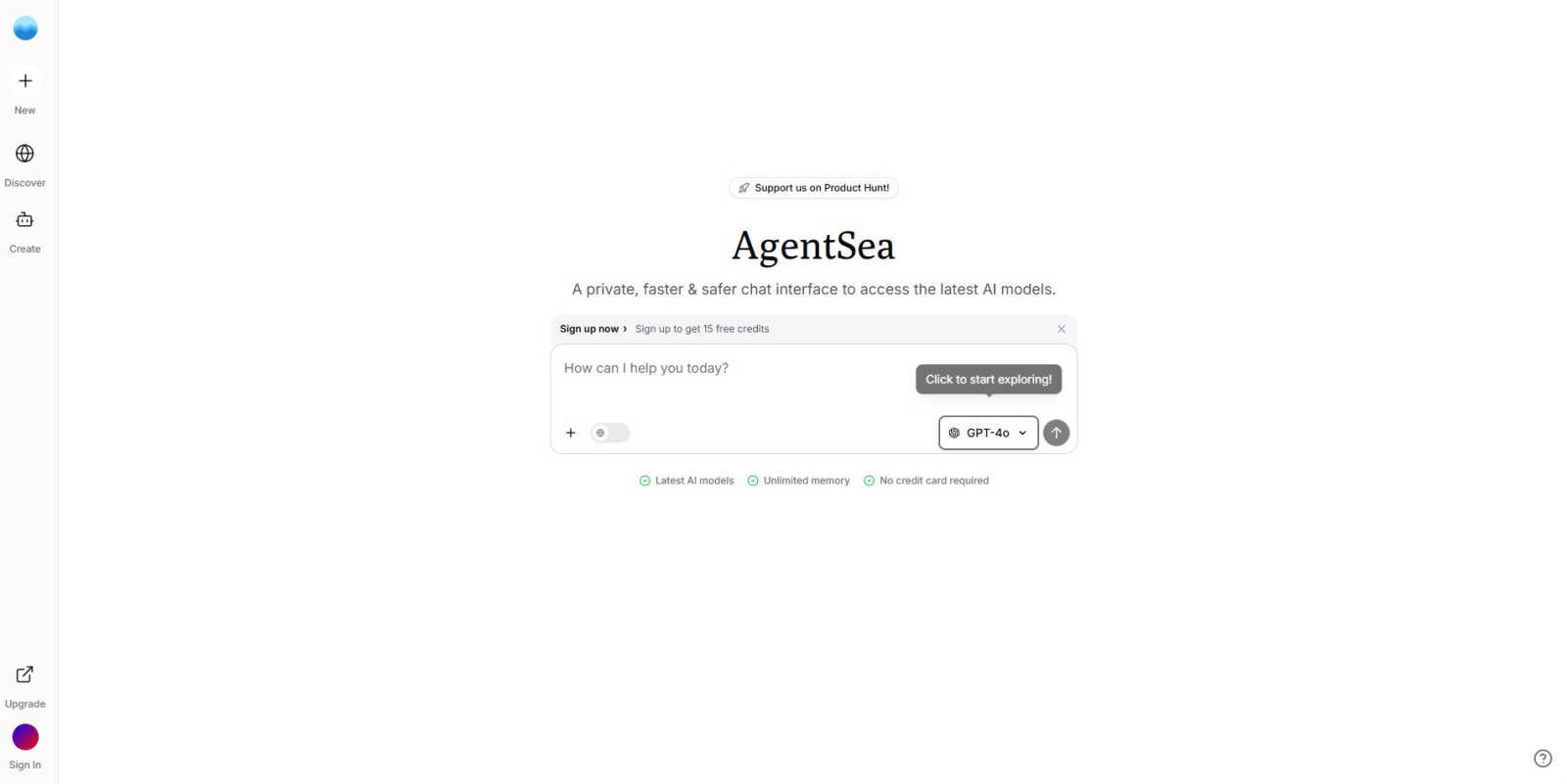
AgentSea
Feature Comparison
Agent to Agent Testing Platform
Automated Scenario Generation
The platform features automated scenario generation that creates a wide range of diverse test cases for AI agents, simulating interactions across chat, voice, and phone calls. This capability ensures that the agents can handle varied scenarios, enhancing their robustness and reliability.
True Multi-Modal Understanding
Agent to Agent Testing allows for multi-modal input analysis, enabling users to define detailed requirements or upload product requirements documents (PRDs) that include images, audio, and videos. This feature ensures that AI agents are evaluated under conditions that closely mirror real-world usage.
Autonomous Test Scenario Generation
Users can access a library of hundreds of pre-defined test scenarios or create custom scenarios tailored to specific needs. This includes testing personality tones, data privacy protocols, and intent recognition, allowing for a comprehensive assessment of the agent's capabilities.
Regression Testing with Risk Scoring
The platform facilitates end-to-end regression testing, providing insights into risk scoring that highlights potential areas of concern. This feature allows teams to prioritize critical issues and optimize their testing efforts, ensuring that the AI agents remain effective over time.
AgentSea
Unified AI Model Interface
AgentSea provides a single, cohesive chat interface that aggregates access to a diverse range of AI resources. This includes the latest standard large language models (LLMs) from leading providers, innovative open-source models, and hundreds of specialized, task-specific AI agents. This consolidation eliminates the need to switch between disparate platforms, streamlining the user experience and saving valuable time that would otherwise be spent on context-switching and managing multiple logins.
Persistent Conversational Context
A critical differentiator for AgentSea is its ability to maintain a continuous thread of conversation and memory when a user switches between different AI models or agents within the platform. This architecture ensures that the context from a previous interaction is not lost, enabling more coherent, complex, and multi-stage workflows. Users can start a task with one model and seamlessly continue or refine it with another, fostering deeper analysis and more productive outcomes.
Privacy-First Security Architecture
Operating as a secure intermediary, AgentSea is built with a privacy-first mandate. It mitigates data exposure risks by acting as a controlled gateway between the user and various AI services, reducing the number of endpoints where sensitive data is transmitted. This design is crucial for professionals and businesses handling confidential information, as it provides a more secure alternative to directly interacting with multiple, independent AI provider interfaces that may have varying data policies.
Specialized AI Agent Ecosystem
Beyond standard LLMs, AgentSea offers integrated access to a curated library of hundreds of specialized AI agents. These agents are fine-tuned for specific tasks such as code generation, data analysis, creative writing, research summarization, and more. This allows users to leverage expert-level AI assistance for niche requirements without needing to source, configure, or subscribe to these tools separately, all within the platform's consistent environment.
Use Cases
Agent to Agent Testing Platform
Quality Assurance for AI Chatbots
Enterprises can leverage the platform to conduct thorough quality assurance testing for AI chatbots, ensuring that they perform accurately and consistently across various customer interactions.
Voice Assistant Performance Evaluation
Organizations can utilize the platform to evaluate the performance of voice assistants, assessing their ability to understand commands, respond appropriately, and maintain a natural conversational flow.
Multi-Persona Testing
The platform enables testing scenarios that simulate interactions with diverse personas, ensuring that AI agents can cater to different user needs and behaviors—crucial for applications in customer service and support.
Compliance and Risk Management
Using the risk scoring feature, companies can conduct compliance testing to ensure that AI agents adhere to relevant regulations and internal policies, significantly reducing the risk associated with AI deployment.
AgentSea
Multi-Model Comparative Analysis
Researchers and developers can use AgentSea to rapidly test and compare outputs from different AI models (e.g., GPT-4 vs. Claude vs. an open-source model) on the same prompt or dataset within a single session. This side-by-side analysis, supported by persistent context, is invaluable for benchmarking model performance, evaluating strengths and weaknesses for specific tasks, and making informed decisions about which model to deploy for a given application.
Complex, Multi-Stage Research Workflows
Academics and analysts can conduct comprehensive research by sequentially employing different specialized agents within AgentSea. A workflow might begin with an agent for academic paper discovery, move to a summarization agent to distill key findings, utilize a data analysis agent to interpret statistics, and finally employ a writing agent to draft a report-all within one continuous, context-aware chat, significantly enhancing research coherence and efficiency.
Secure Enterprise AI Prototyping
Business teams and developers building AI-powered features can use AgentSea as a secure sandbox for prototyping and internal tool development. The platform's unified, privacy-focused interface allows teams to safely experiment with various models and agents using company data, compare results, and iterate on prompts without exposing sensitive information across multiple public AI service front-ends, thereby upholding corporate data governance standards.
Consolidated Creative and Content Production
Content creators, marketers, and writers can streamline their creative process by accessing a suite of AI tools from one dashboard. They might use a brainstorming agent for ideation, switch to a long-form writing model for drafting, employ a graphic design agent for visual concepts, and use an editing agent for refinement. This centralized approach prevents creative disruption and maintains a consistent narrative thread throughout the production cycle.
Overview
About Agent to Agent Testing Platform
The Agent to Agent Testing Platform is a pioneering AI-native framework tailored for validating the behaviors of AI agents in real-world scenarios. As AI systems grow increasingly autonomous and their operations become less predictable, traditional quality assurance (QA) methods—designed for static software—become inadequate. This platform transcends basic prompt-level evaluations, enabling comprehensive assessments of multi-turn conversations across various mediums, such as chat, voice, and multimodal interactions. It is especially beneficial for enterprises seeking to ensure their AI agents perform reliably before they are deployed in production environments. By employing a specialized assurance layer, the platform utilizes over 17 unique AI agents to identify long-tail failures, edge cases, and interaction patterns often overlooked by manual testing. Autonomous synthetic user testing allows for the simulation of thousands of production-like interactions, ensuring that key compliance and performance metrics are met, including bias, toxicity, and hallucination detection.
About AgentSea
AgentSea, now formally rebranded as Okara.ai, is a sophisticated, unified chat platform engineered to solve the pervasive problem of AI tool fragmentation. As noted by industry analysts at Gartner, the proliferation of AI models and services has led to significant operational inefficiencies, with users managing an average of 3-5 different AI interfaces for various tasks. AgentSea directly addresses this by providing private, fast, and secure access to a vast ecosystem of artificial intelligence from a single, persistent workspace. It consolidates leading proprietary models like GPT-4, cutting-edge open-source models, hundreds of specialized AI agents, and various AI tools, eliminating the need to juggle multiple browser tabs and subscriptions. This unified architecture is designed for professionals, researchers, developers, and businesses who require multi-model analysis, comparative testing, and secure data handling. Its core value proposition is centralized, context-aware, and privacy-first AI access. By acting as a secure intermediary, AgentSea mitigates the data exposure risks inherent in using multiple independent AI services, ensuring conversational context and memory are retained across all interactions. This positions it as an essential platform for efficient, coherent, and responsible AI utilization in complex workflows.
Frequently Asked Questions
Agent to Agent Testing Platform FAQ
What types of AI agents can be tested using this platform?
The Agent to Agent Testing Platform supports a variety of AI agents, including chatbots, voice assistants, and phone caller agents, allowing for comprehensive testing across different modalities.
How does the platform ensure the accuracy of AI agents?
The platform employs advanced automated scenario generation and multi-agent testing to simulate a wide range of interactions, ensuring that AI agents are evaluated for accuracy and reliability under real-world conditions.
Can I create custom test scenarios?
Yes, users can create custom test scenarios tailored to specific requirements, in addition to accessing a library of pre-defined scenarios. This flexibility allows for targeted testing according to unique business needs.
What metrics can be evaluated using the platform?
The platform evaluates a variety of metrics, including bias, toxicity, hallucination, effectiveness, accuracy, empathy, and professionalism, providing a comprehensive assessment of AI agent performance.
AgentSea FAQ
What is the relationship between AgentSea and Okara.ai?
AgentSea has been formally rebranded as Okara.ai. The product, its core functionality, and its mission remain the same: to provide a unified, private, and context-aware interface for accessing a broad ecosystem of AI models and agents. The rebranding reflects the platform's evolution and growth. Users visiting the old AgentSea domain are redirected to the new Okara.ai platform.
How does AgentSea ensure user privacy and data security?
AgentSea is architected as a secure intermediary. This means it operates between the user and the various AI service providers, allowing for greater control over data flow. By consolidating access, it reduces the number of external services that directly handle user prompts and data. This design minimizes the attack surface and data exposure points compared to using each AI service's individual interface, aligning with a privacy-by-design principle crucial for professional use.
Can I use my existing AI service subscriptions with AgentSea?
While specific integration details depend on the platform's current implementation, the value proposition of AgentSea is to centralize access. Typically, such platforms either provide direct access to a range of models under their own subscription or allow users to connect their API keys from major providers. This unified billing and access model is a key feature that eliminates the need to manage multiple separate subscriptions and invoices.
Who is the primary target user for AgentSea (Okara.ai)?
AgentSea is primarily built for professionals, researchers, developers, and businesses whose work requires intensive and varied AI interaction. It is ideally suited for users who engage in multi-model analysis, comparative testing, complex research workflows, and who handle data that necessitates a higher standard of privacy and security than offered by typical consumer-facing AI chat tools.
Alternatives
Agent to Agent Testing Platform Alternatives
The Agent to Agent Testing Platform is an innovative AI-native quality assurance framework that specializes in validating the behavior of AI agents across various communication modalities, including chat, voice, and phone. As enterprises increasingly adopt AI solutions, ensuring these agents behave as intended in real-world environments has become critical. However, the complexities and nuances of agent interactions often lead users to seek alternatives that better match their specific needs, whether due to pricing constraints, feature sets, or compatibility with existing platforms. When searching for alternatives to the Agent to Agent Testing Platform, users should consider the scalability of the testing solution, the comprehensiveness of its testing capabilities, and the level of support offered. It's crucial to evaluate how well an alternative can simulate authentic user behavior and detect potential compliance or security risks, ensuring it effectively addresses the unique challenges posed by autonomous AI systems.
AgentSea Alternatives
AgentSea, now operating as Okara.ai, is a unified AI assistant platform designed to consolidate access to multiple large language models into a single, private chat interface. It solves the problem of fragmented AI usage by allowing professionals to switch between models while maintaining persistent conversation context and data security. Users may seek alternatives for various reasons, including budget constraints, a need for platform-specific integrations, or a preference for a different feature set such as advanced automation, team collaboration tools, or a focus on a narrower selection of models. The search often stems from a need to align tool capabilities with specific project requirements or organizational workflows. When evaluating alternatives, key considerations should include the range and quality of accessible AI models, the platform's approach to data privacy and security, the robustness of its context management across conversations, and the overall cost structure. The ideal platform balances powerful functionality with an intuitive user experience that fits your technical and operational needs.