
Agent to Agent Testing Platform vs Prefactor
Side-by-side comparison to help you choose the right product.

Agent to Agent Testing Platform
Validate AI agent performance and compliance across chat, voice, and phone interactions with dynamic testing scenarios.
Last updated: February 27, 2026

Prefactor
Prefactor is the essential control plane for governing AI agents at scale in regulated enterprises.
Last updated: March 1, 2026
Visual Comparison
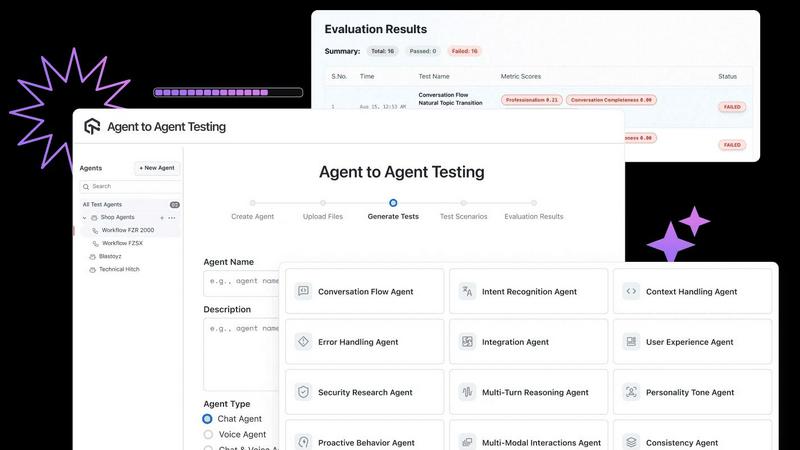
Agent to Agent Testing Platform
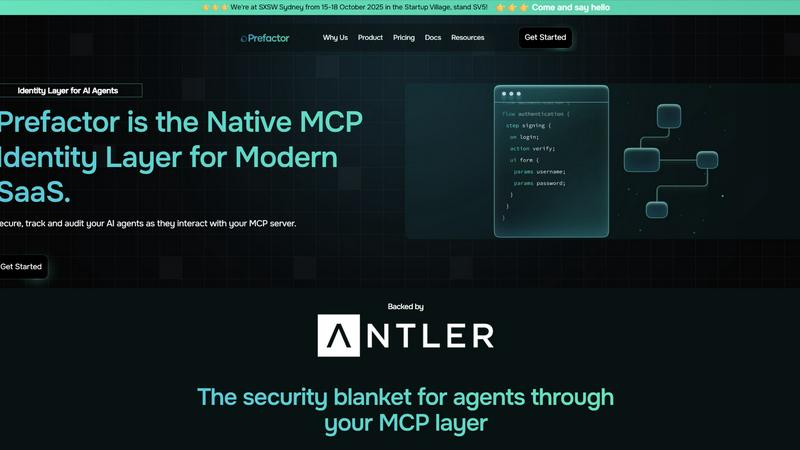
Prefactor
Feature Comparison
Agent to Agent Testing Platform
Automated Scenario Generation
The platform features automated scenario generation that creates a wide range of diverse test cases for AI agents, simulating interactions across chat, voice, and phone calls. This capability ensures that the agents can handle varied scenarios, enhancing their robustness and reliability.
True Multi-Modal Understanding
Agent to Agent Testing allows for multi-modal input analysis, enabling users to define detailed requirements or upload product requirements documents (PRDs) that include images, audio, and videos. This feature ensures that AI agents are evaluated under conditions that closely mirror real-world usage.
Autonomous Test Scenario Generation
Users can access a library of hundreds of pre-defined test scenarios or create custom scenarios tailored to specific needs. This includes testing personality tones, data privacy protocols, and intent recognition, allowing for a comprehensive assessment of the agent's capabilities.
Regression Testing with Risk Scoring
The platform facilitates end-to-end regression testing, providing insights into risk scoring that highlights potential areas of concern. This feature allows teams to prioritize critical issues and optimize their testing efforts, ensuring that the AI agents remain effective over time.
Prefactor
Real-Time Agent Monitoring & Dashboard
Prefactor provides a centralized dashboard for complete operational visibility across your entire AI agent infrastructure. Platform teams can monitor all agents in one place, tracking which agents are active, idle, or failing in real-time. This allows organizations to see what resources agents are accessing and identify emerging issues before they cascade into production incidents, moving teams from a state of flying blind to having full command and control.
Compliance-Ready Audit Trails
The platform generates detailed audit logs that translate low-level technical agent actions into clear business context. Unlike cryptic API call logs, Prefactor's audit trails answer stakeholder and regulatory questions like "what did the agent do and why?" in understandable language. This enables the generation of audit-ready compliance reports in minutes, not weeks, ensuring audit trails can withstand rigorous regulatory scrutiny in industries like finance and healthcare.
Identity-First Access Control
Prefactor applies proven human identity governance principles to AI agents. Every agent is provisioned with a unique, first-class identity, and every action is authenticated. Through dynamic client registration and delegated access, the platform enables fine-grained role and attribute-based controls, ensuring each agent's permissions are explicitly scoped and managed, drastically reducing the risk of unauthorized access or actions.
Enterprise Safety & Cost Controls
Designed for production resilience, Prefactor includes critical enterprise controls such as emergency kill switches for immediate agent deactivation. Simultaneously, it provides cost-tracking capabilities across compute providers, helping organizations identify expensive agent behavior patterns and optimize spending. This combination of safety and financial governance is crucial for sustainable, large-scale agent deployment.
Use Cases
Agent to Agent Testing Platform
Quality Assurance for AI Chatbots
Enterprises can leverage the platform to conduct thorough quality assurance testing for AI chatbots, ensuring that they perform accurately and consistently across various customer interactions.
Voice Assistant Performance Evaluation
Organizations can utilize the platform to evaluate the performance of voice assistants, assessing their ability to understand commands, respond appropriately, and maintain a natural conversational flow.
Multi-Persona Testing
The platform enables testing scenarios that simulate interactions with diverse personas, ensuring that AI agents can cater to different user needs and behaviors—crucial for applications in customer service and support.
Compliance and Risk Management
Using the risk scoring feature, companies can conduct compliance testing to ensure that AI agents adhere to relevant regulations and internal policies, significantly reducing the risk associated with AI deployment.
Prefactor
Regulated Industry Deployment (Banking/Healthcare)
For Fortune 500 financial services or healthcare companies, Prefactor solves the primary compliance blocker to agent deployment. It provides the immutable audit trails, identity governance, and policy enforcement required to meet SOC 2, HIPAA, or financial regulatory standards. This allows Head of AI roles to gain the necessary internal approvals to move agents from restricted pilots to full, compliant production.
Managing Multi-Agent Pilots at Scale
Product and engineering teams running multiple, simultaneous AI agent proofs-of-concept (POCs) across different frameworks (like LangChain or CrewAI) use Prefactor to establish centralized governance. It prevents fragmentation, provides shared visibility across all pilots, and creates a standardized workflow for security review and promotion to production, aligning disparate teams around a single source of truth.
Operational Visibility for Platform Teams
Platform engineering leads burdened with questions about agent activity and performance deploy Prefactor to gain immediate, real-time answers. The control plane dashboard ends the opacity of agent operations, allowing teams to monitor health, track resource utilization, and quickly diagnose failures, thereby increasing operational reliability and reducing mean time to resolution (MTTR).
Cost Optimization for Agent Fleets
Organizations scaling to hundreds or thousands of agents use Prefactor's cost-tracking features to maintain financial control. By monitoring compute costs across providers and analyzing agent behavior patterns, finance and engineering teams can identify inefficiencies, right-size resources, and implement policies to prevent cost overruns, ensuring the economic viability of their AI agent initiatives.
Overview
About Agent to Agent Testing Platform
The Agent to Agent Testing Platform is a pioneering AI-native framework tailored for validating the behaviors of AI agents in real-world scenarios. As AI systems grow increasingly autonomous and their operations become less predictable, traditional quality assurance (QA) methods—designed for static software—become inadequate. This platform transcends basic prompt-level evaluations, enabling comprehensive assessments of multi-turn conversations across various mediums, such as chat, voice, and multimodal interactions. It is especially beneficial for enterprises seeking to ensure their AI agents perform reliably before they are deployed in production environments. By employing a specialized assurance layer, the platform utilizes over 17 unique AI agents to identify long-tail failures, edge cases, and interaction patterns often overlooked by manual testing. Autonomous synthetic user testing allows for the simulation of thousands of production-like interactions, ensuring that key compliance and performance metrics are met, including bias, toxicity, and hallucination detection.
About Prefactor
Prefactor is the enterprise-grade control plane specifically engineered for governing AI agents at scale in production environments. It addresses the critical governance gap that emerges when AI agents transition from proof-of-concept demos to full-scale deployment, particularly within regulated industries. The platform provides a centralized source of truth for agent identity, access, and activity, enabling security, product, engineering, and compliance teams to collaborate effectively. By granting every AI agent a first-class, auditable identity with fine-grained role and attribute-based access controls (RBAC/ABAC), Prefactor transforms complex, bespoke authentication processes into a streamlined and secure layer of trust. Its architecture supports policy-as-code for automated permissions management within CI/CD pipelines and offers full, real-time visibility over every agent action. Built with stringent compliance requirements in mind, Prefactor is SOC 2 compliant, incorporates human-delegated control mechanisms like emergency kill switches, and features interoperable OAuth/OIDC support. It is the essential infrastructure for organizations in banking, healthcare, mining, and financial services that need to deploy AI agents with confidence, auditability, and control.
Frequently Asked Questions
Agent to Agent Testing Platform FAQ
What types of AI agents can be tested using this platform?
The Agent to Agent Testing Platform supports a variety of AI agents, including chatbots, voice assistants, and phone caller agents, allowing for comprehensive testing across different modalities.
How does the platform ensure the accuracy of AI agents?
The platform employs advanced automated scenario generation and multi-agent testing to simulate a wide range of interactions, ensuring that AI agents are evaluated for accuracy and reliability under real-world conditions.
Can I create custom test scenarios?
Yes, users can create custom test scenarios tailored to specific requirements, in addition to accessing a library of pre-defined scenarios. This flexibility allows for targeted testing according to unique business needs.
What metrics can be evaluated using the platform?
The platform evaluates a variety of metrics, including bias, toxicity, hallucination, effectiveness, accuracy, empathy, and professionalism, providing a comprehensive assessment of AI agent performance.
Prefactor FAQ
What is an AI Agent Control Plane?
An AI Agent Control Plane is a dedicated infrastructure layer for managing, securing, and observing autonomous AI agents in production. Analogous to a service mesh for microservices, it provides centralized governance for identity, access control, audit logging, and monitoring across a fleet of agents. Prefactor is built as this essential control plane, addressing the unique challenges of agent-scale security and compliance that traditional IAM tools cannot.
How does Prefactor handle compliance for regulated industries?
Prefactor is engineered from the ground up for regulated environments. It achieves SOC 2 compliance and provides features critical for auditors: business-context audit trails, immutable logs, fine-grained access controls, and human-in-the-loop oversight (like kill switches). These features translate agent actions into auditable events, enabling organizations in banking, healthcare, and mining to demonstrate due diligence and control to regulators.
Does Prefactor support the Model Context Protocol (MCP)?
Yes, Prefactor is designed with the evolving agent ecosystem in mind. The company recognizes MCP is becoming the default standard for agents to access tools and data. Prefactor's control plane provides the missing production-grade visibility and governance layer for MCP-based agents, ensuring that as teams adopt this protocol, they are not "flying blind" in production environments.
Can I integrate Prefactor with existing AI agent frameworks?
Absolutely. Prefactor is integration-ready and works seamlessly with popular agent frameworks including LangChain, CrewAI, and AutoGen, as well as custom-built agent systems. The platform is designed for deployment in hours, not months, allowing teams to add governance to existing agent workflows without a costly and time-consuming rebuild of their security and compliance infrastructure.
Alternatives
Agent to Agent Testing Platform Alternatives
The Agent to Agent Testing Platform is an innovative AI-native quality assurance framework that specializes in validating the behavior of AI agents across various communication modalities, including chat, voice, and phone. As enterprises increasingly adopt AI solutions, ensuring these agents behave as intended in real-world environments has become critical. However, the complexities and nuances of agent interactions often lead users to seek alternatives that better match their specific needs, whether due to pricing constraints, feature sets, or compatibility with existing platforms. When searching for alternatives to the Agent to Agent Testing Platform, users should consider the scalability of the testing solution, the comprehensiveness of its testing capabilities, and the level of support offered. It's crucial to evaluate how well an alternative can simulate authentic user behavior and detect potential compliance or security risks, ensuring it effectively addresses the unique challenges posed by autonomous AI systems.
Prefactor Alternatives
Prefactor is an AI agent governance platform, a specialized control plane designed to manage and secure autonomous AI agents at scale within regulated enterprises. Users often explore alternatives to solutions like Prefactor for several reasons, including budget constraints, specific feature requirements not fully met, or a need for a platform that integrates more seamlessly with their existing technology stack and development workflows. When evaluating alternatives in the AI governance and security category, key considerations should include the depth of real-time monitoring and audit capabilities, the flexibility of identity and access management frameworks, and the robustness of emergency control features like kill switches. It is also critical to assess the platform's compliance certifications, such as SOC 2, and its ability to provide clear, business-contextualized audit trails that satisfy regulatory scrutiny in industries like finance and healthcare. Ultimately, the choice depends on aligning the platform's capabilities with the organization's specific risk tolerance, operational scale, and compliance obligations. A thorough evaluation should prioritize solutions that offer transparent visibility, enforceable policy controls, and a secure foundation for deploying AI agents responsibly.