1800*pod vs 3DAIStudio
Side-by-side comparison to help you choose the right product.

1800pod connects podcast hosts with ideal guests, streamlining production and revitalizing the creative process.
Last updated: February 28, 2026

3DAIStudio
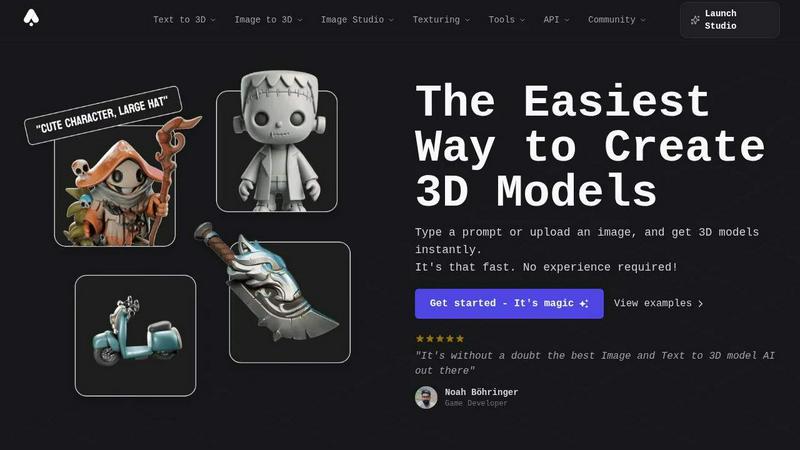
3DAIStudio is an AI-powered platform that instantly generates production-ready 3D models from text prompts or images, as evidenced by its use by over.
Last updated: April 4, 2026
Visual Comparison
1800*pod

3DAIStudio
Feature Comparison
1800*pod
Free-to-Use Directory
1800*pod operates as a completely free directory, eliminating financial barriers for both novice and established podcasters. This model encourages widespread participation, creating a larger and more diverse pool of hosts and guests. Users can create detailed profiles showcasing their expertise, podcast themes, and interests without any subscription fee, fostering an inclusive community dedicated to knowledge sharing and conversation.
Intuitive Swipe-to-Match Interface
The platform employs a familiar and engaging swipe-based interface to simplify the discovery process. Users can quickly browse through curated profiles, swiping right to express interest in a potential collaboration or left to pass. This gamified, low-commitment approach accelerates the initial connection phase, making it efficient and enjoyable to find compatible podcast partners based on mutual interests and goals.
Detailed Profile & Interest Matching
Beyond simple browsing, 1800*pod emphasizes meaningful connections through detailed user profiles. Hosts and guests can list their specific expertise, podcast genres, past experience, and collaboration goals. The system uses this information to suggest relevant matches, increasing the likelihood of productive partnerships and ensuring conversations are built on a foundation of shared topics and professional alignment.
Integrated Connection & Messaging
Once a mutual match is made, the platform provides built-in tools to initiate and manage conversations. This seamless integration allows users to discuss potential episode topics, logistics, and recording details directly within the ecosystem. By keeping the initial coordination contained within 1800*pod, it reduces context-switching and streamlines the workflow from match to recorded episode.
3DAIStudio
Text to 3D
This core feature allows users to generate fully textured 3D models by simply typing a descriptive text prompt. The AI interprets the natural language description, such as "realistic fantasy orc warrior, muscular, wearing rugged armor," and constructs a corresponding 3D asset with appropriate geometry and surface details. This eliminates the need for manual modeling from scratch, enabling rapid prototyping and concept visualization directly from written ideas.
Image to 3D
Users can upload any 2D image, sketch, or illustration, and 3DAIStudio's AI will extrapolate depth and form to create a three-dimensional model. This process converts flat reference artwork into a tangible 3D object, preserving the visual style and intent of the original image. It is particularly valuable for turning concept art, product photos, or hand-drawn sketches into immediate 3D assets for further use.
AI Texturing
Beyond geometry creation, the platform includes an AI-powered texturing system that can apply realistic, physically-based rendering (PBR) materials to models. Users can generate textures from text prompts or paint and edit details directly onto the model's surface. This ensures that outputs are not just geometric meshes but are visually complete with colors, materials, and surface properties ready for rendering in game engines or animations.
Quad-Remesh & Optimization
To ensure assets are production-ready, 3DAIStudio provides automated retopology tools like Quad-Remesh. This feature optimizes the mesh topology generated by the AI, creating clean, efficient polygon flow, reducing polygon count, and generating levels of detail (LODs). This critical step prepares models for performance-sensitive applications like real-time gaming and VR, fixing potential mesh issues before export.
Use Cases
1800*pod
Hosts Seeking Expert Guests
Podcast hosts looking to add credibility and depth to a specific episode can use 1800*pod to find verified experts. For example, a tech podcast host can quickly locate software engineers, startup founders, or academic researchers to provide authoritative commentary on emerging trends, ensuring content is both informative and research-backed.
Industry Professionals Seeking Exposure
Experts, authors, or consultants aiming to build their personal brand and authority can use the platform to find relevant podcasts in their field. By securing guest appearances, they can share their knowledge with new audiences, promote their work, and establish themselves as thought leaders, all through a targeted and efficient matching process.
New Podcasters Building a Network
Individuals launching a new podcast often struggle to book their first guests. 1800*pod provides a vital starting point by connecting newcomers with a community of willing guests and fellow hosts. This helps in building an initial content calendar, gaining interview experience, and cross-promoting within the platform's network to grow an audience.
Content Diversification for Established Shows
Seasoned podcasters experiencing guest fatigue or seeking fresh perspectives can utilize 1800*pod to break out of their usual network. The platform's vast directory makes it easy to discover voices from different industries, backgrounds, and geographic locations, injecting new energy and diverse viewpoints into an existing show format.
3DAIStudio
Game Development
Game developers and studios use 3DAIStudio to rapidly generate a vast array of 3D assets, including characters, props, weapons, and environmental elements. The speed of generation allows for faster iteration on game design concepts and helps small teams or indie developers overcome resource constraints by quickly populating their worlds with unique, high-quality models, accelerating the entire content creation pipeline.
Film & Animation Pre-Visualization
In film and animation production, the tool is invaluable for pre-visualization (previs). Directors and artists can quickly generate 3D models of characters, creatures, or set pieces from script descriptions or concept art. This allows for faster storyboarding, scene blocking, and asset planning before committing to costly, time-intensive final modeling and rendering processes.
Product Design & Prototyping
Industrial and product designers can upload sketches or describe new product ideas to instantly create 3D visualizations. This facilitates rapid prototyping, client presentations, and early-stage design validation. The ability to quickly iterate on form and aesthetic in 3D space significantly shortens the design cycle and improves communication of concepts.
Educational Content Creation
Educators and e-learning content creators leverage 3DAIStudio to build engaging 3D models for instructional materials, simulations, and interactive lessons. Without needing expert 3D modeling skills, they can create accurate models of historical artifacts, scientific molecules, or geographical formations, making complex subjects more tangible and accessible for students.
Overview
About 1800*pod
1800pod is a modern, free-to-use platform designed to revolutionize how podcast hosts and potential guests connect. It functions as an intuitive directory and matching service, specifically engineered to remove the traditional friction points in podcast collaboration. The platform serves a dual audience: podcast hosts seeking diverse, knowledgeable guests to enrich their content, and experts or personalities looking for platforms to share their insights. Its core value proposition lies in its ability to "make podcasting fun again" by streamlining the discovery and connection process. Instead of relying on inefficient cold outreach or fragmented networks, users leverage a centralized system inspired by modern dating apps, allowing them to "swipe, match, and record." This approach is backed by the understanding that successful podcasting relies on dynamic chemistry and shared interests, which 1800pod facilitates through profile-based discovery. By offering this service for free, it significantly lowers the barrier to entry, democratizing access to podcast appearances and fostering a more vibrant, interconnected podcasting ecosystem.
About 3DAIStudio
3DAIStudio is a revolutionary AI-powered platform that democratizes 3D content creation by enabling users to generate high-quality, production-ready 3D models from simple text prompts or 2D images in seconds. This tool fundamentally transforms a traditionally complex and time-intensive process, which according to industry standards can take skilled artists days or weeks, into an accessible and instantaneous workflow. It serves a broad spectrum of users, from game developers, film and VR/AR studios, and product designers to educators, 3D printing enthusiasts, and independent creators with no prior 3D modeling experience. The core value proposition of 3DAIStudio lies in its ability to drastically accelerate the 3D asset pipeline, reduce technical barriers to entry, and provide a comprehensive suite of AI tools that extend beyond simple generation to include texturing, mesh optimization, and image editing. By leveraging advanced generative AI, the platform allows for rapid iteration and ideation, empowering professionals to meet tight deadlines and enabling newcomers to bring their creative visions to life without the steep learning curve associated with conventional 3D software like Blender or Maya.
Frequently Asked Questions
1800*pod FAQ
Is 1800*pod really free to use?
Yes, 1800*pod is completely free to use. The core service of creating a profile, browsing the directory, using the swipe-to-match interface, and connecting with mutual matches does not require any payment. The platform's mission is to lower barriers in podcasting, which it achieves through this freemium model focused on accessibility.
How does the matching process work?
The process is designed for simplicity. After creating a profile detailing your role (host or guest), topics, and expertise, you can browse other user profiles. Using a swipe mechanism, you indicate interest. Only when two users mutually "swipe right" on each other's profiles is a connection made, unlocking the ability to message and discuss collaboration directly within the platform.
What kind of profiles can I find on 1800*pod?
The directory hosts a wide range of users, including podcast hosts from various genres (business, tech, wellness, entertainment), subject matter experts, authors, entrepreneurs, and industry professionals. The diversity is a key strength, allowing for cross-disciplinary connections and unique conversations that might not occur in more siloed networks.
Can I use it to promote my existing podcast?
Absolutely. The platform is an excellent tool for promotion and networking. Hosts can find guests to attract new listeners, while guests can find shows to share their message. Furthermore, the connections made often lead to cross-promotion opportunities, as hosts and guests typically share episode releases with their respective audiences.
3DAIStudio FAQ
What 3D file formats can I export my models in?
3DAIStudio is designed for production pipelines and supports export in industry-standard formats. This typically includes .glb/.glTF (for web and real-time applications), .obj, .fbx, and .stl (for 3D printing). These formats ensure compatibility with major platforms like Unity, Unreal Engine, Blender, Maya, and various 3D printing slicers.
Do I need any prior 3D modeling experience to use 3DAIStudio?
No, one of the primary advantages of 3DAIStudio is its accessibility to users with zero 3D modeling experience. The interface is built around simple inputs: text prompts and image uploads. The AI handles the complex tasks of geometry generation, texturing, and optimization, allowing complete beginners to create professional-looking 3D assets.
How does the AI handle complex or specific text prompts?
The platform's AI is trained on vast datasets of 3D models and associated descriptions. For best results, users should provide clear, descriptive prompts that include details about the subject, style, materials, and context (e.g., "a low-poly cartoon red apple on a wooden table"). The more descriptive the prompt, the more accurate and detailed the resulting 3D model will be.
Is the output from 3DAIStudio ready for commercial use?
Yes, models generated on 3DAIStudio are intended to be production-ready and suitable for commercial projects. The platform includes tools like Quad-Remesh specifically to optimize topology for real-time performance in games and VR. However, users should always review the generated model's polygon count and texture maps to ensure they meet the specific technical requirements of their project.
Alternatives
1800*pod Alternatives
1800pod is a podcast guest booking platform within the marketing and podcasting technology category. It functions as a free directory, using a matching algorithm to connect hosts with relevant guests, streamlining the collaboration process. Users often seek alternatives for various reasons. Some may require more advanced features like integrated scheduling or video recording, while others might seek platforms with larger, more niche-specific networks. Budget considerations also play a role, as some services operate on premium or subscription models. When evaluating alternatives, key factors include the size and relevance of the user network, the sophistication of matching and search filters, and the availability of tools for communication and project management. Security and data privacy policies are also critical, as these platforms handle professional contact information and communication.
3DAIStudio Alternatives
3DAIStudio is an AI-powered content creation tool designed to rapidly generate quality 3D models from simple text prompts or uploaded images. It falls within the burgeoning category of generative AI for 3D asset creation, aiming to democratize 3D design for professionals and enthusiasts alike. Users often explore alternatives to such tools for several practical reasons. These can include seeking different pricing models or subscription tiers, needing specific export formats or integration capabilities with other software, or requiring a different balance between automation and manual control. The specific feature set, output quality for particular use cases, and platform compatibility are also common drivers for comparison. When evaluating alternatives, key considerations should include the core AI technology's reliability, the supported input and output file types, the learning curve and user interface, and the scalability of the service for project needs. Assessing the tool's intended audience—whether for game development, product visualization, or animation—is crucial to ensure it aligns with your specific creative or professional workflow.