
Rock Smith
Rock Smith is an AI agent that visually understands and automates QA testing like a real user.
Visit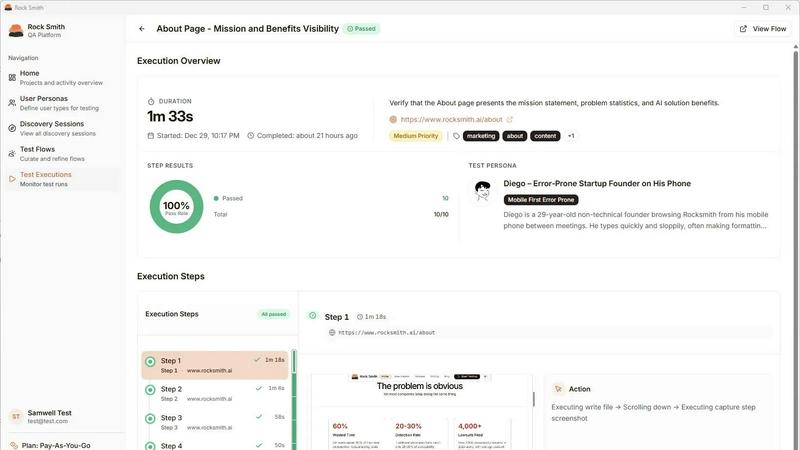
About Rock Smith
Rock Smith is an advanced AI-powered black box QA testing solution engineered to revolutionize the validation of web applications. It transcends traditional, script-heavy automation by deploying autonomous AI agents that interact with applications just like a human user would. This approach fundamentally eliminates dependency on brittle, code-level selectors like CSS or XPath, which are a primary source of test failure and maintenance overhead in dynamic development environments. The core value proposition lies in its self-healing capability; when UI elements change, Rock Smith's AI intelligently adapts, finding new paths to complete test flows without manual intervention. This results in a testing suite that is significantly more resilient, reliable, and reduces maintenance efforts by an estimated 70-80%, according to industry analyses on AI-augmented testing. Designed for fast-moving engineering teams, Rock Smith serves a diverse audience including QA engineers seeking efficiency, developers advocating for shift-left testing, and business leaders focused on accelerating release cycles without compromising quality. It empowers organizations to focus on building high-quality applications by automating a critical, yet traditionally cumbersome, aspect of the software development lifecycle.
Features of Rock Smith
Autonomous AI Test Agents
Rock Smith utilizes sophisticated autonomous AI agents that navigate and test web applications by visually interpreting the UI and understanding user intent, much like a human tester. These agents execute complex workflows—from login sequences to multi-step transactions—without relying on underlying code selectors. This method, validated by research into agentic AI systems, creates tests that are inherently more robust against the constant changes typical in modern CI/CD pipelines.
Self-Healing Test Flows
The platform's defining feature is its ability to self-heal when encountering altered or missing UI elements. Instead of failing, the AI dynamically explores the interface context to identify the new location or representation of a button, field, or link. This dramatically reduces the "test maintenance tax," a well-documented pain point in software testing that can consume up to 30% of a QA team's time, allowing engineers to focus on new functionality rather than fixing broken tests.
Black-Box, Selector-Free Testing
By operating purely as a black-box testing tool that interacts with the rendered front-end, Rock Smith completely bypasses the need for CSS, XPath, or other DOM-based selectors. This approach not only makes tests more durable but also more accessible, as test creation does not require deep knowledge of the application's internal code structure. It aligns with the principle of testing from the user's perspective, ensuring validation of actual user experience.
Rapid Test Generation and Execution
Teams can rapidly generate and execute comprehensive test suites without writing extensive code. By defining user journeys and acceptance criteria, Rock Smith's AI can quickly create corresponding test scenarios. This accelerates test coverage expansion and enables continuous testing, a practice cited by the DevOps Research and Assessment (DORA) team as key to high-performing software teams, by seamlessly integrating into development workflows.
Use Cases of Rock Smith
Continuous Integration/Continuous Deployment (CI/CD) Pipelines
Integrate Rock Smith into CI/CD pipelines to provide automated, reliable regression testing for every build. Its resilience to UI changes ensures that deployment gates are not falsely triggered by test failures due to minor cosmetic updates, enabling faster and more confident releases. This is critical for organizations practicing agile or DevOps methodologies, where deployment frequency is a key performance indicator.
Cross-Browser and Cross-Platform Compatibility Testing
Efficiently validate application behavior across multiple browsers (Chrome, Firefox, Safari, Edge) and viewports. The AI agents' visual interaction model allows them to adapt to different renderings and layouts, providing broad compatibility coverage without the need to write and maintain separate test scripts for each environment, a traditionally resource-intensive task.
Legacy Application Test Automation
Modernize testing for legacy web applications where the codebase may be poorly documented or use outdated frameworks that challenge conventional automation tools. Rock Smith's black-box, selector-free approach can automate test scenarios for these systems without requiring invasive changes or deep integration, helping organizations manage risk and plan modernization efforts.
Agile Sprint Validation
Support agile teams by providing immediate feedback on user stories completed within a sprint. QA engineers and developers can quickly generate acceptance tests for new features, ensuring they work as intended before sprint review. This facilitates a true shift-left approach, embedding quality assurance directly into the development process and reducing bottlenecks.
Frequently Asked Questions
How does Rock Smith differ from traditional testing tools like Selenium?
Traditional tools like Selenium rely on static, code-based locators (e.g., XPath) to find elements. When the UI changes, these locators break, requiring manual updates. Rock Smith uses AI to understand the UI contextually and visually, interacting with elements based on their purpose and appearance. This makes tests far more adaptable and reduces maintenance overhead, as confirmed by comparative studies on test fragility.
Can Rock Smith handle complex, dynamic web applications (e.g., single-page apps)?
Yes, Rock Smith is specifically designed for modern, dynamic web applications, including those built with React, Angular, and Vue.js. Its AI agents wait for and understand dynamic content loading, state changes, and asynchronous updates, effectively navigating the application's flow to execute tests under real-world conditions that often challenge scripted automation.
What technical skills are required to use Rock Smith?
Rock Smith is built to be accessible. While beneficial, deep programming expertise is not required to create and manage tests. Users primarily need to understand application workflows and user stories. The platform's intuitive interface and AI-driven test generation lower the barrier to entry, enabling product managers and business analysts to contribute directly to test definition.
How does the self-healing capability actually work?
When an expected UI element is not found, Rock Smith's AI employs a multi-strategy recovery process. It analyzes the visual and semantic context of the page, searches for elements with similar labels, functions, or positions, and can even infer actions based on the overall workflow. This process is inspired by computer vision and natural language processing techniques applied to software testing, allowing it to "heal" tests autonomously.
Pricing of Rock Smith
Rock Smith offers a tiered pricing model designed to scale from individual builders to collaborative teams. A free tier is available to start exploring the platform's capabilities. For professional use, the Solo Pro plan is priced at $10 per month (billed annually) and is tailored for founders and solopreneurs. It includes unlimited projects, custom AI experts, detailed implementation plans, and sharing options. For startups and larger teams, the Band plan supports collaboration with up to 5 human experts and includes all Solo Pro features, plus enhanced team workflow tools. All prices exclude VAT, which may vary by country.