Project20x vs ZoeMD
Side-by-side comparison to help you choose the right product.

Project20x
Project20x provides AI governance solutions for compliant and effective policy enforcement.
Last updated: March 4, 2026

ZoeMD
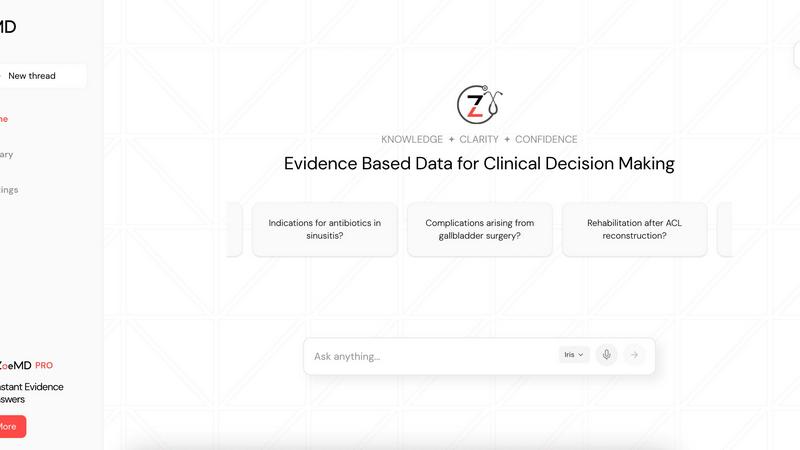
ZoeMD is an AI clinical assistant that instantly finds and summarizes evidence-based guidelines for physicians.
Last updated: February 28, 2026
Visual Comparison
Project20x
ZoeMD
Feature Comparison
Project20x
Governance Layer: AI-Powered Policy Analysis
This foundational layer employs a sophisticated ten-step AI methodology to assist lawmakers in the legislative drafting process. It analyzes proposed legislative texts for semantic clarity, logical consistency, and potential conflicts with existing statutes. By providing data-driven insights, it helps policymakers draft more precise, enforceable, and effective laws from the outset, reducing downstream interpretation errors and implementation friction, as supported by research on computational law and legal informatics.
Management Layer: Rules as Code Automation
The Management Layer is where approved policies are transformed into functional, machine-executable code. This "Rules as Code" approach encodes legislation and regulations directly into software logic, creating automated back-office workflows. This eliminates manual processing bottlenecks, ensures consistent application of rules, and dramatically increases operational efficiency for government agencies, allowing resources to be redirected toward complex cases requiring human judgment.
Interface Layer: Citizen-Facing AI Agents
Project20x deploys always-available AI agents to the public interface, trained exclusively on the codified rules from the Management Layer. These agents can guide citizens through complex procedures, such as applying for permits or benefits, answering eligibility questions, and submitting documentation. This provides a consistent, 24/7 point of access, reducing wait times and improving the citizen experience while ensuring all guidance is anchored in the official, up-to-date legal code.
End-to-End Transparency & Audit Framework
A core architectural principle of Project20x is baked-in transparency. Every automated decision, policy interaction, and workflow step is logged, creating a complete, immutable audit trail. This allows for full traceability from a citizen's inquiry back to the specific rule that governed the response, enabling quantifiable performance metrics and rigorous oversight. This framework is critical for maintaining public trust and accountability in automated government systems.
ZoeMD
Instant Evidence Synthesis
ZoeMD's AI engine processes complex clinical queries and instantly synthesizes information from a vast corpus of peer-reviewed research, clinical guidelines, and pivotal studies. It delivers concise, actionable summaries, saving clinicians valuable time otherwise spent manually searching through multiple databases and resources to compile relevant evidence for a single case.
Direct Source Citation
Every summary and recommendation provided by ZoeMD includes direct citations to its source material, such as specific clinical trials, guideline publications, or systematic reviews. This transparency allows medical professionals to verify the evidence base, understand the strength of the recommendations, and facilitates deeper reading when necessary for complex decision-making.
Dual-Mode Platform
ZoeMD offers distinct tools for healthcare providers and patients. The provider-facing platform delivers in-depth clinical decision support, while the patient-facing features provide vetted, educational health information. This clear separation ensures that patients receive accessible knowledge without it being mistaken for personalized medical advice, maintaining professional and ethical standards.
Seamless Clinical Integration
Designed for the point-of-care, ZoeMD integrates into a clinician's existing workflow with minimal disruption. Its interface allows for rapid querying and receipt of answers during patient encounters, in rounds, or during study sessions, ensuring that evidence-based insights are available precisely when and where they are needed to inform immediate clinical decisions.
Use Cases
Project20x
Streamlining Social Benefit Applications
Government agencies can use Project20x to automate the entire lifecycle of benefit programs (e.g., SNAP, unemployment insurance). The AI agents interface with citizens to collect information and pre-fill applications, while the Rules as Code backend instantly verifies eligibility against codified regulations. This reduces processing times from weeks to minutes, minimizes errors, and ensures equitable access, allowing caseworkers to focus on applicants needing exceptional support.
Legislative Drafting and Impact Simulation
Lawmakers and legislative staff can utilize the Governance Layer as a collaborative drafting tool. The AI can simulate the downstream effects of proposed policy language, flagging unintended consequences or conflicts with existing laws. This enables evidence-based policymaking, improves the quality of legislation, and helps forecast administrative burdens and resource requirements before a bill is ever passed into law.
Automated Business Licensing and Permitting
Municipal and state governments can implement Project20x to manage business licenses, construction permits, and other regulatory approvals. The platform guides business owners through the requirements via the AI interface, automatically checks submissions against zoning, safety, and environmental codes, and routes applications to the correct departments. This creates a predictable, efficient environment for economic development.
Public Information and Compliance Assistance
Citizens and businesses often struggle to navigate complex regulatory obligations. Project20x's AI agents, acting as a single point of truth, can provide instant, accurate answers to questions about tax codes, environmental regulations, or housing standards. This proactive compliance assistance improves regulatory adherence, reduces inadvertent violations, and empowers the public with clear, accessible information.
ZoeMD
Diagnostic Decision Support
When a physician encounters a patient with atypical or complex symptoms, they can use ZoeMD to quickly query differential diagnoses based on the latest evidence. The AI cross-references symptoms with current research and guidelines, providing a ranked list of potential conditions with supporting citations, thereby enhancing diagnostic accuracy and reducing cognitive bias.
Treatment Plan Optimization
For a nurse practitioner managing a chronic condition like Type 2 Diabetes, ZoeMD can be queried for the latest first-line and adjunctive pharmacotherapy recommendations, including dosing considerations and contraindications from recent studies. This ensures treatment plans are aligned with the most current, evidence-based best practices.
Medical Education & Research
Medical students and residents can use ZoeMD as an educational tool to rapidly understand the evidence behind clinical protocols for their rotations. Similarly, researchers can utilize it to quickly survey existing literature on a niche topic, identifying key studies and gaps in knowledge to inform their own research proposals and literature reviews.
Patient Consultation Preparation
Prior to a patient consultation, a clinician can use ZoeMD to prepare by querying the latest prognostic data, screening recommendations, or comparative effectiveness of new treatment options for a specific condition. This allows the clinician to enter the consultation armed with the most up-to-date information to discuss with the patient.
Overview
About Project20x
Project20x is a foundational AI-native platform engineered to transform the architecture and execution of modern governance. It addresses a critical systemic gap: the disconnect between high-level policy creation and its practical, equitable implementation for citizens. The platform serves a tripartite audience of government agencies, lawmakers, and the public, with a core value proposition of translating complex regulatory frameworks into transparent, actionable, and automated digital processes. This is achieved through its unique three-layer operational model. The Governance Layer assists policymakers in crafting clear, coherent, and conflict-free legislation using AI-driven analysis. The Management Layer then operationalizes this legislation by applying "Rules as Code" principles, converting legal text into executable software logic for automated workflows. Finally, the Interface Layer democratizes access by providing citizens with 24/7 interaction via AI agents trained on these codified rules, streamlining service delivery. By ensuring all processes are traceable, quantifiable, and under human oversight, Project20x establishes a new standard for governmental transparency, efficiency, and accountability, fundamentally bridging policy intent with public impact.
About ZoeMD
ZoeMD is an advanced, evidence-based medical AI assistant engineered specifically for point-of-care clinical decision support. It serves as a powerful tool for physicians, nurse practitioners, medical students, and researchers who require rapid, trustworthy access to the latest medical evidence during patient encounters. The platform's core value proposition lies in its ability to drastically reduce the time clinicians spend searching across disparate sources like PubMed, UpToDate, and clinical guidelines by providing synthesized, actionable answers to complex medical questions in seconds. Built on a foundation of peer-reviewed research, ZoeMD retrieves and analyzes relevant clinical guidelines, pivotal studies, and best-practice recommendations, then distills them into concise, structured summaries with direct citations. This process enhances diagnostic accuracy, treatment planning consistency, and overall clinical confidence without replacing the essential role of professional judgment. By integrating seamlessly into a clinician's workflow, ZoeMD empowers healthcare professionals to make more informed, evidence-based decisions efficiently, ultimately aiming to improve patient outcomes and streamline clinical workflow. The platform also offers patient-facing informational features, which are clearly distinguished from provider tools and are for educational purposes only, not medical advice.
Frequently Asked Questions
Project20x FAQ
How does Project20x ensure the AI does not make biased or incorrect decisions?
Project20x employs a "human-in-the-loop" governance model. The AI does not create policy; it operationalizes human-written legislation into code. All critical automated decisions are designed to be reviewable by human officials. Furthermore, the AI agents in the Interface Layer are constrained to respond only based on the codified rules, eliminating hallucination. The comprehensive audit trail allows any output to be traced back to its source rule for validation, ensuring accountability.
What is "Rules as Code" and how is it different from traditional IT implementation?
Traditional IT implementation involves software developers manually interpreting legal text to build systems, a process prone to misinterpretation and delay. "Rules as Code" (RaC) is a methodology where legislation is drafted and published in both human-language and machine-executable code simultaneously. Project20x's Management Layer specializes in this RaC approach, treating the law itself as the source code. This ensures the digital service is a direct, unambiguous reflection of the law, enabling precision, consistency, and easier updates when laws change.
Is citizen data secure on the Project20x platform?
Security and data sovereignty are paramount. Project20x is designed to meet the highest government security standards (such as FedRAMP requirements in the U.S.). Data encryption, strict access controls, and compliance with relevant data protection regulations (like GDPR for applicable jurisdictions) are foundational. The platform can be deployed in a government-controlled cloud or on-premise environment, ensuring that sensitive citizen data remains under strict governmental custody and control.
Can Project20x integrate with existing government legacy systems?
Yes, a key design consideration for Project20x is interoperability. The platform is built with API-first architecture, allowing its core engines—policy analysis, rules execution, and AI interface—to connect with existing case management systems, databases, and digital identity platforms. This enables a phased implementation strategy where Project20x can modernize specific processes or services without requiring a wholesale, disruptive replacement of all existing government IT infrastructure.
ZoeMD FAQ
What is ZoeMD?
ZoeMD is an AI-powered clinical decision support platform designed for healthcare professionals. It provides instant, synthesized answers to medical questions by analyzing and summarizing peer-reviewed research, clinical guidelines, and pivotal studies. It also offers patient-facing educational content, which is strictly informational and not a substitute for professional medical advice.
Who is ZoeMD for?
ZoeMD is engineered for medical professionals including physicians, nurse practitioners, physician assistants, and medical residents who require point-of-care decision support. It is also a valuable tool for medical students, researchers, and other healthcare trainees seeking to efficiently access and understand the latest medical evidence.
Does ZoeMD replace clinical judgment?
No, ZoeMD does not replace clinical judgment. It is designed as a decision-support tool to augment a clinician's expertise by providing rapid access to synthesized evidence. The final diagnosis, treatment plan, and clinical decisions remain the sole responsibility of the treating healthcare professional, who must apply their own knowledge and judgment to the patient's unique context.
How can I access ZoeMD?
ZoeMD is accessible through its web-based platform. Users can visit the ZoeMD website to explore pricing plans, which include a Free tier and a Pro subscription. After selecting a plan, users can create an account and immediately begin using the platform to query medical evidence and access its suite of tools.
Alternatives
Project20x Alternatives
Project20x is an AI governance platform within the broader category of AI assistants and regulatory technology. It specializes in translating complex government policies into automated, accessible digital services through its unique three-layer architecture. Users exploring this space often seek alternatives for various practical reasons, including budget constraints, specific feature requirements not covered by a single platform, or the need for solutions tailored to different organizational scales or private-sector compliance needs. When evaluating alternatives to a specialized platform like Project20x, it is crucial to define your core requirements. Key considerations should include the solution's primary focus—whether on policy analysis, workflow automation, or public engagement—its approach to data security and auditability, and the level of human-in-the-loop oversight it provides. According to industry analyses from firms like Gartner, the most effective governance tools offer transparency in their AI decision-making processes and demonstrate clear compliance with relevant regulatory frameworks.
ZoeMD Alternatives
ZoeMD is an AI-powered clinical decision support tool designed for healthcare professionals. It operates within the category of point-of-care medical reference and evidence synthesis platforms, helping clinicians quickly access and summarize guidelines and research during patient care. Users may explore alternatives for various reasons, including budget constraints, specific feature requirements not met by a single platform, or the need for integration with particular electronic health record systems. Institutional policies and preferences for certain medical content publishers can also drive the search for different solutions. When evaluating an alternative, key considerations should include the depth and credibility of the evidence base, the speed and accuracy of the AI synthesis, compliance with healthcare data security standards like HIPAA, and how seamlessly the tool integrates into existing clinical workflows. The ultimate goal is to find a solution that enhances, rather than disrupts, the process of delivering evidence-based care.