
Decode This Text vs voicebrief.io
Side-by-side comparison to help you choose the right product.

Decode This Text
Decode This Text provides quick, human-like analyses of conversations in just 30 seconds for ultimate clarity and.
Last updated: February 28, 2026

voicebrief.io
VoiceBrief converts PDFs into audio lectures with an AI tutor for faster, more effective learning.
Last updated: February 28, 2026
Visual Comparison
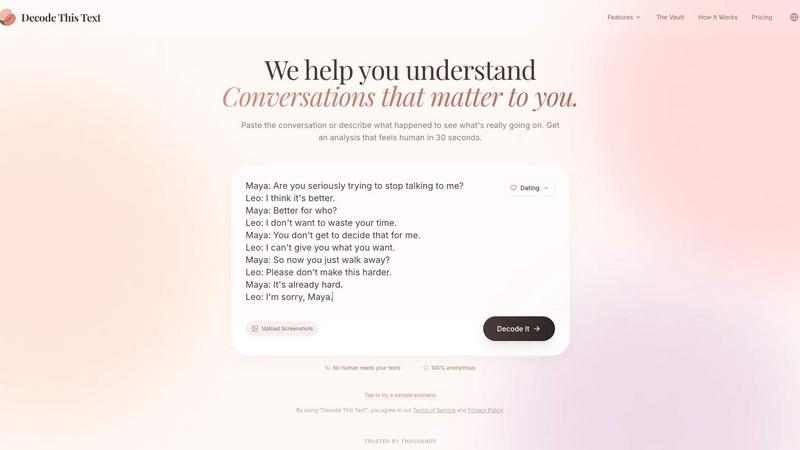
Decode This Text
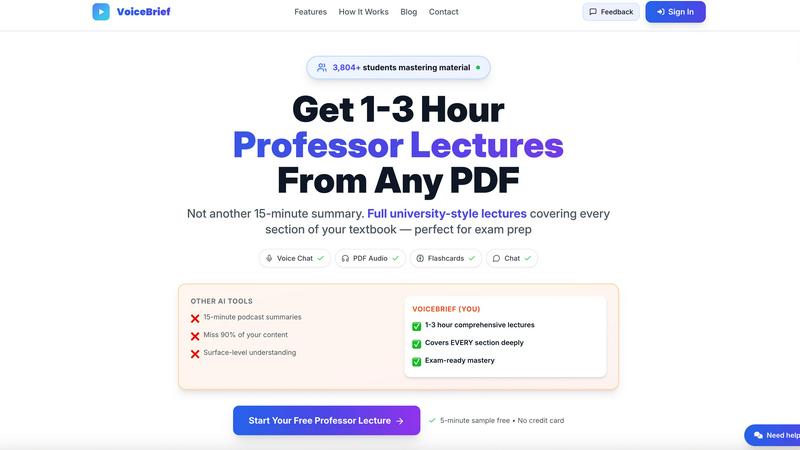
voicebrief.io
Feature Comparison
Decode This Text
Comprehensive Analysis
Decode This Text offers a thorough examination of messages, highlighting emotional tones, intentions, and contextual elements. This feature ensures that users grasp the nuances behind any communication, enabling them to respond appropriately.
Visual Input Capability
Users can conveniently upload screenshots of conversations, allowing the tool to analyze the text without requiring manual input. This feature simplifies the process for those who prefer visual communication, making it easier to decode complex interactions.
Emotional Tone Detection
This feature assesses the emotional temperature of messages, categorizing them as cold, sarcastic, or friendly. By understanding the emotional context, users can avoid misinterpretations and respond in a manner that aligns with the sender's mood.
Response Suggestions
For users unsure about how to reply, Decode This Text provides three tailored response options—calm, direct, or firm. This feature equips users with the confidence to engage in conversations effectively, regardless of the message's complexity.
voicebrief.io
AI-Generated Audio Lectures
VoiceBrief.io's core feature is its ability to synthesize uploaded documents into detailed, narrative-style audio explanations, not merely a robotic reading of text. The AI analyzes the material's structure and concepts to create a coherent lecture, mimicking how a professor would break down complex topics. This process transforms a 50-page textbook chapter into a structured 90-minute audio session, facilitating deeper understanding through auditory processing and contextual explanation, which is far more effective for comprehension than speed-reading or passive highlighting.
Interactive AI Tutor & Voice Chat
Users can engage in natural conversation with an AI assistant that has been specifically trained on the content of their uploaded documents. This allows for real-time Q&A, where students can ask for clarifications on confusing paragraphs, request examples, or dive deeper into specific concepts. The AI provides explanations with citations to the source material, creating an interactive, Socratic learning environment. This feature addresses the "illusion of explanatory depth," where learners overestimate their understanding until they attempt to explain it, by forcing active recall and clarification.
Smart Flashcards & Spaced Repetition
The platform automatically generates flashcards from key concepts and facts within the document. These flashcards are then integrated into a spaced repetition system (SRS), an evidence-based learning technique that schedules review sessions at optimal intervals to combat the forgetting curve. This systematic approach to revision, proven to significantly improve long-term memory retention, ensures that knowledge moves from short-term to long-term storage efficiently, making exam preparation more effective.
Multi-Format Document Processing
VoiceBrief.io accepts a wide array of input formats beyond standard PDFs, including photographs of handwritten notes (using Optical Character Recognition) and direct URLs to web articles. This flexibility ensures that virtually any learning material—from a professor's whiteboard notes to the latest online research paper—can be converted into an audio learning asset. The OCR capability for handwritten text is particularly valuable for capturing personalized study notes and integrating them into the audio learning and quiz ecosystem.
Use Cases
Decode This Text
Navigating Ambiguous Texts
Decode This Text is invaluable when dealing with vague texts from friends or colleagues. By providing a clear interpretation, users can avoid unnecessary confusion and maintain healthy communication.
Professional Email Clarification
In the workplace, ambiguous emails can lead to miscommunication. This tool helps users decipher the true meaning behind brief or unclear messages, ensuring that responses are appropriate and informed.
Family Communication Enhancement
Family dynamics can be complicated by misunderstandings. Decode This Text assists users in interpreting family messages, promoting better understanding and reducing potential conflicts.
Relationship Insights
For those in romantic relationships, Decode This Text can help clarify intentions behind messages that may seem evasive or confusing. This insight fosters healthier conversations and strengthens connections.
voicebrief.io
Medical & Law Student Exam Preparation
Students facing vast volumes of dense textual information from textbooks like Gray's Anatomy or case law journals can upload their materials. VoiceBrief.io converts them into long-form audio lectures for listening during clinical rotations or commutes. The interactive AI tutor allows for drilling on specific procedures or legal precedents, while auto-generated flashcards on drug interactions or landmark cases facilitate efficient memorization through spaced repetition, leading to more confident exam performance.
Professional Continuing Education
Busy professionals, such as engineers, analysts, or consultants, need to stay current with industry whitepapers, technical reports, and market research. Instead of struggling to find focused reading time, they can upload these documents to VoiceBrief.io. The AI summaries provide quick overviews, and the audio lectures enable deep dives during daily commutes or travel, turning downtime into productive upskilling sessions without sacrificing work-life balance.
Auditory & Multimodal Learning
Learners who retain information better through listening (auditory learners) or through a combination of senses (multimodal learners) can leverage VoiceBrief.io to complement visual reading. By consuming the same material in audio format, they engage different cognitive pathways, reinforcing understanding. This is supported by research on learning styles, which indicates that matching presentation mode to learner preference can improve outcomes (Pashler et al., 2008).
Accessibility & Inclusive Learning
The platform serves as a powerful tool for individuals with dyslexia, ADHD, or visual impairments that make sustained reading challenging. Converting text to high-quality audio provides an alternative, accessible pathway to the same educational content. The ability to ask questions via voice chat further lowers barriers to engagement, promoting inclusivity by accommodating different learning needs and preferences.
Overview
About Decode This Text
Decode This Text is a cutting-edge communication tool designed to assist users in unraveling the often ambiguous meanings behind various messages. Whether you're struggling to interpret a cryptic email from your boss, a vague text from a friend, or a confusing message from a client, this innovative tool provides essential clarity. By simply pasting the text or describing the context, users receive an insightful analysis of the sender's underlying intentions, emotional tone, and appropriate response strategies. This tool is particularly beneficial for anyone looking to enhance their communication skills, foster better relationships, and eliminate misunderstandings. With a user-friendly interface and rapid analysis, Decode This Text empowers you to navigate your interactions confidently, alleviating the stress of overanalyzing every word.
About voicebrief.io
VoiceBrief.io is an advanced AI-powered audio learning platform designed to transform passive reading into active, efficient auditory comprehension. It addresses a critical challenge in modern education and professional development: cognitive overload from dense textual materials. The platform converts static documents—including PDFs, photos with OCR for handwritten notes, and web articles—into comprehensive, professor-style audio lectures that can last from one to three hours, ensuring no critical detail is omitted. This method leverages the pedagogical principle of dual coding theory, which suggests combining verbal and auditory information enhances memory and recall (Paivio, 1971). Primarily serving students in rigorous fields like medicine, law, engineering, and business, as well as professionals and lifelong learners, VoiceBrief.io's core value proposition is turning otherwise lost time (commutes, workouts, chores) into productive learning sessions. Unlike basic text-to-speech tools, it provides an interactive learning ecosystem where users can engage in voice or text-based dialogue with an AI tutor trained specifically on their uploaded content, request cited explanations, and utilize auto-generated flashcards for spaced repetition, a proven technique for long-term retention (Cepeda et al., 2008). It represents a shift from one-way content consumption to a dynamic, Socratic learning experience.
Frequently Asked Questions
Decode This Text FAQ
How does Decode This Text ensure user privacy?
Decode This Text guarantees 100% anonymity. No human reads your texts, ensuring that your conversations remain private and secure.
What types of messages can I analyze with Decode This Text?
You can analyze any written communication, including text messages, emails, and social media messages. The tool is designed to handle a wide variety of contexts and formats.
How quickly can I expect to receive an analysis?
The tool typically provides a comprehensive analysis within 30 seconds, allowing users to gain clarity rapidly and respond in a timely manner.
Is there any limit to the number of messages I can decode?
Currently, there is no specified limit on the number of messages you can analyze. Users can decode as many conversations as they need to enhance their communication skills.
voicebrief.io FAQ
How is VoiceBrief.io different from simple text-to-speech apps like Speechify?
While basic TTS apps merely read text aloud with a synthetic voice, VoiceBrief.io employs advanced AI to comprehend and explain the content. It generates structured, lecture-style narratives, provides interactive Q&A with cited answers, and creates adaptive study tools like quizzes and flashcards. It's designed for understanding and retention, not just audio playback, making it an active learning platform rather than a passive reading tool.
What kinds of documents can I upload to VoiceBrief.io?
The platform supports a wide range of formats to accommodate various learning materials. This includes standard PDFs (textbooks, research papers), image files (JPEG, PNG) of handwritten or printed notes which it processes using OCR technology, and direct URLs to online articles and blog posts. This ensures almost any study material can be integrated into your audio learning workflow.
Can I ask the AI questions about specific parts of my document?
Yes, this is a core functionality. The Interactive AI Tutor is trained specifically on the content you upload. You can ask questions via text or voice chat about any concept, paragraph, or data point within your document. The AI will reference the source material to provide a detailed, contextual explanation, much like asking a professor for clarification during a lecture.
Is there a limit to the length or number of documents I can process?
Limits are typically defined by your subscription plan. The provided context mentions a "Pro" plan starting from $9.99/month, which would offer higher processing limits compared to a free or trial tier. It's common for such platforms to have constraints on file size, audio generation length per month, or the number of active documents to manage server resources effectively.
Alternatives
Decode This Text Alternatives
Decode This Text is an innovative tool in the productivity and management category, designed to help users decipher the true meanings behind confusing conversations. By providing quick, human-like analyses of messages, it offers insights that can enhance understanding and communication. Users often seek alternatives to Decode This Text for various reasons, including pricing concerns, feature sets, specific platform compatibility, or personal preferences in user interface design. When selecting an alternative, it's essential to consider factors such as the depth of analysis provided, user-friendliness, response time, and whether the tool meets your specific communication needs. Additionally, evaluating customer support options and user reviews can offer insight into the effectiveness and reliability of the alternative tool, ensuring that it aligns with your expectations.
voicebrief.io Alternatives
VoiceBrief.io is a specialized productivity tool in the AI-powered learning and study aid category. It converts static documents like PDFs and notes into comprehensive audio lectures, augmented by interactive AI chat and auto-generated study aids. This approach is designed to transform passive reading into an active, auditory learning process, particularly for students in rigorous academic fields. Users may seek alternatives for various practical reasons. Common factors include budget constraints and specific pricing model preferences, such as needing a free tier or a one-time purchase. Others might require different core functionalities, like support for additional file formats, integration with specific learning management systems, or a focus on shorter summary content rather than in-depth lectures. Platform compatibility, including mobile app availability, is also a key consideration. When evaluating an alternative, prioritize a solution that aligns with your primary learning objectives. Key criteria should include the quality and depth of audio output, the intelligence and context-awareness of any integrated AI assistant, and the robustness of supplementary study features like flashcards or quizzes. Data privacy and security policies are paramount, as these tools process sensitive academic materials. Finally, consider the overall user experience and how seamlessly the tool fits into your existing study workflow.