Seedance 2 AI Video Generator vs Vidgo API
Side-by-side comparison to help you choose the right product.

Seedance 2 AI Video Generator
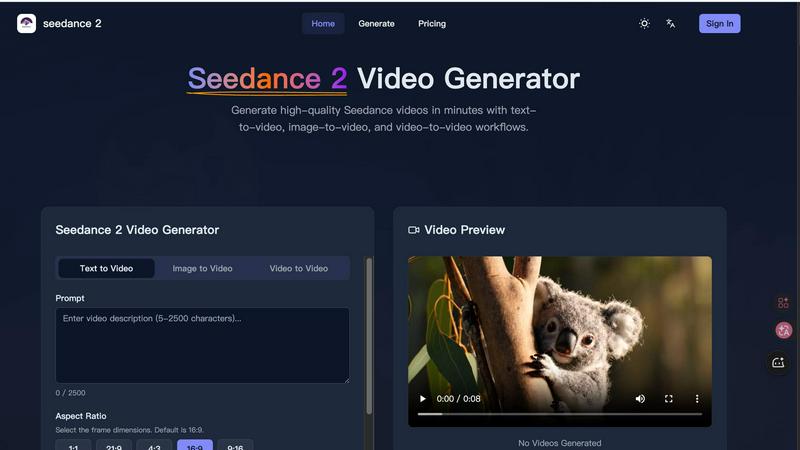
Seedance 2.0 instantly creates cinematic videos from text, images, or clips with consistent quality and easy control.
Last updated: March 1, 2026

Vidgo API
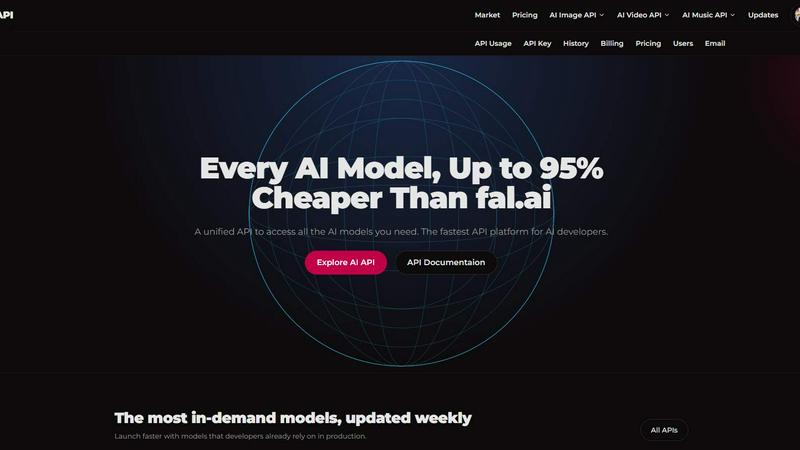
Vidgo API provides unified, low-cost access to diverse AI models for rapid development.
Last updated: February 28, 2026
Visual Comparison
Seedance 2 AI Video Generator
Vidgo API
Feature Comparison
Seedance 2 AI Video Generator
Multimodal Input Flexibility
Seedance 2.0 supports three distinct generation modes: Text-to-Video, Image-to-Video, and Video-to-Video. This flexibility allows users to choose the optimal starting point for any project, whether conceptualizing from a written idea, extending a specific visual style from a reference image, or restyling and enhancing existing source footage. This multimodal approach, as highlighted in platform comparisons, provides maximum creative control and workflow adaptability that many competing models lack (AI Video Generator Comparison, 2024).
Reference-First Generation Workflow
A defining feature of Seedance 2.0 is its emphasis on using visual references to guide the AI. Instead of relying solely on the nuances of prompt wording, users can upload an image or video clip to anchor character design, artistic style, color palette, and cinematic feel. This results in significantly higher output consistency and reduces the iterative trial-and-error often required in AI video generation, making it a more predictable and efficient tool for professional workflows.
Integrated Audio-Video Synthesis
Unlike many competitors that generate silent video, Seedance 2.0 Pro model includes joint audio generation in a single pass. This synchronized synthesis can produce sound effects (SFX), background music, and even voiceovers with lip-sync accuracy across 10+ languages, including English, Chinese, Japanese, and Korean. This all-in-one capability streamlines production, creating a more cohesive and finished video asset without requiring separate audio editing software.
Advanced Motion and Consistency Control
The platform is engineered for "steadier motion and more coherent scenes," addressing common AI video pitfalls like temporal flickering or unstable subjects. Technical specifications note a cinema-standard frame rate of up to 24fps, and showcases demonstrate its strength in maintaining character consistency and realistic physics across frames. This makes it particularly suitable for narratives, product demonstrations, and any use case where smooth, believable motion is critical.
Vidgo API
Unified AI Model Marketplace
Vidgo API consolidates access to a curated selection of over 36 state-of-the-art AI models for video, image, and music generation into one dashboard. This marketplace is continuously updated with the "most in-demand models, updated weekly," such as Kling 2.6 for motion control and Hailuo 02 for ultra-realistic video. Developers can browse, test, and integrate these models without negotiating separate contracts or navigating different API standards, significantly accelerating the prototyping and development cycle for AI-powered media features.
Cost-Effective & Predictable Pricing
A defining feature of Vidgo API is its aggressive, transparent pricing model designed as a cost-effective alternative. The platform explicitly positions itself as offering services "up to 95% cheaper than fal.ai," with per-request costs clearly listed for each model (e.g., Sora 2 at $0.15 per request). This predictable, pay-per-use structure allows development teams to forecast expenses accurately and scale their AI media generation without encountering prohibitive costs, a common barrier cited in industry reports on generative AI adoption.
Production-Ready Reliability & Performance
Built for enterprise and developer teams, Vidgo API guarantees high availability with a 99.9% uptime SLA and optimizes for speed with an average response time of 120ms. This performance consistency is critical for applications requiring real-time or near-real-time media generation. The platform provides "stable throughput" and "smart" routing, ensuring that integrations remain robust under load, a necessity for maintaining user experience in production applications as noted in software reliability engineering principles.
Simplified Developer Integration
The platform is designed with a developer-first approach, featuring a single authentication flow, consistent API endpoints across all models, and clear, comprehensive documentation. The integration process is standardized: developers use one API key, one billing account, and a uniform request structure to access any model. Example code snippets, like the provided cURL command for task submission, demonstrate the straightforward workflow, reducing integration time from days to minutes and lowering the technical barrier to implementing advanced AI capabilities.
Use Cases
Seedance 2 AI Video Generator
Social Media and Marketing Content Creation
Marketing teams and social media managers can leverage Seedance 2.0 to rapidly produce a high volume of platform-optimized video ads, promotional clips, and engaging social posts. The fast iteration cycle and support for aspect ratios like 9:16 (for Stories/Reels) and 1:1 allow for quick adaptation of core creative concepts across multiple channels, significantly accelerating campaign rollout.
Concept Visualization and Storyboarding
Filmmakers, agencies, and creative directors can use the Text-to-Video and Image-to-Video modes to quickly visualize concepts, create dynamic mood boards, or generate preliminary storyboard sequences. This enables faster client presentations, internal alignment on creative direction, and early testing of narrative ideas before committing to full-scale production.
Product Demonstration and Explainer Videos
Businesses can create polished product demo videos or animated explainer content by using image references of their product or interface. The Video-to-Video mode can also be used to add stylistic flair or illustrative animations to existing screen recordings, creating more engaging and professional tutorials or sales materials without complex animation software.
Content Restyling and Localization
Content creators and media companies can repurpose existing video footage by using the Video-to-Video mode for controllable restyling—applying new artistic filters, adjusting settings, or changing environments. The integrated multilingual lip-sync feature also opens efficient pathways for localizing explainer or spokesperson videos for different international markets.
Vidgo API
Dynamic Content Creation for Marketing & Social Media
Marketing agencies and social media managers can leverage Vidgo API to generate high volumes of tailored visual and audio content rapidly. By utilizing text-to-video models like Wan 2.6 or image-editing capabilities of Seedream 4.5, teams can produce platform-specific ads, promotional videos, and engaging social posts. The significant cost savings enable A/B testing of different creative concepts at scale, allowing data-driven optimization of campaign performance, a best practice highlighted in modern digital marketing strategies.
Enhanced Features for Software & App Development
SaaS companies and app developers can integrate AI media generation directly into their products. For instance, a design tool could use the image API for instant mockup generation, while a video editing app could offer AI-powered scene extension using models like Sora 2 Pro. The unified API allows development teams to add multiple AI features without building complex backend integrations for each service, accelerating feature deployment and improving product competitiveness in fast-moving tech markets.
Prototyping and Production in Media & Entertainment
Film studios, game developers, and independent creators can use Vidgo API for storyboarding, concept art generation, and soundtrack creation. Motion control models like Kling 2.6 can animate character designs, while Suno v5 can generate original, studio-quality music scores. This provides a powerful, affordable toolkit for pre-visualization and rapid iteration during creative development, a process that traditionally requires significant time and resource investment according to entertainment production studies.
Automated Asset Generation for E-commerce & Retail
E-commerce platforms can automate the creation of product visuals and demonstration videos. Using image-to-video models, a retailer can transform static product photos into engaging lifestyle videos. The API's cost structure makes it feasible to generate unique media for thousands of product listings, enhancing online storefronts and improving conversion rates. Research in e-commerce consistently shows that high-quality, dynamic media directly correlates with increased customer engagement and sales.
Overview
About Seedance 2 AI Video Generator
Seedance 2.0 is a state-of-the-art AI video generation platform engineered to transform text prompts, reference images, or existing source footage into polished, cinematic-quality video clips. It represents a significant advancement in controllable AI video synthesis, moving beyond simple text-to-video conversion to offer a robust, multimodal workflow. The platform is specifically designed for creators, marketers, and agencies who require high-quality video output at speed, eliminating the traditional bottlenecks and heavy editing overhead associated with conventional video production (Seedance 2.0, 2024). Its core value proposition lies in a unique "reference-first" methodology, which allows users to anchor the AI's output to specific visual styles, characters, or camera feels, resulting in greater consistency and less guesswork compared to prompt-only systems. With support for resolutions up to 1080p, synchronized audio generation, and multilingual lip-sync capabilities, Seedance 2.0 is positioned as a production-ready tool for creating content for advertising, social media, product demos, and more, facilitating rapid iteration without compromising on motion quality or visual coherence.
About Vidgo API
Vidgo API is a comprehensive, unified platform that provides developers and creative teams with streamlined access to a vast marketplace of cutting-edge AI models for video, image, and music generation through a single, consistent REST API. It addresses a critical pain point in the AI development landscape: the fragmentation and complexity of integrating multiple, disparate AI services. By aggregating over 36 top-tier models—including industry leaders like OpenAI's Sora 2, Google's Nano Banana Pro, ByteDance's Seedream 4.5, and Suno v5—Vidgo API eliminates the need for developers to manage separate accounts, authentication keys, and billing systems for each AI capability. Its core value proposition is threefold: significant cost reduction, operational simplicity, and production-grade reliability. Independent analysis of its pricing structure indicates services are offered at 15-95% lower cost than competing platforms like Fal.ai, providing a compelling economic advantage for scaling applications. The platform is engineered for production environments, boasting a 99.9% uptime SLA and an average response time of 120ms, ensuring consistent performance for user-facing applications. With comprehensive documentation and dedicated support, Vidgo API empowers businesses to efficiently enhance their digital content pipelines, from marketing and entertainment to software development and social media.
Frequently Asked Questions
Seedance 2 AI Video Generator FAQ
What input methods does Seedance 2.0 support?
Seedance 2.0 supports three primary input methods for video generation: Text (via a 2500-character prompt field), Image (uploading a reference image to guide style and composition), and Video (uploading source footage for restyling or extension). This multimodal flexibility allows users to choose the most effective starting point for their specific project needs.
What is the maximum video length and quality I can generate?
According to its technical specifications, Seedance 2.0 can generate video clips with a duration of 5 to 10 seconds per generation, with capabilities for extension. The maximum output resolution is 1080p (Full HD) at a cinematic frame rate of up to 24 frames per second, ensuring professional-grade visual quality suitable for various platforms.
How does the audio generation and lip-sync feature work?
The Seedance 2.0 Pro model includes a joint audio-video synthesis engine. It can generate synchronized sound effects, music, and voiceovers directly from your video generation parameters. The advanced lip-sync functionality automatically animates character mouth movements to match generated or provided voice audio across 10+ supported languages.
How does Seedance 2.0 ensure consistency in characters and scenes?
Seedance 2.0 employs a reference-first architecture and advanced temporal modeling. By using a provided image or video as a visual anchor, the AI maintains consistent character appearance, style, and color palette across frames. This approach, combined with its optimized motion synthesis, results in smoother animation and more coherent scene continuity compared to models relying solely on text prompts.
Vidgo API FAQ
What AI models are available on Vidgo API?
Vidgo API provides access to a growing marketplace of over 36 leading AI models spanning video, image, and music generation. This includes cutting-edge models such as OpenAI's Sora 2 and Sora 2 Pro for video, Google's Nano Banana Pro and ByteDance's Seedream 4.5 for images, and Suno v5 for music. The catalog is frequently updated with new and in-demand models, ensuring developers have access to the latest advancements in generative AI technology through a single integration point.
How does the pricing compare to other AI API providers?
Vidgo API is positioned as a highly cost-effective solution, with public pricing indicating savings of 15% to 95% compared to competitors like Fal.ai. Pricing is transparent and on a per-request basis for each specific model, allowing for precise cost control. For example, generating a video with Sora 2 costs $0.15 per request, while using the Nano Banana Pro image model costs $0.05 per request. This model can lead to substantial cost reductions at scale for development teams.
Is Vidgo API suitable for production applications?
Yes, Vidgo API is explicitly built for production use. The platform guarantees 99.9% uptime, offers consistent endpoints, and maintains an average response time of 120ms to ensure reliable performance for user-facing applications. Features like callback URLs for asynchronous task handling and comprehensive documentation support stable integration. This focus on reliability and predictable performance makes it a viable backbone for commercial applications requiring dependable AI media generation.
How do I get started and integrate the API?
Getting started is a streamlined three-step process. First, sign up for an account to instantly generate an API key with no waitlist. Second, browse the API marketplace to select the best models for your use case. Third, integrate using the provided documentation, which includes consistent endpoints and code examples. You can submit a generation task with a simple cURL command or SDK, and scale your usage without changing the integration as your needs grow.
Alternatives
Seedance 2 AI Video Generator Alternatives
Seedance 2 AI Video Generator is a prominent tool in the AI video synthesis category, designed to transform text prompts, images, and existing clips into cinematic-quality videos. It emphasizes a fast, all-in-one workflow with features for maintaining visual consistency and providing easy prompt control, catering to creators seeking efficient video production. Users often explore alternatives to such platforms for various practical reasons. These can include budget constraints, as subscription costs may not align with all project scales. Others may seek different feature sets, such as more advanced editing controls, specific output formats, or integration with other software in their workflow. Platform compatibility, including operating system requirements or browser-based versus desktop application preferences, also drives the search for other options. When evaluating an alternative, key considerations should include the core AI capabilities for video generation and extension, the overall cost-effectiveness relative to your output volume, and the intuitiveness of the user interface. It is also prudent to assess the tool's performance in generating consistent characters and scenes, the flexibility of its input methods, and the quality of its customer support and learning resources, as noted in industry analyses of content creation software.
Vidgo API Alternatives
Vidgo API is a unified platform providing access to a diverse array of AI models for video, image, and music generation through a single REST API. It belongs to the development tools category, specifically designed for integrating advanced AI media capabilities into applications. This makes it a key resource for developers and creative teams building AI-focused projects. Users often explore alternatives for several strategic reasons. These include seeking different pricing structures or specific billing models that better fit their budget, requiring niche features or specialized models not available in a generalist platform, or needing integration with a particular existing tech stack or ecosystem. The decision is typically driven by the unique technical and financial requirements of a project. When evaluating alternatives, key considerations should include the breadth and specialism of the available AI models, the clarity and reliability of the API documentation and developer support, the overall cost-effectiveness and transparency of the pricing model, and the platform's performance metrics, such as generation speed and output quality. A thorough assessment ensures the selected tool aligns with both immediate project goals and long-term scalability.