OpenMark AI vs Skene
Side-by-side comparison to help you choose the right product.

OpenMark AI benchmarks over 100 LLMs on your specific tasks, delivering rapid insights into cost, speed, quality, and stability without setup.
Last updated: March 26, 2026

Skene is a code-native growth engine that automates product-led growth directly within your codebase.
Last updated: February 28, 2026
Visual Comparison
OpenMark AI
Skene
Feature Comparison
OpenMark AI
User-Friendly Task Configuration
OpenMark AI features an intuitive task configuration interface that allows users to describe their benchmarking tasks in simple language. This accessibility ensures that even those without extensive technical knowledge can effectively set up their tests and receive meaningful results.
Comprehensive Model Comparison
The platform supports benchmarking against over 100 different AI models, enabling users to gain a comprehensive understanding of which models perform best for their specific tasks. This wide-ranging comparison helps teams make informed decisions based on real-world performance metrics.
Real-Time API Results
OpenMark AI provides side-by-side results of real API calls, ensuring that users receive accurate data reflective of actual performance. This real-time feedback is crucial for developers looking to understand how different models behave under similar conditions.
Cost Efficiency Analysis
One of the standout features of OpenMark AI is its ability to analyze the cost efficiency of different models. Users can see not only the quality of outputs but also how the costs compare against each model, enabling them to make financially sound decisions when selecting an AI solution.
Skene
Codebase-Integrated Signal Detection
Skene derives growth signals directly from your application's source code, creating a context layer for AI-driven optimization. By analyzing the repository structure, it automatically identifies key user flows, components, and potential friction points without requiring manual tagging or external scripts. This deep integration ensures that growth instrumentation is version-controlled, performant, and never becomes a "black box" that breaks with deployments, providing a single source of truth for both your product and growth logic.
Autonomous Growth Loop Orchestration
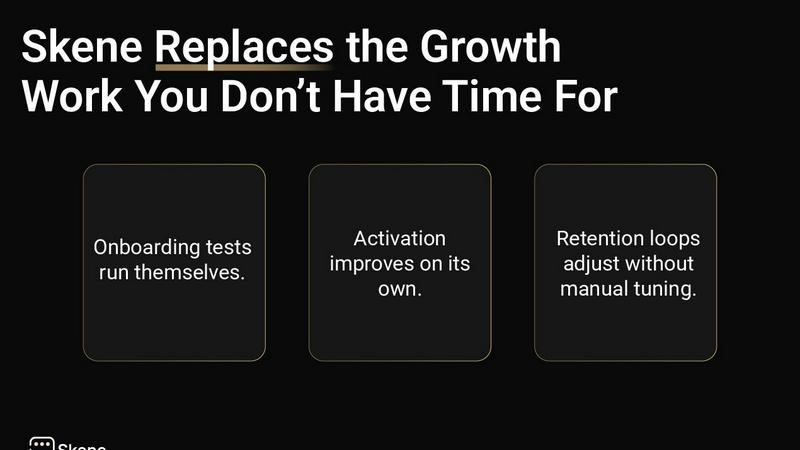
The platform acts as a self-learning engine that autonomously observes user behavior, identifies bottlenecks in journeys like onboarding, and implements data-driven optimizations. Skene can automatically generate, A/B test, and deploy improved versions of user flows, creating a continuous feedback loop for metrics such as activation and retention. This removes the manual burden of hypothesis testing and implementation, allowing the system to systematically improve conversion paths without constant developer intervention.
Prompt-Driven Growth Implementation
Growth workflows are managed through natural language prompts within your existing development environment, such as Cursor or a terminal. Developers can instruct Skene to analyze code, generate growth manifests, or implement specific optimizations using simple commands like uvx skene-growth analyze .. This shifts growth work from managing disparate SaaS dashboards to a programmable, code-first workflow that integrates seamlessly with modern development practices.
Owned Infrastructure & Performance
Skene replaces legacy stacks of third-party snippets and widgets with owned code that you control, version, and deploy. By eliminating external JavaScript bloat and siloed data pipelines, it preserves your application's core performance and security posture. This architecture ensures that growth tooling enhances rather than hinders site speed and user experience, while keeping all data and logic within your ecosystem.
Use Cases
OpenMark AI
Model Selection for AI Features
Developers can utilize OpenMark AI to select the most appropriate model for their AI-driven features by benchmarking performance on specific tasks. This ensures that the chosen model aligns with both performance goals and budget constraints.
Pre-Deployment Validation
Product teams can validate their model choices before deployment by testing outputs for consistency and quality. This capability reduces the risk associated with deploying a less effective model, ensuring a smoother transition from development to production.
Cost-Benefit Analysis
Businesses seeking to optimize their AI spending can leverage OpenMark AI to perform a detailed cost-benefit analysis. By comparing the actual costs of API calls with the outputs generated, organizations can identify the best value options.
Research and Development
Researchers can use OpenMark AI to experiment with various models for academic or product development purposes. The tool allows for thorough testing of hypotheses regarding model performance across different tasks and environments.
Skene
Automated Onboarding Flow Optimization
For product teams aiming to improve user activation, Skene automatically analyzes the onboarding journey within the code, identifies where users drop off, and deploys tailored improvements. It can test different guidance strategies, UI tweaks, or feature introductions to maximize the rate at which new users reach the "aha!" moment, all without engineering writing new code for each experiment.
Continuous Retention & Lifecycle Automation
Skene enables the creation of self-optimizing lifecycle campaigns based on actual user behavior derived from the product. It can detect signs of churn risk or feature underutilization and automatically trigger in-app messages, email sequences, or feature prompts to re-engage users, turning the product itself into the primary driver of customer retention and expansion.
Product-Led Customer Success
Customer success teams can leverage Skene's deep product integration to move beyond reactive support. The platform identifies users struggling with specific features or workflows and can proactively deliver contextual, in-app guidance or resources. This transforms the product into a scalable success tool, ensuring users derive value independently and reducing support ticket volume.
Data-Driven Feature Adoption Campaigns
For launching new features or increasing adoption of existing ones, Skene analyzes which user segments are not utilizing key functionality. It then automatically designs and targets in-product campaigns or tutorials to specific user cohorts, measuring impact on usage metrics and iterating on the messaging and placement to drive organic feature discovery and usage.
Overview
About OpenMark AI
OpenMark AI is an innovative web application designed specifically for task-level benchmarking of large language models (LLMs). It allows users to articulate their testing requirements in plain language, facilitating the benchmarking of over 100 AI models within a single session. By running identical prompts across multiple models, users can effectively compare key metrics such as cost per request, latency, scored quality, and stability, providing insights into the variance of model outputs rather than relying on potentially misleading singular results. This is particularly valuable for developers and product teams who need to evaluate or validate AI models before deploying features that incorporate artificial intelligence.
OpenMark AI eliminates the complexity of managing multiple API keys by using a credit system for hosted benchmarking, making it easier to conduct comprehensive comparisons without the need for extensive configuration. Users benefit from real-time results based on actual API calls rather than pre-cached marketing data, making the tool essential for those who prioritize cost efficiency and consistent performance over simply choosing the lowest-priced token option. The platform supports a wide array of models and is designed to assist teams in pre-deployment decisions, ensuring they select the most suitable model for their specific workflow while maintaining budget considerations. OpenMark AI offers both free and paid plans, providing flexibility according to user needs.
About Skene
Skene is an AI-powered, fully automated Product-Led Growth (PLG) infrastructure that fundamentally reimagines growth tooling by integrating directly with a product's codebase. It functions as a self-learning growth engine, eliminating the need for external scripts, siloed dashboards, and manual optimization. The platform operates by first analyzing a user's code to understand the product's structure and user flows. It then automatically observes user behavior to detect friction points and drop-offs in critical journeys like onboarding and activation. Using this intelligence, Skene autonomously creates, A/B tests, and deploys improved versions of these flows, continuously optimizing for key metrics like activation and retention without human intervention. Its core value proposition is turning growth into a programmable, owned layer of infrastructure rather than a collection of brittle third-party services. Primarily built for indie developers, early-stage startups, and established PLG companies, Skene serves as a "growth team in a box." It enables technical teams to scale their product's growth loops efficiently without adding headcount or sacrificing the technical control, performance, and data ownership intrinsic to their core product.
Frequently Asked Questions
OpenMark AI FAQ
What types of models can I benchmark with OpenMark AI?
OpenMark AI supports a wide variety of models from leading AI providers, including OpenAI, Anthropic, and Google, enabling users to benchmark over 100 different LLMs.
Do I need to manage multiple API keys to use OpenMark AI?
No, OpenMark AI streamlines the process by utilizing a credit system for hosted benchmarking, which means you do not need to configure separate API keys for each model comparison.
Is OpenMark AI suitable for non-technical users?
Yes, the user-friendly interface allows individuals without extensive technical knowledge to easily describe tasks and benchmark models, making it accessible to a broader audience.
What kind of results can I expect from OpenMark AI?
Users can expect detailed results that include cost per request, latency, scored quality, and stability metrics, allowing for a comprehensive evaluation of model performance based on real API calls.
Skene FAQ
What is PLG software?
PLG (Product-Led Growth) software is designed to help users discover value in a product without manual intervention from sales or customer success teams. It automates the user journey, guiding users to activation, driving feature adoption, and strengthening retention through the product experience itself. According to industry frameworks, effective PLG turns the product into the primary acquisition, conversion, and expansion channel.
How is Skene different from traditional customer experience software?
Traditional tools like walkthrough builders require manual tour creation, constant maintenance, and rely on brittle UI selectors that break with every code deploy. Skene is fundamentally different; it reads your codebase to understand your product's structure and automatically generates and maintains onboarding, analytics, and automation. When you push new code, Skene's understanding and implementations update themselves, eliminating maintenance overhead and selector fragility.
How long does it take to set up Skene?
Setup is designed to take less than 60 seconds. You simply connect your GitHub or GitLab repository with read-only access. Skene then automatically analyzes your codebase to generate an initial set of PLG flows and signals. No initial code changes, API modifications, or snippet installations are required to begin receiving insights and automation.
Is my source code secure with Skene?
Absolutely. Security is a core tenet of Skene's architecture. The platform only requires read-only access to your repository. All code analysis occurs in a secure, isolated environment. Your code is not used for training models, and the infrastructure is designed to ensure that your proprietary logic and data remain within your controlled ecosystem, aligning with enterprise security standards.
Alternatives
OpenMark AI Alternatives
OpenMark AI is a powerful web application designed for benchmarking over 100 large language models (LLMs) on various tasks, focusing on key metrics such as cost, speed, quality, and stability. This tool is particularly beneficial for developers and product teams seeking to make informed decisions about AI model selection before deploying features. Users often search for alternatives to OpenMark AI due to factors like pricing, specific feature sets, or platform compatibility that may better suit their unique project needs. When considering alternatives, it is essential to evaluate the specific functionalities offered, such as user interface design, supported models, and benchmarking capabilities. Additionally, users should assess the pricing structure, including free and paid plans, and the degree of support provided for integration and usage. Ultimately, finding the right tool hinges on identifying a solution that aligns with both project requirements and budget constraints.
Skene Alternatives
Skene is a code-native growth engine, representing a new category of fully automated Product-Led Growth (PLG) infrastructure. It integrates directly into an application's codebase to automate the analysis, testing, and optimization of user journeys like onboarding and activation, functioning as a self-learning system. Users may explore alternatives for several reasons. These include budget constraints, a need for more traditional marketing tools, or a preference for platforms with a visual, no-code interface rather than a code-native approach. The specific stage of a company, its technical resources, and its desired level of control over growth experiments are also key decision factors. When evaluating alternatives, consider the core methodology: code-native versus API-based or pixel-tracking solutions. Assess the depth of automation, from basic analytics to automated A/B testing and deployment. Security posture, integration requirements, and the ability to scale with your product's technical complexity are also critical dimensions for comparison.