OGimagen vs Skene
Side-by-side comparison to help you choose the right product.

OGImagen is an AI-powered tool that instantly generates and delivers optimized Open Graph images with ready-to-use meta tags for all major social.
Last updated: March 11, 2026

Skene is a code-native growth engine that automates product-led growth directly within your codebase.
Last updated: February 28, 2026
Visual Comparison
OGimagen
Skene
Feature Comparison
OGimagen
AI-Powered, Multi-Format Generation
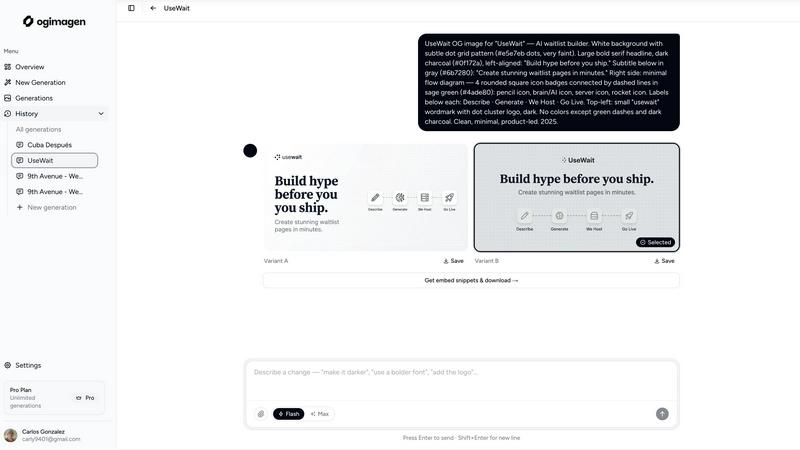
OGimagen's artificial intelligence engine simultaneously creates two visual variants (A & B) of your social card, each automatically optimized for the precise specifications of major platforms. With a single generation, it outputs three correctly sized formats: a 1200x630px OG image for Facebook and general use, a 1200x600px Twitter Card, and a 1200x627px LinkedIn Card. This ensures pixel-perfect presentation everywhere a link is shared, eliminating manual resizing and cropping errors that can degrade user experience and brand perception.
Framework-Specific Meta Tag Snippets
Beyond image creation, OGimagen provides ready-to-paste code snippets for embedding the generated images directly into your project's <head> section. It supports a wide range of modern frameworks, including Next.js (App Router and Pages Router), Astro, SvelteKit, and Remix. This feature drastically reduces implementation time and prevents common coding mistakes associated with manually writing Open Graph and Twitter Card meta tags, as outlined in the official documentation for these frameworks.
MCP (Model Context Protocol) Integration
A key feature for the Pro plan, MCP integration allows developers to generate and manage OG images without leaving their code editor. By connecting OGimagen to MCP-compatible tools like Claude Code, Cursor, or Windsurf, users can trigger image generation, list previous creations, and fetch embed snippets through direct editor commands. This seamlessly incorporates social preview asset creation into the existing development workflow, enhancing productivity.
Global CDN Hosting & Asset Management
All generated images are automatically hosted and delivered via the Cloudflare content delivery network (CDN), ensuring fast, reliable global access—a critical factor for social platform crawlers that generate previews. Plans include managed hosting durations (45-day, 90-day, or permanent), removing the burden of image storage and bandwidth management from the user's own infrastructure. This guarantees optimal deliverability and performance for social previews.
Skene
Codebase-Integrated Signal Detection
Skene derives growth signals directly from your application's source code, creating a context layer for AI-driven optimization. By analyzing the repository structure, it automatically identifies key user flows, components, and potential friction points without requiring manual tagging or external scripts. This deep integration ensures that growth instrumentation is version-controlled, performant, and never becomes a "black box" that breaks with deployments, providing a single source of truth for both your product and growth logic.
Autonomous Growth Loop Orchestration
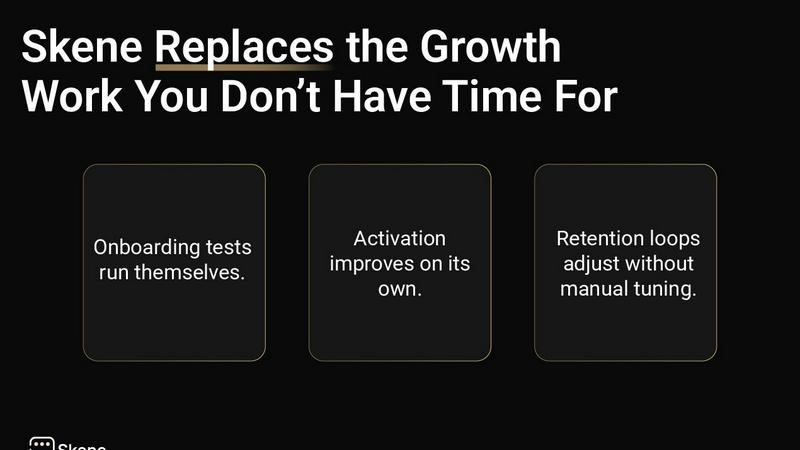
The platform acts as a self-learning engine that autonomously observes user behavior, identifies bottlenecks in journeys like onboarding, and implements data-driven optimizations. Skene can automatically generate, A/B test, and deploy improved versions of user flows, creating a continuous feedback loop for metrics such as activation and retention. This removes the manual burden of hypothesis testing and implementation, allowing the system to systematically improve conversion paths without constant developer intervention.
Prompt-Driven Growth Implementation
Growth workflows are managed through natural language prompts within your existing development environment, such as Cursor or a terminal. Developers can instruct Skene to analyze code, generate growth manifests, or implement specific optimizations using simple commands like uvx skene-growth analyze .. This shifts growth work from managing disparate SaaS dashboards to a programmable, code-first workflow that integrates seamlessly with modern development practices.
Owned Infrastructure & Performance
Skene replaces legacy stacks of third-party snippets and widgets with owned code that you control, version, and deploy. By eliminating external JavaScript bloat and siloed data pipelines, it preserves your application's core performance and security posture. This architecture ensures that growth tooling enhances rather than hinders site speed and user experience, while keeping all data and logic within your ecosystem.
Use Cases
OGimagen
Streamlining Developer Workflows
Developers building websites or applications can integrate OGimagen into their deployment or content publishing pipeline. By using the API or MCP integration, they can automatically generate unique social preview images for every blog post, product page, or documentation update, ensuring consistent branding and professional presentation without manual intervention for each new piece of content.
Enhancing Content Marketing Campaigns
Marketing teams and content creators can use OGimagen to rapidly produce multiple visually distinct OG image variants for A/B testing headlines or campaign messaging on social media. The ability to quickly generate branded, platform-optimized images allows for agile campaign adjustments and helps identify which visuals drive the highest engagement and CTR for shared articles, landing pages, or promotional content.
Agency and Freelancer Client Deliverables
Web design agencies and freelance developers can leverage OGimagen to provide added value to clients. By efficiently creating professional social preview images as a standard part of website delivery, they improve the client's overall social media presence and link-sharing effectiveness. The one-time purchase packs (Starter, Growth) are particularly cost-effective for project-based work.
Maintaining Brand Consistency for SaaS Platforms
Software-as-a-Service (SaaS) companies with user-generated content or dynamic pages (like user profiles, dashboards, or generated reports) can use OGimagen's API to ensure that any shareable link from their platform displays a branded, coherent preview image. This turns every user-shared link into a consistent brand touchpoint, strengthening market recognition.
Skene
Automated Onboarding Flow Optimization
For product teams aiming to improve user activation, Skene automatically analyzes the onboarding journey within the code, identifies where users drop off, and deploys tailored improvements. It can test different guidance strategies, UI tweaks, or feature introductions to maximize the rate at which new users reach the "aha!" moment, all without engineering writing new code for each experiment.
Continuous Retention & Lifecycle Automation
Skene enables the creation of self-optimizing lifecycle campaigns based on actual user behavior derived from the product. It can detect signs of churn risk or feature underutilization and automatically trigger in-app messages, email sequences, or feature prompts to re-engage users, turning the product itself into the primary driver of customer retention and expansion.
Product-Led Customer Success
Customer success teams can leverage Skene's deep product integration to move beyond reactive support. The platform identifies users struggling with specific features or workflows and can proactively deliver contextual, in-app guidance or resources. This transforms the product into a scalable success tool, ensuring users derive value independently and reducing support ticket volume.
Data-Driven Feature Adoption Campaigns
For launching new features or increasing adoption of existing ones, Skene analyzes which user segments are not utilizing key functionality. It then automatically designs and targets in-product campaigns or tutorials to specific user cohorts, measuring impact on usage metrics and iterating on the messaging and placement to drive organic feature discovery and usage.
Overview
About OGimagen
OGimagen is an AI-powered platform designed to generate production-ready Open Graph (OG) images and social card previews for websites and applications. It addresses a critical yet often overlooked aspect of web development and content marketing: ensuring shared links display compelling, professional preview images on social platforms like Facebook, X (Twitter), LinkedIn, WhatsApp, and Discord. Research consistently shows that links with optimized OG images achieve significantly higher click-through rates (CTRs). A study by BuzzSumo analyzing over 100 million articles found that content with effective preview images garners up to 150% more engagement. OGimagen eliminates the need for manual design work or complex image editing software, allowing developers, marketers, and content creators to generate platform-specific images and corresponding meta tag code snippets in seconds. Its core value proposition lies in simplifying a technical workflow into a three-step process, directly integrating into modern development environments via MCP (Model Context Protocol), and delivering optimized assets through a global CDN, ensuring fast load times and reliability.
About Skene
Skene is an AI-powered, fully automated Product-Led Growth (PLG) infrastructure that fundamentally reimagines growth tooling by integrating directly with a product's codebase. It functions as a self-learning growth engine, eliminating the need for external scripts, siloed dashboards, and manual optimization. The platform operates by first analyzing a user's code to understand the product's structure and user flows. It then automatically observes user behavior to detect friction points and drop-offs in critical journeys like onboarding and activation. Using this intelligence, Skene autonomously creates, A/B tests, and deploys improved versions of these flows, continuously optimizing for key metrics like activation and retention without human intervention. Its core value proposition is turning growth into a programmable, owned layer of infrastructure rather than a collection of brittle third-party services. Primarily built for indie developers, early-stage startups, and established PLG companies, Skene serves as a "growth team in a box." It enables technical teams to scale their product's growth loops efficiently without adding headcount or sacrificing the technical control, performance, and data ownership intrinsic to their core product.
Frequently Asked Questions
OGimagen FAQ
What exactly is an OG image?
An OG (Open Graph) image is the preview picture that appears when a website link is shared on social media platforms, messaging apps, or other services that support the Open Graph protocol. It is defined by specific HTML meta tags (like og:image) in your webpage's code. A compelling OG image is crucial as it acts as the primary visual anchor for your content in a crowded social feed, directly influencing whether users decide to click on the shared link.
How does AI generation work?
OGimagen's AI generation process analyzes the text inputs you provide—such as title, description, and selected style preset—to create relevant and aesthetically cohesive visual compositions. The system is trained to understand contextual relationships between words and visual concepts, generating two unique design variants that adhere to best practices for readability and visual hierarchy on social cards, all within the constrained dimensions required by each platform.
What is MCP integration?
MCP, or Model Context Protocol, is an open protocol that allows development tools (like code editors AI assistants) to connect securely to external services. OGimagen's MCP integration means you can interact with its image generation and management features directly from within compatible editors like Cursor or Claude Code using natural language or commands, without needing to switch to a web browser or separate application, streamlining the developer experience.
What happens when CDN hosting expires?
When the included CDN hosting period for your generated images expires (e.g., after 45 days on the Starter plan), the image files are removed from the OGimagen CDN. This will cause the social previews for those specific images to break, displaying a default error or missing image on social platforms. To maintain live links, users must upgrade their plan for longer hosting, purchase a new pack, or manually download and re-host the images on their own permanent storage before the expiry date.
Skene FAQ
What is PLG software?
PLG (Product-Led Growth) software is designed to help users discover value in a product without manual intervention from sales or customer success teams. It automates the user journey, guiding users to activation, driving feature adoption, and strengthening retention through the product experience itself. According to industry frameworks, effective PLG turns the product into the primary acquisition, conversion, and expansion channel.
How is Skene different from traditional customer experience software?
Traditional tools like walkthrough builders require manual tour creation, constant maintenance, and rely on brittle UI selectors that break with every code deploy. Skene is fundamentally different; it reads your codebase to understand your product's structure and automatically generates and maintains onboarding, analytics, and automation. When you push new code, Skene's understanding and implementations update themselves, eliminating maintenance overhead and selector fragility.
How long does it take to set up Skene?
Setup is designed to take less than 60 seconds. You simply connect your GitHub or GitLab repository with read-only access. Skene then automatically analyzes your codebase to generate an initial set of PLG flows and signals. No initial code changes, API modifications, or snippet installations are required to begin receiving insights and automation.
Is my source code secure with Skene?
Absolutely. Security is a core tenet of Skene's architecture. The platform only requires read-only access to your repository. All code analysis occurs in a secure, isolated environment. Your code is not used for training models, and the infrastructure is designed to ensure that your proprietary logic and data remain within your controlled ecosystem, aligning with enterprise security standards.
Alternatives
OGimagen Alternatives
OGimagen is an AI-powered developer tool designed to automate the creation of Open Graph images. These social preview images are critical for maximizing engagement when links are shared across platforms like Twitter, LinkedIn, and Facebook. As a specialized dev tool, it streamlines a traditionally manual design process into a code-friendly workflow. Users often seek alternatives to OGimagen for various practical reasons. Common drivers include budget constraints, as pricing models can vary significantly between services. Others may require specific integrations with their existing tech stack, more granular customization options, or different levels of hands-on control versus full automation that better suit their team's workflow and technical expertise. When evaluating an alternative, key considerations should include the tool's API reliability and documentation, the quality and flexibility of its image generation engine, and its compliance with the latest social platform specifications. Security practices for handling any input data and the overall total cost of ownership, factoring in developer time saved, are also paramount for a sustainable implementation.
Skene Alternatives
Skene is a code-native growth engine, representing a new category of fully automated Product-Led Growth (PLG) infrastructure. It integrates directly into an application's codebase to automate the analysis, testing, and optimization of user journeys like onboarding and activation, functioning as a self-learning system. Users may explore alternatives for several reasons. These include budget constraints, a need for more traditional marketing tools, or a preference for platforms with a visual, no-code interface rather than a code-native approach. The specific stage of a company, its technical resources, and its desired level of control over growth experiments are also key decision factors. When evaluating alternatives, consider the core methodology: code-native versus API-based or pixel-tracking solutions. Assess the depth of automation, from basic analytics to automated A/B testing and deployment. Security posture, integration requirements, and the ability to scale with your product's technical complexity are also critical dimensions for comparison.