documentorium vs Skene
Side-by-side comparison to help you choose the right product.

documentorium
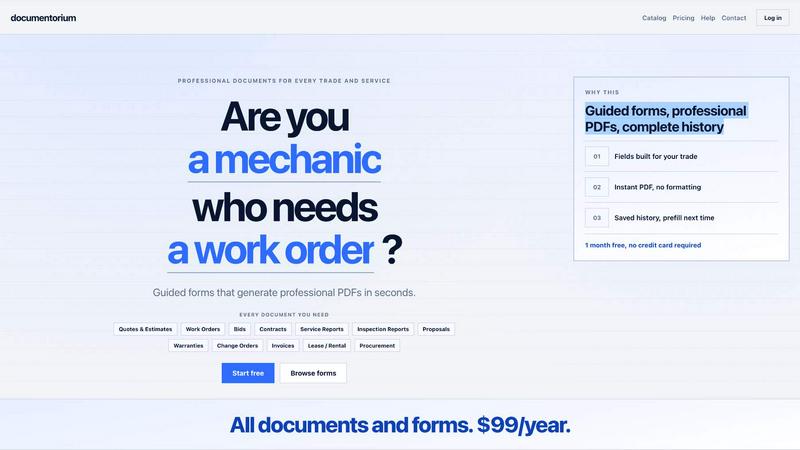
Documentorium generates professional contractor documents and PDFs using guided, trade-specific forms in seconds.
Last updated: March 26, 2026

Skene is a code-native growth engine that automates product-led growth directly within your codebase.
Last updated: February 28, 2026
Visual Comparison
documentorium
Skene
Feature Comparison
documentorium
Trade-Specific Template Library
documentorium offers a curated catalog of more than 200 guided templates meticulously designed for 26 distinct trade categories. Unlike generic office software, each template—be it for a quote, work order, service report, or warranty—contains fields and terminology specific to that trade. For an electrician, this means fields for circuit amperage and NEC code references; for an HVAC tech, it includes SEER ratings and refrigerant types. This specificity ensures completeness, accuracy, and professional relevance, removing the guesswork from document creation and significantly reducing errors of omission.
Guided Form Interface & Instant PDF Generation
The platform utilizes a simple, step-by-step guided form interface that prompts users to enter all required information systematically. This structured approach prevents users from overlooking critical details. Upon form completion, documentorium's engine instantly processes the data into a professionally formatted, print-ready PDF document. This process, which takes mere seconds, eliminates the manual labor of designing layouts, adjusting fonts, and ensuring consistent branding, delivering a client-ready document with zero formatting effort required by the user.
Complete Document History & Prefill Capability
Every document created is automatically saved to the user's secure account history, creating a searchable digital filing cabinet. This feature provides a complete audit trail for all jobs and client interactions. Furthermore, the system intelligently uses this historical data to prefill information on new forms. For repeat clients or similar jobs, details like client name, address, and standard service descriptions auto-populate, dramatically speeding up the creation of subsequent documents and ensuring consistency across all business communications.
All-Access, Flat-Rate Subscription Model
documentorium operates on a straightforward, transparent pricing model. A single annual subscription provides full, unrestricted access to the entire template library and all platform features. There are no tiered plans, per-document fees, or hidden costs. This predictable, all-inclusive pricing allows tradespeople to budget effectively and use the service for every document need without worrying about incremental charges, making it a cost-effective solution for businesses of all sizes within the trades.
Skene
Codebase-Integrated Signal Detection
Skene derives growth signals directly from your application's source code, creating a context layer for AI-driven optimization. By analyzing the repository structure, it automatically identifies key user flows, components, and potential friction points without requiring manual tagging or external scripts. This deep integration ensures that growth instrumentation is version-controlled, performant, and never becomes a "black box" that breaks with deployments, providing a single source of truth for both your product and growth logic.
Autonomous Growth Loop Orchestration
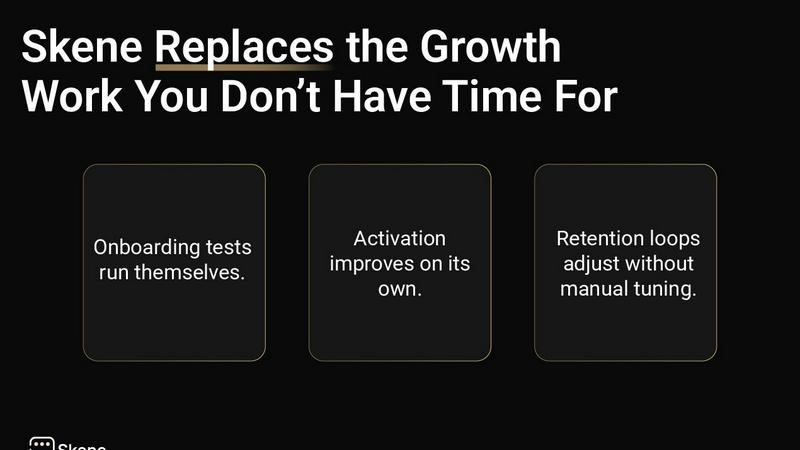
The platform acts as a self-learning engine that autonomously observes user behavior, identifies bottlenecks in journeys like onboarding, and implements data-driven optimizations. Skene can automatically generate, A/B test, and deploy improved versions of user flows, creating a continuous feedback loop for metrics such as activation and retention. This removes the manual burden of hypothesis testing and implementation, allowing the system to systematically improve conversion paths without constant developer intervention.
Prompt-Driven Growth Implementation
Growth workflows are managed through natural language prompts within your existing development environment, such as Cursor or a terminal. Developers can instruct Skene to analyze code, generate growth manifests, or implement specific optimizations using simple commands like uvx skene-growth analyze .. This shifts growth work from managing disparate SaaS dashboards to a programmable, code-first workflow that integrates seamlessly with modern development practices.
Owned Infrastructure & Performance
Skene replaces legacy stacks of third-party snippets and widgets with owned code that you control, version, and deploy. By eliminating external JavaScript bloat and siloed data pipelines, it preserves your application's core performance and security posture. This architecture ensures that growth tooling enhances rather than hinders site speed and user experience, while keeping all data and logic within your ecosystem.
Use Cases
documentorium
Creating a Detailed, Legally-Sound Service Contract
A general contractor securing a major home renovation project can use documentorium to generate a comprehensive contract. By selecting the appropriate contracting template, they are guided through including all critical clauses: payment schedules, scope of work details, change order procedures, material specifications, and warranty terms. This ensures the contract is thorough and protects both parties, projecting professionalism and reducing legal risk far more effectively than a handshake agreement or a self-drafted document.
Streamlining the Quote-to-Invoice Workflow for an HVAC Technician
An HVAC technician on a service call can use documentorium to create a detailed inspection report and quote on-site using a mobile device. After client approval, the same job data can be instantly converted into a formal work order. Once the repair is complete, the technician can generate the final invoice directly from the saved job record, ensuring all parts, labor, and previously agreed-upon rates are accurately transferred, creating a seamless, professional, and efficient customer journey from initial contact to payment.
Submitting a Competitive and Professional Bid for a Roofing Project
A roofing company bidding on a commercial project can utilize documentorium's bid templates to structure a compelling proposal. The guided form ensures inclusion of all necessary components: detailed material specifications (brand, type, warranty), labor breakdown, project timeline, safety compliance statements, and total cost summary. This results in a polished, complete bid that instills confidence in the potential client and competitively positions the roofer against others who may submit less formal or incomplete proposals.
Generating Compliance-Ready Inspection Reports for an Electrician
A licensed electrician completing a home electrical inspection for a real estate transaction can use a specialized inspection report template. The form will include all required checkpoints per common codes, spaces for detailed notes on each circuit and panel, and sections for photographic evidence. This allows for the rapid creation of a standardized, thorough report that meets regulatory and insurance requirements, demonstrating due diligence and expertise to clients and authorities alike.
Skene
Automated Onboarding Flow Optimization
For product teams aiming to improve user activation, Skene automatically analyzes the onboarding journey within the code, identifies where users drop off, and deploys tailored improvements. It can test different guidance strategies, UI tweaks, or feature introductions to maximize the rate at which new users reach the "aha!" moment, all without engineering writing new code for each experiment.
Continuous Retention & Lifecycle Automation
Skene enables the creation of self-optimizing lifecycle campaigns based on actual user behavior derived from the product. It can detect signs of churn risk or feature underutilization and automatically trigger in-app messages, email sequences, or feature prompts to re-engage users, turning the product itself into the primary driver of customer retention and expansion.
Product-Led Customer Success
Customer success teams can leverage Skene's deep product integration to move beyond reactive support. The platform identifies users struggling with specific features or workflows and can proactively deliver contextual, in-app guidance or resources. This transforms the product into a scalable success tool, ensuring users derive value independently and reducing support ticket volume.
Data-Driven Feature Adoption Campaigns
For launching new features or increasing adoption of existing ones, Skene analyzes which user segments are not utilizing key functionality. It then automatically designs and targets in-product campaigns or tutorials to specific user cohorts, measuring impact on usage metrics and iterating on the messaging and placement to drive organic feature discovery and usage.
Overview
About documentorium
documentorium is a specialized document automation platform engineered specifically for skilled trades and service professionals. It addresses a critical pain point in industries like electrical, plumbing, contracting, HVAC, roofing, and solar installation: the excessive time and effort required to create professional, job-specific business documents from scratch. The platform's core value proposition is replacing blank-page document creation with a streamlined, guided process. Users gain access to a comprehensive library of over 200 professionally crafted templates across 26 trade categories. These are not generic forms but are built with field-level specificity for each trade, ensuring all necessary technical and commercial details are captured correctly. By filling out a structured, intuitive form, a tradesperson can generate a clean, print-ready PDF document in seconds. This eliminates formatting headaches, reduces administrative overhead, and projects a polished, credible image to clients. documentorium functions as a centralized document engine, consolidating the entire workflow from quote to invoice, thereby enhancing operational efficiency and allowing professionals to focus more on their craft and less on paperwork.
About Skene
Skene is an AI-powered, fully automated Product-Led Growth (PLG) infrastructure that fundamentally reimagines growth tooling by integrating directly with a product's codebase. It functions as a self-learning growth engine, eliminating the need for external scripts, siloed dashboards, and manual optimization. The platform operates by first analyzing a user's code to understand the product's structure and user flows. It then automatically observes user behavior to detect friction points and drop-offs in critical journeys like onboarding and activation. Using this intelligence, Skene autonomously creates, A/B tests, and deploys improved versions of these flows, continuously optimizing for key metrics like activation and retention without human intervention. Its core value proposition is turning growth into a programmable, owned layer of infrastructure rather than a collection of brittle third-party services. Primarily built for indie developers, early-stage startups, and established PLG companies, Skene serves as a "growth team in a box." It enables technical teams to scale their product's growth loops efficiently without adding headcount or sacrificing the technical control, performance, and data ownership intrinsic to their core product.
Frequently Asked Questions
documentorium FAQ
Can I cancel my subscription at any time?
Yes, you retain full control over your subscription. You can cancel directly from your account settings at any time. Upon cancellation, your access to create new documents will remain active until the end of your current pre-paid billing period. There are no cancellation penalties, lock-in contracts, or hidden fees, ensuring flexibility for your business.
What happens to my data and documents when the free trial ends?
Your existing documents and data are preserved and remain accessible in your account history. When the trial expires, you retain the ability to view, download, and print all documents you created during the trial. To create or edit new documents, you will need to activate a paid subscription. No user data or document history is deleted after the trial period.
Do I lose access to my old documents if I don't subscribe after the trial?
No, you do not lose access to your documents. As noted in the platform's policies, your document history is maintained. You can log in to your account to view and download any documents you created during your active period. The subscription is required for the creation and editing of new documents, but your historical work remains yours to access.
Does documentorium provide legal advice for contracts or forms?
No. documentorium provides document automation tools and template frameworks designed for common trade scenarios. The platform and its templates are intended to facilitate the efficient generation of business documents and are not a substitute for professional legal advice. Users are responsible for ensuring that the documents they create meet their specific legal, regulatory, and contractual requirements.
Skene FAQ
What is PLG software?
PLG (Product-Led Growth) software is designed to help users discover value in a product without manual intervention from sales or customer success teams. It automates the user journey, guiding users to activation, driving feature adoption, and strengthening retention through the product experience itself. According to industry frameworks, effective PLG turns the product into the primary acquisition, conversion, and expansion channel.
How is Skene different from traditional customer experience software?
Traditional tools like walkthrough builders require manual tour creation, constant maintenance, and rely on brittle UI selectors that break with every code deploy. Skene is fundamentally different; it reads your codebase to understand your product's structure and automatically generates and maintains onboarding, analytics, and automation. When you push new code, Skene's understanding and implementations update themselves, eliminating maintenance overhead and selector fragility.
How long does it take to set up Skene?
Setup is designed to take less than 60 seconds. You simply connect your GitHub or GitLab repository with read-only access. Skene then automatically analyzes your codebase to generate an initial set of PLG flows and signals. No initial code changes, API modifications, or snippet installations are required to begin receiving insights and automation.
Is my source code secure with Skene?
Absolutely. Security is a core tenet of Skene's architecture. The platform only requires read-only access to your repository. All code analysis occurs in a secure, isolated environment. Your code is not used for training models, and the infrastructure is designed to ensure that your proprietary logic and data remain within your controlled ecosystem, aligning with enterprise security standards.
Alternatives
documentorium Alternatives
documentorium is a specialized document generation platform within the broader contractor management and productivity software category. It focuses on providing trade-specific templates for creating professional PDF documents like quotes, invoices, and work orders. Users may explore alternatives for various reasons, including budget constraints, the need for integrated features like scheduling or CRM, or a preference for different platforms such as mobile-first apps or comprehensive desktop suites. The search often stems from a need to find a tool that aligns perfectly with a business's specific workflow and growth stage. When evaluating alternatives, key considerations should include the depth of trade-specific content, the efficiency of the document creation process, output quality, and overall value. The ideal solution balances specialized functionality with ease of use, ensuring professionals spend less time on paperwork and more on their trade.
Skene Alternatives
Skene is a code-native growth engine, representing a new category of fully automated Product-Led Growth (PLG) infrastructure. It integrates directly into an application's codebase to automate the analysis, testing, and optimization of user journeys like onboarding and activation, functioning as a self-learning system. Users may explore alternatives for several reasons. These include budget constraints, a need for more traditional marketing tools, or a preference for platforms with a visual, no-code interface rather than a code-native approach. The specific stage of a company, its technical resources, and its desired level of control over growth experiments are also key decision factors. When evaluating alternatives, consider the core methodology: code-native versus API-based or pixel-tracking solutions. Assess the depth of automation, from basic analytics to automated A/B testing and deployment. Security posture, integration requirements, and the ability to scale with your product's technical complexity are also critical dimensions for comparison.