ScopeSnap vs Skene
Side-by-side comparison to help you choose the right product.

ScopeSnap
ScopeSnap transforms messy discovery notes into structured project scopes and polished proposals in minutes, streamlining freelance workflows.
Last updated: March 18, 2026

Skene is a code-native growth engine that automates product-led growth directly within your codebase.
Last updated: February 28, 2026
Visual Comparison
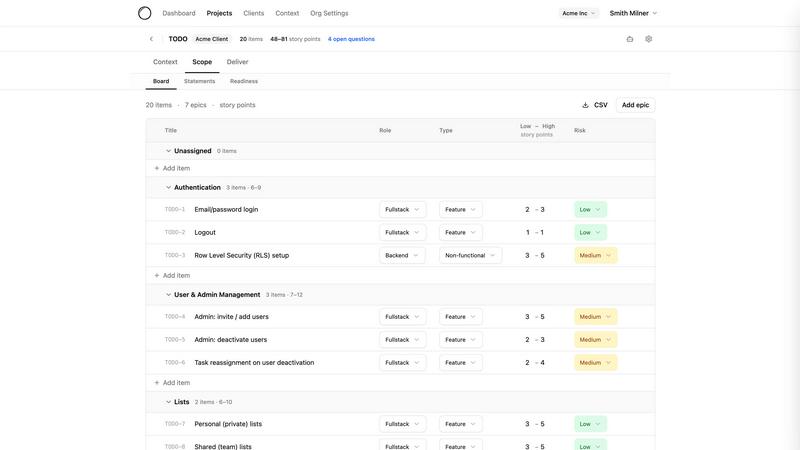
ScopeSnap
Skene
Feature Comparison
ScopeSnap
Intelligent Context Input
ScopeSnap allows users to easily input context by pasting in transcripts, emails, and notes from discovery conversations. This feature ensures that all relevant information is gathered in one place, providing a comprehensive foundation for project scoping.
AI-Driven Backlog Generation
Once the context is inputted, ScopeSnap leverages advanced AI to automatically generate epics and scope items. It surfaces open questions and flags assumptions, thus providing a structured backlog that highlights areas needing further clarification.
Collaborative Refinement and Estimation
Users can review the structured backlog, assign roles, set estimates, and resolve open questions within the platform. This collaborative feature encourages team involvement and ensures that all aspects of the project are thoroughly vetted before moving forward.
Automatic Proposal Generation
After refining the scope, ScopeSnap enables users to automatically generate a polished proposal or statement of work. This feature streamlines the process of delivering professional documentation to clients, enhancing the overall client experience and improving project clarity.
Skene
Codebase-Integrated Signal Detection
Skene derives growth signals directly from your application's source code, creating a context layer for AI-driven optimization. By analyzing the repository structure, it automatically identifies key user flows, components, and potential friction points without requiring manual tagging or external scripts. This deep integration ensures that growth instrumentation is version-controlled, performant, and never becomes a "black box" that breaks with deployments, providing a single source of truth for both your product and growth logic.
Autonomous Growth Loop Orchestration
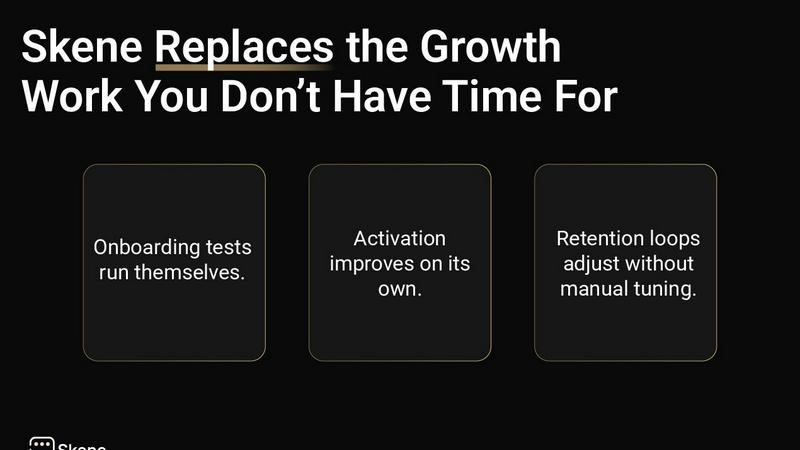
The platform acts as a self-learning engine that autonomously observes user behavior, identifies bottlenecks in journeys like onboarding, and implements data-driven optimizations. Skene can automatically generate, A/B test, and deploy improved versions of user flows, creating a continuous feedback loop for metrics such as activation and retention. This removes the manual burden of hypothesis testing and implementation, allowing the system to systematically improve conversion paths without constant developer intervention.
Prompt-Driven Growth Implementation
Growth workflows are managed through natural language prompts within your existing development environment, such as Cursor or a terminal. Developers can instruct Skene to analyze code, generate growth manifests, or implement specific optimizations using simple commands like uvx skene-growth analyze .. This shifts growth work from managing disparate SaaS dashboards to a programmable, code-first workflow that integrates seamlessly with modern development practices.
Owned Infrastructure & Performance
Skene replaces legacy stacks of third-party snippets and widgets with owned code that you control, version, and deploy. By eliminating external JavaScript bloat and siloed data pipelines, it preserves your application's core performance and security posture. This architecture ensures that growth tooling enhances rather than hinders site speed and user experience, while keeping all data and logic within your ecosystem.
Use Cases
ScopeSnap
Freelance Development
Freelance developers can utilize ScopeSnap to efficiently convert discovery call notes into structured project scopes. This not only saves time but also mitigates the risk of overlooking critical requirements, facilitating smoother project execution.
Software Agencies
Software agencies can leverage ScopeSnap to standardize their proposal generation process. By creating a consistent workflow for scoping and estimating projects, agencies can improve their operational efficiency and client satisfaction.
Client Consultations
During initial client consultations, ScopeSnap can assist in capturing and organizing thoughts and ideas. This structured approach allows developers to present clear and actionable project outlines, leading to better client engagement.
Project Management
Project managers can benefit from ScopeSnap by using it as a tool to refine project scopes and estimates collaboratively with their teams. This ensures that everyone is aligned on project objectives and deliverables, reducing the likelihood of scope creep.
Skene
Automated Onboarding Flow Optimization
For product teams aiming to improve user activation, Skene automatically analyzes the onboarding journey within the code, identifies where users drop off, and deploys tailored improvements. It can test different guidance strategies, UI tweaks, or feature introductions to maximize the rate at which new users reach the "aha!" moment, all without engineering writing new code for each experiment.
Continuous Retention & Lifecycle Automation
Skene enables the creation of self-optimizing lifecycle campaigns based on actual user behavior derived from the product. It can detect signs of churn risk or feature underutilization and automatically trigger in-app messages, email sequences, or feature prompts to re-engage users, turning the product itself into the primary driver of customer retention and expansion.
Product-Led Customer Success
Customer success teams can leverage Skene's deep product integration to move beyond reactive support. The platform identifies users struggling with specific features or workflows and can proactively deliver contextual, in-app guidance or resources. This transforms the product into a scalable success tool, ensuring users derive value independently and reducing support ticket volume.
Data-Driven Feature Adoption Campaigns
For launching new features or increasing adoption of existing ones, Skene analyzes which user segments are not utilizing key functionality. It then automatically designs and targets in-product campaigns or tutorials to specific user cohorts, measuring impact on usage metrics and iterating on the messaging and placement to drive organic feature discovery and usage.
Overview
About ScopeSnap
ScopeSnap is an innovative AI-driven tool designed to empower freelance developers and software agencies by transforming chaotic discovery notes into organized project scopes, precise estimates, and professional client-ready proposals. Estimating custom software projects is often a cumbersome process fraught with risks, including missed requirements and vague scopes that can lead to project overruns. ScopeSnap alleviates these challenges by facilitating a structured workflow that enables users to break down project ideas into clear, estimatable tasks. This iterative refinement process ensures every feature is meticulously understood and confidently priced. Once the scope is finalized, ScopeSnap seamlessly generates polished proposals or statements of work (SOW) that are ready to be sent to clients, saving time and enhancing professionalism in client interactions.
About Skene
Skene is an AI-powered, fully automated Product-Led Growth (PLG) infrastructure that fundamentally reimagines growth tooling by integrating directly with a product's codebase. It functions as a self-learning growth engine, eliminating the need for external scripts, siloed dashboards, and manual optimization. The platform operates by first analyzing a user's code to understand the product's structure and user flows. It then automatically observes user behavior to detect friction points and drop-offs in critical journeys like onboarding and activation. Using this intelligence, Skene autonomously creates, A/B tests, and deploys improved versions of these flows, continuously optimizing for key metrics like activation and retention without human intervention. Its core value proposition is turning growth into a programmable, owned layer of infrastructure rather than a collection of brittle third-party services. Primarily built for indie developers, early-stage startups, and established PLG companies, Skene serves as a "growth team in a box." It enables technical teams to scale their product's growth loops efficiently without adding headcount or sacrificing the technical control, performance, and data ownership intrinsic to their core product.
Frequently Asked Questions
ScopeSnap FAQ
What types of documents can ScopeSnap generate?
ScopeSnap can generate polished proposals and statements of work (SOW) based on the structured project scope created from discovery notes, making it easy to present to clients.
How does ScopeSnap ensure accuracy in project estimates?
By breaking down project ideas into clear, estimatable tasks and allowing for iterative refinement, ScopeSnap helps ensure that all requirements are understood and accurately estimated, minimizing the risk of missing critical components.
Is ScopeSnap suitable for both freelancers and larger software agencies?
Yes, ScopeSnap is designed to cater to both freelancers and software agencies, providing tools that enhance the scoping and estimating process regardless of project size or complexity.
Can ScopeSnap integrate with other project management tools?
While specific integrations may vary, ScopeSnap aims to provide a seamless experience for users, making it easier to incorporate the tool into existing workflows and project management systems. For the latest integration capabilities, users should check the ScopeSnap website.
Skene FAQ
What is PLG software?
PLG (Product-Led Growth) software is designed to help users discover value in a product without manual intervention from sales or customer success teams. It automates the user journey, guiding users to activation, driving feature adoption, and strengthening retention through the product experience itself. According to industry frameworks, effective PLG turns the product into the primary acquisition, conversion, and expansion channel.
How is Skene different from traditional customer experience software?
Traditional tools like walkthrough builders require manual tour creation, constant maintenance, and rely on brittle UI selectors that break with every code deploy. Skene is fundamentally different; it reads your codebase to understand your product's structure and automatically generates and maintains onboarding, analytics, and automation. When you push new code, Skene's understanding and implementations update themselves, eliminating maintenance overhead and selector fragility.
How long does it take to set up Skene?
Setup is designed to take less than 60 seconds. You simply connect your GitHub or GitLab repository with read-only access. Skene then automatically analyzes your codebase to generate an initial set of PLG flows and signals. No initial code changes, API modifications, or snippet installations are required to begin receiving insights and automation.
Is my source code secure with Skene?
Absolutely. Security is a core tenet of Skene's architecture. The platform only requires read-only access to your repository. All code analysis occurs in a secure, isolated environment. Your code is not used for training models, and the infrastructure is designed to ensure that your proprietary logic and data remain within your controlled ecosystem, aligning with enterprise security standards.
Alternatives
ScopeSnap Alternatives
ScopeSnap is an innovative tool designed to streamline project scoping and proposals for freelance developers and software agencies. By utilizing AI technology, it transforms messy discovery notes into structured project scopes and client-ready proposals, reducing the time and effort needed to estimate custom software projects. Users often seek alternatives to ScopeSnap due to various factors such as pricing, specific feature sets, or compatibility with their preferred platforms. When choosing an alternative, it is crucial to consider the software's ease of use, the depth of features offered, integration capabilities, and overall cost-effectiveness to ensure it meets your project's unique requirements.
Skene Alternatives
Skene is a code-native growth engine, representing a new category of fully automated Product-Led Growth (PLG) infrastructure. It integrates directly into an application's codebase to automate the analysis, testing, and optimization of user journeys like onboarding and activation, functioning as a self-learning system. Users may explore alternatives for several reasons. These include budget constraints, a need for more traditional marketing tools, or a preference for platforms with a visual, no-code interface rather than a code-native approach. The specific stage of a company, its technical resources, and its desired level of control over growth experiments are also key decision factors. When evaluating alternatives, consider the core methodology: code-native versus API-based or pixel-tracking solutions. Assess the depth of automation, from basic analytics to automated A/B testing and deployment. Security posture, integration requirements, and the ability to scale with your product's technical complexity are also critical dimensions for comparison.