OpenMark AI vs Prefactor
Side-by-side comparison to help you choose the right product.

OpenMark AI benchmarks over 100 LLMs on your specific tasks, delivering rapid insights into cost, speed, quality, and stability without setup.
Last updated: March 26, 2026

Prefactor
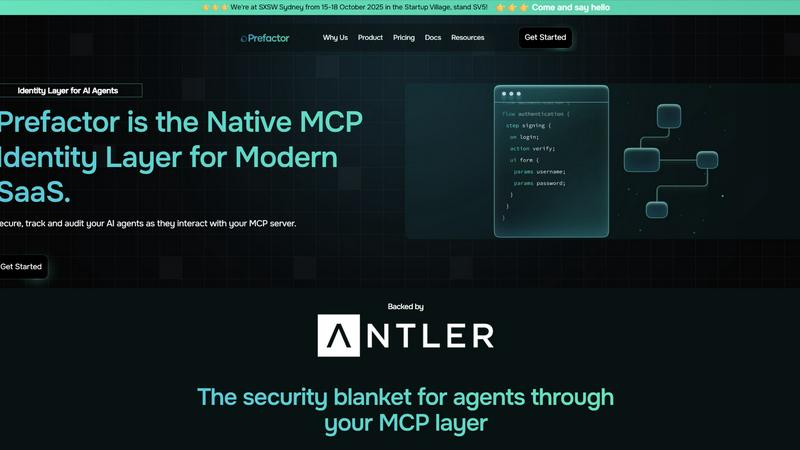
Prefactor is the essential control plane for governing AI agents at scale in regulated enterprises.
Last updated: March 1, 2026
Visual Comparison
OpenMark AI
Prefactor
Feature Comparison
OpenMark AI
User-Friendly Task Configuration
OpenMark AI features an intuitive task configuration interface that allows users to describe their benchmarking tasks in simple language. This accessibility ensures that even those without extensive technical knowledge can effectively set up their tests and receive meaningful results.
Comprehensive Model Comparison
The platform supports benchmarking against over 100 different AI models, enabling users to gain a comprehensive understanding of which models perform best for their specific tasks. This wide-ranging comparison helps teams make informed decisions based on real-world performance metrics.
Real-Time API Results
OpenMark AI provides side-by-side results of real API calls, ensuring that users receive accurate data reflective of actual performance. This real-time feedback is crucial for developers looking to understand how different models behave under similar conditions.
Cost Efficiency Analysis
One of the standout features of OpenMark AI is its ability to analyze the cost efficiency of different models. Users can see not only the quality of outputs but also how the costs compare against each model, enabling them to make financially sound decisions when selecting an AI solution.
Prefactor
Real-Time Agent Monitoring & Dashboard
Prefactor provides a centralized dashboard for complete operational visibility across your entire AI agent infrastructure. Platform teams can monitor all agents in one place, tracking which agents are active, idle, or failing in real-time. This allows organizations to see what resources agents are accessing and identify emerging issues before they cascade into production incidents, moving teams from a state of flying blind to having full command and control.
Compliance-Ready Audit Trails
The platform generates detailed audit logs that translate low-level technical agent actions into clear business context. Unlike cryptic API call logs, Prefactor's audit trails answer stakeholder and regulatory questions like "what did the agent do and why?" in understandable language. This enables the generation of audit-ready compliance reports in minutes, not weeks, ensuring audit trails can withstand rigorous regulatory scrutiny in industries like finance and healthcare.
Identity-First Access Control
Prefactor applies proven human identity governance principles to AI agents. Every agent is provisioned with a unique, first-class identity, and every action is authenticated. Through dynamic client registration and delegated access, the platform enables fine-grained role and attribute-based controls, ensuring each agent's permissions are explicitly scoped and managed, drastically reducing the risk of unauthorized access or actions.
Enterprise Safety & Cost Controls
Designed for production resilience, Prefactor includes critical enterprise controls such as emergency kill switches for immediate agent deactivation. Simultaneously, it provides cost-tracking capabilities across compute providers, helping organizations identify expensive agent behavior patterns and optimize spending. This combination of safety and financial governance is crucial for sustainable, large-scale agent deployment.
Use Cases
OpenMark AI
Model Selection for AI Features
Developers can utilize OpenMark AI to select the most appropriate model for their AI-driven features by benchmarking performance on specific tasks. This ensures that the chosen model aligns with both performance goals and budget constraints.
Pre-Deployment Validation
Product teams can validate their model choices before deployment by testing outputs for consistency and quality. This capability reduces the risk associated with deploying a less effective model, ensuring a smoother transition from development to production.
Cost-Benefit Analysis
Businesses seeking to optimize their AI spending can leverage OpenMark AI to perform a detailed cost-benefit analysis. By comparing the actual costs of API calls with the outputs generated, organizations can identify the best value options.
Research and Development
Researchers can use OpenMark AI to experiment with various models for academic or product development purposes. The tool allows for thorough testing of hypotheses regarding model performance across different tasks and environments.
Prefactor
Regulated Industry Deployment (Banking/Healthcare)
For Fortune 500 financial services or healthcare companies, Prefactor solves the primary compliance blocker to agent deployment. It provides the immutable audit trails, identity governance, and policy enforcement required to meet SOC 2, HIPAA, or financial regulatory standards. This allows Head of AI roles to gain the necessary internal approvals to move agents from restricted pilots to full, compliant production.
Managing Multi-Agent Pilots at Scale
Product and engineering teams running multiple, simultaneous AI agent proofs-of-concept (POCs) across different frameworks (like LangChain or CrewAI) use Prefactor to establish centralized governance. It prevents fragmentation, provides shared visibility across all pilots, and creates a standardized workflow for security review and promotion to production, aligning disparate teams around a single source of truth.
Operational Visibility for Platform Teams
Platform engineering leads burdened with questions about agent activity and performance deploy Prefactor to gain immediate, real-time answers. The control plane dashboard ends the opacity of agent operations, allowing teams to monitor health, track resource utilization, and quickly diagnose failures, thereby increasing operational reliability and reducing mean time to resolution (MTTR).
Cost Optimization for Agent Fleets
Organizations scaling to hundreds or thousands of agents use Prefactor's cost-tracking features to maintain financial control. By monitoring compute costs across providers and analyzing agent behavior patterns, finance and engineering teams can identify inefficiencies, right-size resources, and implement policies to prevent cost overruns, ensuring the economic viability of their AI agent initiatives.
Overview
About OpenMark AI
OpenMark AI is an innovative web application designed specifically for task-level benchmarking of large language models (LLMs). It allows users to articulate their testing requirements in plain language, facilitating the benchmarking of over 100 AI models within a single session. By running identical prompts across multiple models, users can effectively compare key metrics such as cost per request, latency, scored quality, and stability, providing insights into the variance of model outputs rather than relying on potentially misleading singular results. This is particularly valuable for developers and product teams who need to evaluate or validate AI models before deploying features that incorporate artificial intelligence.
OpenMark AI eliminates the complexity of managing multiple API keys by using a credit system for hosted benchmarking, making it easier to conduct comprehensive comparisons without the need for extensive configuration. Users benefit from real-time results based on actual API calls rather than pre-cached marketing data, making the tool essential for those who prioritize cost efficiency and consistent performance over simply choosing the lowest-priced token option. The platform supports a wide array of models and is designed to assist teams in pre-deployment decisions, ensuring they select the most suitable model for their specific workflow while maintaining budget considerations. OpenMark AI offers both free and paid plans, providing flexibility according to user needs.
About Prefactor
Prefactor is the enterprise-grade control plane specifically engineered for governing AI agents at scale in production environments. It addresses the critical governance gap that emerges when AI agents transition from proof-of-concept demos to full-scale deployment, particularly within regulated industries. The platform provides a centralized source of truth for agent identity, access, and activity, enabling security, product, engineering, and compliance teams to collaborate effectively. By granting every AI agent a first-class, auditable identity with fine-grained role and attribute-based access controls (RBAC/ABAC), Prefactor transforms complex, bespoke authentication processes into a streamlined and secure layer of trust. Its architecture supports policy-as-code for automated permissions management within CI/CD pipelines and offers full, real-time visibility over every agent action. Built with stringent compliance requirements in mind, Prefactor is SOC 2 compliant, incorporates human-delegated control mechanisms like emergency kill switches, and features interoperable OAuth/OIDC support. It is the essential infrastructure for organizations in banking, healthcare, mining, and financial services that need to deploy AI agents with confidence, auditability, and control.
Frequently Asked Questions
OpenMark AI FAQ
What types of models can I benchmark with OpenMark AI?
OpenMark AI supports a wide variety of models from leading AI providers, including OpenAI, Anthropic, and Google, enabling users to benchmark over 100 different LLMs.
Do I need to manage multiple API keys to use OpenMark AI?
No, OpenMark AI streamlines the process by utilizing a credit system for hosted benchmarking, which means you do not need to configure separate API keys for each model comparison.
Is OpenMark AI suitable for non-technical users?
Yes, the user-friendly interface allows individuals without extensive technical knowledge to easily describe tasks and benchmark models, making it accessible to a broader audience.
What kind of results can I expect from OpenMark AI?
Users can expect detailed results that include cost per request, latency, scored quality, and stability metrics, allowing for a comprehensive evaluation of model performance based on real API calls.
Prefactor FAQ
What is an AI Agent Control Plane?
An AI Agent Control Plane is a dedicated infrastructure layer for managing, securing, and observing autonomous AI agents in production. Analogous to a service mesh for microservices, it provides centralized governance for identity, access control, audit logging, and monitoring across a fleet of agents. Prefactor is built as this essential control plane, addressing the unique challenges of agent-scale security and compliance that traditional IAM tools cannot.
How does Prefactor handle compliance for regulated industries?
Prefactor is engineered from the ground up for regulated environments. It achieves SOC 2 compliance and provides features critical for auditors: business-context audit trails, immutable logs, fine-grained access controls, and human-in-the-loop oversight (like kill switches). These features translate agent actions into auditable events, enabling organizations in banking, healthcare, and mining to demonstrate due diligence and control to regulators.
Does Prefactor support the Model Context Protocol (MCP)?
Yes, Prefactor is designed with the evolving agent ecosystem in mind. The company recognizes MCP is becoming the default standard for agents to access tools and data. Prefactor's control plane provides the missing production-grade visibility and governance layer for MCP-based agents, ensuring that as teams adopt this protocol, they are not "flying blind" in production environments.
Can I integrate Prefactor with existing AI agent frameworks?
Absolutely. Prefactor is integration-ready and works seamlessly with popular agent frameworks including LangChain, CrewAI, and AutoGen, as well as custom-built agent systems. The platform is designed for deployment in hours, not months, allowing teams to add governance to existing agent workflows without a costly and time-consuming rebuild of their security and compliance infrastructure.
Alternatives
OpenMark AI Alternatives
OpenMark AI is a powerful web application designed for benchmarking over 100 large language models (LLMs) on various tasks, focusing on key metrics such as cost, speed, quality, and stability. This tool is particularly beneficial for developers and product teams seeking to make informed decisions about AI model selection before deploying features. Users often search for alternatives to OpenMark AI due to factors like pricing, specific feature sets, or platform compatibility that may better suit their unique project needs. When considering alternatives, it is essential to evaluate the specific functionalities offered, such as user interface design, supported models, and benchmarking capabilities. Additionally, users should assess the pricing structure, including free and paid plans, and the degree of support provided for integration and usage. Ultimately, finding the right tool hinges on identifying a solution that aligns with both project requirements and budget constraints.
Prefactor Alternatives
Prefactor is an AI agent governance platform, a specialized control plane designed to manage and secure autonomous AI agents at scale within regulated enterprises. Users often explore alternatives to solutions like Prefactor for several reasons, including budget constraints, specific feature requirements not fully met, or a need for a platform that integrates more seamlessly with their existing technology stack and development workflows. When evaluating alternatives in the AI governance and security category, key considerations should include the depth of real-time monitoring and audit capabilities, the flexibility of identity and access management frameworks, and the robustness of emergency control features like kill switches. It is also critical to assess the platform's compliance certifications, such as SOC 2, and its ability to provide clear, business-contextualized audit trails that satisfy regulatory scrutiny in industries like finance and healthcare. Ultimately, the choice depends on aligning the platform's capabilities with the organization's specific risk tolerance, operational scale, and compliance obligations. A thorough evaluation should prioritize solutions that offer transparent visibility, enforceable policy controls, and a secure foundation for deploying AI agents responsibly.