
LLMWise vs Project20x
Side-by-side comparison to help you choose the right product.

Access 62+ AI models seamlessly with LLMWise's smart auto-routing and pay only for what you use, with no subscriptions.
Last updated: February 27, 2026

Project20x
Project20x provides AI governance solutions for compliant and effective policy enforcement.
Last updated: March 4, 2026
Visual Comparison
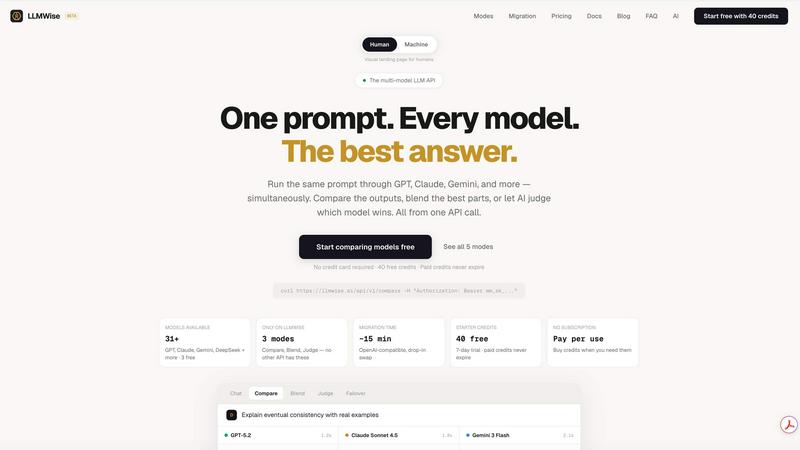
LLMWise
Project20x
Feature Comparison
LLMWise
Smart Routing
LLMWise employs intelligent routing to ensure that every prompt is sent to the most appropriate model based on the task at hand. For instance, coding-related queries are directed to GPT, while creative writing prompts are routed to Claude. This feature enhances the accuracy and relevance of AI responses, optimizing overall performance for developers.
Compare & Blend
This feature allows users to run prompts across multiple models simultaneously, providing side-by-side comparisons of their outputs. The blending functionality synthesizes the best parts of each response into a single, cohesive answer. This capability is instrumental for users seeking to leverage the strengths of different models for improved results.
Always Resilient
LLMWise includes a circuit-breaker failover system that automatically reroutes requests to backup models if a primary provider experiences downtime. This ensures that applications remain operational and responsive, preventing disruptions and maintaining a seamless user experience.
Test & Optimize
Developers can utilize benchmarking suites and batch tests to evaluate model performance based on speed, cost, and reliability. Additionally, LLMWise offers automated regression checks, allowing users to continuously optimize their AI integrations and ensure consistent quality in output.
Project20x
Governance Layer: AI-Powered Policy Analysis
This foundational layer employs a sophisticated ten-step AI methodology to assist lawmakers in the legislative drafting process. It analyzes proposed legislative texts for semantic clarity, logical consistency, and potential conflicts with existing statutes. By providing data-driven insights, it helps policymakers draft more precise, enforceable, and effective laws from the outset, reducing downstream interpretation errors and implementation friction, as supported by research on computational law and legal informatics.
Management Layer: Rules as Code Automation
The Management Layer is where approved policies are transformed into functional, machine-executable code. This "Rules as Code" approach encodes legislation and regulations directly into software logic, creating automated back-office workflows. This eliminates manual processing bottlenecks, ensures consistent application of rules, and dramatically increases operational efficiency for government agencies, allowing resources to be redirected toward complex cases requiring human judgment.
Interface Layer: Citizen-Facing AI Agents
Project20x deploys always-available AI agents to the public interface, trained exclusively on the codified rules from the Management Layer. These agents can guide citizens through complex procedures, such as applying for permits or benefits, answering eligibility questions, and submitting documentation. This provides a consistent, 24/7 point of access, reducing wait times and improving the citizen experience while ensuring all guidance is anchored in the official, up-to-date legal code.
End-to-End Transparency & Audit Framework
A core architectural principle of Project20x is baked-in transparency. Every automated decision, policy interaction, and workflow step is logged, creating a complete, immutable audit trail. This allows for full traceability from a citizen's inquiry back to the specific rule that governed the response, enabling quantifiable performance metrics and rigorous oversight. This framework is critical for maintaining public trust and accountability in automated government systems.
Use Cases
LLMWise
Software Development
Developers can leverage LLMWise to access the best models for coding tasks, utilizing smart routing to direct programming prompts to GPT. This significantly reduces debugging time and enhances code quality by providing tailored recommendations.
Content Creation
Writers and marketers can utilize the compare and blend feature to generate high-quality content. By running creative prompts through models like Claude and Gemini, users can create compelling narratives that combine the best elements from each model's output.
Language Translation
LLMWise supports translation tasks by routing queries to the most efficient model for linguistic conversion. This ensures accurate and contextually relevant translations, making it ideal for businesses operating in multilingual environments.
Research and Analysis
Researchers can benefit from LLMWise by comparing outputs from different models when analyzing data or generating insights. The ability to test multiple models concurrently allows for comprehensive evaluations, leading to more informed conclusions.
Project20x
Streamlining Social Benefit Applications
Government agencies can use Project20x to automate the entire lifecycle of benefit programs (e.g., SNAP, unemployment insurance). The AI agents interface with citizens to collect information and pre-fill applications, while the Rules as Code backend instantly verifies eligibility against codified regulations. This reduces processing times from weeks to minutes, minimizes errors, and ensures equitable access, allowing caseworkers to focus on applicants needing exceptional support.
Legislative Drafting and Impact Simulation
Lawmakers and legislative staff can utilize the Governance Layer as a collaborative drafting tool. The AI can simulate the downstream effects of proposed policy language, flagging unintended consequences or conflicts with existing laws. This enables evidence-based policymaking, improves the quality of legislation, and helps forecast administrative burdens and resource requirements before a bill is ever passed into law.
Automated Business Licensing and Permitting
Municipal and state governments can implement Project20x to manage business licenses, construction permits, and other regulatory approvals. The platform guides business owners through the requirements via the AI interface, automatically checks submissions against zoning, safety, and environmental codes, and routes applications to the correct departments. This creates a predictable, efficient environment for economic development.
Public Information and Compliance Assistance
Citizens and businesses often struggle to navigate complex regulatory obligations. Project20x's AI agents, acting as a single point of truth, can provide instant, accurate answers to questions about tax codes, environmental regulations, or housing standards. This proactive compliance assistance improves regulatory adherence, reduces inadvertent violations, and empowers the public with clear, accessible information.
Overview
About LLMWise
LLMWise is an advanced API solution designed to streamline access to multiple large language models (LLMs) from renowned providers like OpenAI, Anthropic, Google, Meta, xAI, and DeepSeek. It eliminates the hassle of managing various AI subscriptions by offering a single API interface that intelligently routes requests to the most suitable model for each task. Whether it is coding, creative writing, or translation, LLMWise optimizes performance by intelligently matching prompts to the best-suited AI model. This platform is particularly beneficial for developers seeking a flexible, efficient solution without the complications of managing multiple APIs or incurring high subscription costs. By harnessing the power of diverse LLMs, LLMWise enhances productivity, reduces operational complexity, and delivers superior results in AI-driven projects.
About Project20x
Project20x is a foundational AI-native platform engineered to transform the architecture and execution of modern governance. It addresses a critical systemic gap: the disconnect between high-level policy creation and its practical, equitable implementation for citizens. The platform serves a tripartite audience of government agencies, lawmakers, and the public, with a core value proposition of translating complex regulatory frameworks into transparent, actionable, and automated digital processes. This is achieved through its unique three-layer operational model. The Governance Layer assists policymakers in crafting clear, coherent, and conflict-free legislation using AI-driven analysis. The Management Layer then operationalizes this legislation by applying "Rules as Code" principles, converting legal text into executable software logic for automated workflows. Finally, the Interface Layer democratizes access by providing citizens with 24/7 interaction via AI agents trained on these codified rules, streamlining service delivery. By ensuring all processes are traceable, quantifiable, and under human oversight, Project20x establishes a new standard for governmental transparency, efficiency, and accountability, fundamentally bridging policy intent with public impact.
Frequently Asked Questions
LLMWise FAQ
What types of models can I access with LLMWise?
LLMWise provides access to over 62 models from 20 different providers, including well-known names like OpenAI, Google, and Meta. This diverse range allows users to select the best tool for their specific needs.
How does the pricing work for LLMWise?
LLMWise operates on a pay-per-use model, allowing users to pay only for the credits they consume. There are no subscriptions required, and users can also bring their own API keys for additional flexibility.
Is there a way to test LLMWise before committing?
Yes, LLMWise offers a free trial with 20 credits that never expire. Users can start testing the platform without needing to provide credit card information, making it easy to explore its capabilities risk-free.
What happens if a model I am using goes down?
LLMWise features a circuit-breaker failover mechanism that automatically reroutes requests to backup models if a primary model fails. This ensures that your applications remain functional and efficient, even during outages.
Project20x FAQ
How does Project20x ensure the AI does not make biased or incorrect decisions?
Project20x employs a "human-in-the-loop" governance model. The AI does not create policy; it operationalizes human-written legislation into code. All critical automated decisions are designed to be reviewable by human officials. Furthermore, the AI agents in the Interface Layer are constrained to respond only based on the codified rules, eliminating hallucination. The comprehensive audit trail allows any output to be traced back to its source rule for validation, ensuring accountability.
What is "Rules as Code" and how is it different from traditional IT implementation?
Traditional IT implementation involves software developers manually interpreting legal text to build systems, a process prone to misinterpretation and delay. "Rules as Code" (RaC) is a methodology where legislation is drafted and published in both human-language and machine-executable code simultaneously. Project20x's Management Layer specializes in this RaC approach, treating the law itself as the source code. This ensures the digital service is a direct, unambiguous reflection of the law, enabling precision, consistency, and easier updates when laws change.
Is citizen data secure on the Project20x platform?
Security and data sovereignty are paramount. Project20x is designed to meet the highest government security standards (such as FedRAMP requirements in the U.S.). Data encryption, strict access controls, and compliance with relevant data protection regulations (like GDPR for applicable jurisdictions) are foundational. The platform can be deployed in a government-controlled cloud or on-premise environment, ensuring that sensitive citizen data remains under strict governmental custody and control.
Can Project20x integrate with existing government legacy systems?
Yes, a key design consideration for Project20x is interoperability. The platform is built with API-first architecture, allowing its core engines—policy analysis, rules execution, and AI interface—to connect with existing case management systems, databases, and digital identity platforms. This enables a phased implementation strategy where Project20x can modernize specific processes or services without requiring a wholesale, disruptive replacement of all existing government IT infrastructure.
Alternatives
LLMWise Alternatives
LLMWise is an innovative platform that provides a single API for accessing a range of large language models (LLMs), including those from prominent providers like OpenAI, Anthropic, and Google. It simplifies the process for developers by offering intelligent routing to ensure that each prompt is handled by the most suitable model, thereby enhancing the quality and efficiency of AI interactions. As AI technology evolves, users often seek alternatives to address various needs such as cost-effectiveness, feature sets, or compatibility with specific platforms and applications. When exploring alternatives to LLMWise, it is crucial to consider criteria such as pricing structures, available features, and ease of integration. Users should look for solutions that not only meet their current requirements but also offer scalability and adaptability for future needs. This ensures that they can leverage the best AI technology without unnecessary complexity or limitations.
Project20x Alternatives
Project20x is an AI governance platform within the broader category of AI assistants and regulatory technology. It specializes in translating complex government policies into automated, accessible digital services through its unique three-layer architecture. Users exploring this space often seek alternatives for various practical reasons, including budget constraints, specific feature requirements not covered by a single platform, or the need for solutions tailored to different organizational scales or private-sector compliance needs. When evaluating alternatives to a specialized platform like Project20x, it is crucial to define your core requirements. Key considerations should include the solution's primary focus—whether on policy analysis, workflow automation, or public engagement—its approach to data security and auditability, and the level of human-in-the-loop oversight it provides. According to industry analyses from firms like Gartner, the most effective governance tools offer transparency in their AI decision-making processes and demonstrate clear compliance with relevant regulatory frameworks.