Image to 3D AI vs Project20x
Side-by-side comparison to help you choose the right product.

Image to 3D AI
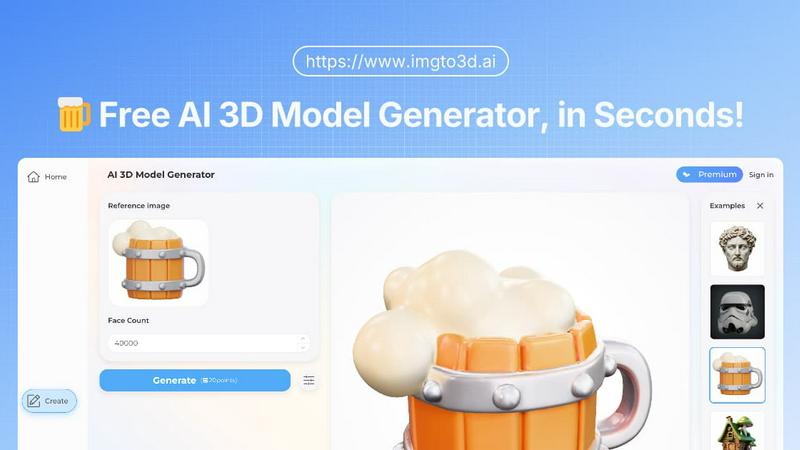
ImgTo3D.ai instantly converts any 2D image into a detailed 3D model for free, as noted by its 20,000 monthly users.
Last updated: March 1, 2026

Project20x
Project20x provides AI governance solutions for compliant and effective policy enforcement.
Last updated: March 4, 2026
Visual Comparison
Image to 3D AI
Project20x
Feature Comparison
Image to 3D AI
AI-Powered Textured Image-to-3D Conversion
This core feature utilizes advanced deep learning algorithms to instantly transform any uploaded 2D image into a detailed 3D model complete with projected textures. The AI interprets depth, geometry, and surface details from a single static image, a complex task that traditionally requires photogrammetry with multiple photos or manual modeling. Users can select from different generation modes like "Turbo" and "Ultra" to balance speed and detail, making professional-grade 3D asset creation accessible in seconds without any manual sculpting.
Adaptive Polygon Density Control
The platform provides users with critical control over the final model's complexity by allowing adjustment of the face count, with options ranging from 5K to 40K polygons. This adaptive mesh optimization ensures an optimal balance between visual fidelity and performance. For instance, a game developer can create a low-poly model for real-time rendering, while a 3D printing enthusiast can generate a high-detail model, all from the same source image, preserving critical details through intelligent algorithmic processing.
Multi-Format Export for Professional Workflows
Image to 3D AI supports exporting the generated models in industry-standard formats, including OBJ, GLB, and STL. This versatility ensures seamless integration into downstream professional pipelines. OBJ and GLB files are perfect for game engines, AR/VR applications, and animation software, while the STL format is optimized for direct use in 3D printing, making the platform a unified solution for both digital and physical 3D creation.
Zero-Barrier Free Tier with Instant Access
A foundational feature is the permanently free AI 3D model generator that requires no software installation, user sign-up, or credit card. This eliminates all initial barriers to entry, allowing anyone to experiment and create. The free tier meets the needs of most casual users and serves as a full-featured proof of concept, embodying the platform's mission to democratize 3D technology, though it may involve processing queues during peak hours to manage service quality.
Project20x
Governance Layer: AI-Powered Policy Analysis
This foundational layer employs a sophisticated ten-step AI methodology to assist lawmakers in the legislative drafting process. It analyzes proposed legislative texts for semantic clarity, logical consistency, and potential conflicts with existing statutes. By providing data-driven insights, it helps policymakers draft more precise, enforceable, and effective laws from the outset, reducing downstream interpretation errors and implementation friction, as supported by research on computational law and legal informatics.
Management Layer: Rules as Code Automation
The Management Layer is where approved policies are transformed into functional, machine-executable code. This "Rules as Code" approach encodes legislation and regulations directly into software logic, creating automated back-office workflows. This eliminates manual processing bottlenecks, ensures consistent application of rules, and dramatically increases operational efficiency for government agencies, allowing resources to be redirected toward complex cases requiring human judgment.
Interface Layer: Citizen-Facing AI Agents
Project20x deploys always-available AI agents to the public interface, trained exclusively on the codified rules from the Management Layer. These agents can guide citizens through complex procedures, such as applying for permits or benefits, answering eligibility questions, and submitting documentation. This provides a consistent, 24/7 point of access, reducing wait times and improving the citizen experience while ensuring all guidance is anchored in the official, up-to-date legal code.
End-to-End Transparency & Audit Framework
A core architectural principle of Project20x is baked-in transparency. Every automated decision, policy interaction, and workflow step is logged, creating a complete, immutable audit trail. This allows for full traceability from a citizen's inquiry back to the specific rule that governed the response, enabling quantifiable performance metrics and rigorous oversight. This framework is critical for maintaining public trust and accountability in automated government systems.
Use Cases
Image to 3D AI
Rapid Prototyping in Game Development
Indie game studios and developers use the platform to rapidly generate characters, environmental props, and assets in minutes instead of days. The ability to control polygon density is crucial, allowing for the creation of optimized, game-ready models that integrate directly into engines like Unity or Unreal Engine. This accelerates iteration cycles, slashing pre-production time and enabling small teams to compete with larger studios by focusing resources on gameplay and design rather than asset modeling.
Accessible 3D Printing and Product Design
Hobbyists, educators, and startup founders leverage the tool to convert photographs or sketches into printable 3D models. Users can create custom figurines, replacement parts, or artistic sculptures. The export in STL format ensures compatibility with most slicing software and 3D printers. This use case is particularly valuable for fields like heritage preservation, where photographs of objects or monuments can be transformed into physical replicas without expensive 3D scanning equipment.
Efficient Asset Creation for XR/VR/AR
Producers of virtual reality, augmented reality, and metaverse experiences require a high volume of optimized 3D assets that perform well in resource-constrained environments. This platform allows for the quick population of virtual worlds with textured models. The generated assets maintain visual quality while adhering to strict polygon budgets, which is essential for maintaining high frame rates and a smooth, immersive user experience in real-time applications.
Enhanced Creative Portfolio Development
Artists, graphic designers, and architects use Image to 3D AI to rapidly visualize concepts and expand their creative portfolios. A hand-drawn sketch or a concept art piece can be turned into a presentable 3D model in seconds, allowing creatives to demonstrate their ideas in a more tangible and impressive format without needing to invest weeks in learning complex 3D modeling software, thereby showcasing their vision rather than their technical modeling skills.
Project20x
Streamlining Social Benefit Applications
Government agencies can use Project20x to automate the entire lifecycle of benefit programs (e.g., SNAP, unemployment insurance). The AI agents interface with citizens to collect information and pre-fill applications, while the Rules as Code backend instantly verifies eligibility against codified regulations. This reduces processing times from weeks to minutes, minimizes errors, and ensures equitable access, allowing caseworkers to focus on applicants needing exceptional support.
Legislative Drafting and Impact Simulation
Lawmakers and legislative staff can utilize the Governance Layer as a collaborative drafting tool. The AI can simulate the downstream effects of proposed policy language, flagging unintended consequences or conflicts with existing laws. This enables evidence-based policymaking, improves the quality of legislation, and helps forecast administrative burdens and resource requirements before a bill is ever passed into law.
Automated Business Licensing and Permitting
Municipal and state governments can implement Project20x to manage business licenses, construction permits, and other regulatory approvals. The platform guides business owners through the requirements via the AI interface, automatically checks submissions against zoning, safety, and environmental codes, and routes applications to the correct departments. This creates a predictable, efficient environment for economic development.
Public Information and Compliance Assistance
Citizens and businesses often struggle to navigate complex regulatory obligations. Project20x's AI agents, acting as a single point of truth, can provide instant, accurate answers to questions about tax codes, environmental regulations, or housing standards. This proactive compliance assistance improves regulatory adherence, reduces inadvertent violations, and empowers the public with clear, accessible information.
Overview
About Image to 3D AI
Image to 3D AI, powered by ImgTo3D.ai, is a transformative artificial intelligence platform that automates the conversion of two-dimensional images into fully realized three-dimensional models. This technology addresses a significant bottleneck in digital content creation, where traditional 3D modeling requires extensive manual effort, specialized software expertise, and considerable time investment, often taking skilled artists hours or days per asset. By leveraging cutting-edge deep learning algorithms, the platform can process a single input—be it a photograph, digital artwork, or hand-drawn sketch—and generate a textured 3D model with geometry in a matter of seconds. This process democratizes 3D content creation, making it accessible to a broad audience beyond professional 3D artists. The primary value proposition lies in its unprecedented speed and accessibility, offering a zero-cost entry point with a free tier while enabling professional-grade output. According to platform statistics, this approach can reduce prototyping costs by up to 90% and accelerate asset creation workflows by 8x for independent studios. It is engineered for a diverse user base, including indie game developers, 3D printing enthusiasts, e-commerce managers, and XR/VR producers, serving as a strategic tool for rapid iteration and production in today's fast-paced digital economy.
About Project20x
Project20x is a foundational AI-native platform engineered to transform the architecture and execution of modern governance. It addresses a critical systemic gap: the disconnect between high-level policy creation and its practical, equitable implementation for citizens. The platform serves a tripartite audience of government agencies, lawmakers, and the public, with a core value proposition of translating complex regulatory frameworks into transparent, actionable, and automated digital processes. This is achieved through its unique three-layer operational model. The Governance Layer assists policymakers in crafting clear, coherent, and conflict-free legislation using AI-driven analysis. The Management Layer then operationalizes this legislation by applying "Rules as Code" principles, converting legal text into executable software logic for automated workflows. Finally, the Interface Layer democratizes access by providing citizens with 24/7 interaction via AI agents trained on these codified rules, streamlining service delivery. By ensuring all processes are traceable, quantifiable, and under human oversight, Project20x establishes a new standard for governmental transparency, efficiency, and accountability, fundamentally bridging policy intent with public impact.
Frequently Asked Questions
Image to 3D AI FAQ
What kind of images work best with the AI 3D Model Generator?
For optimal results, upload clear, well-lit images featuring a single object against a relatively uncluttered background. The AI algorithm is trained to interpret depth and form from visual cues, so high-contrast photos with distinct edges and good lighting yield the most accurate 3D geometry. Simple sketches with defined outlines also work effectively. Avoid overly busy backgrounds or images with multiple overlapping objects, as this can confuse the depth perception algorithm.
What are the main differences between the Free and Pro tiers?
The free tier offers full access to the core AI generation technology with polygon control and OBJ export, but users may experience processing queues during peak traffic. The Pro tier, or "Pro Access," provides priority processing with no queues, higher generation limits, and the ability to export in multiple formats including GLB and STL. Pro users also gain access to advanced features for textured models, making it suitable for professional, high-volume production workflows.
How does the polygon density (face count) setting affect my model?
The polygon density, or face count, directly determines the level of detail and the file size of your 3D model. A lower count (e.g., 5K faces) creates a lighter, more performance-optimized model ideal for real-time applications like video games or VR. A higher count (e.g., 40K faces) captures finer details and smoother curves, which is better for close-up renders, high-quality visuals, or 3D printing where detail is paramount. The AI adaptively optimizes the mesh to preserve critical details at any chosen setting.
Are the generated 3D models ready for commercial use?
Yes, models generated using Image to 3D AI are typically free for personal and commercial use. However, it is the user's responsibility to ensure they have the necessary rights or licenses to the original 2D image source they are uploading. The platform grants you the rights to the 3D model derived from your input, but you must own or have permission to use the underlying image, especially for commercial projects, to avoid copyright infringement.
Project20x FAQ
How does Project20x ensure the AI does not make biased or incorrect decisions?
Project20x employs a "human-in-the-loop" governance model. The AI does not create policy; it operationalizes human-written legislation into code. All critical automated decisions are designed to be reviewable by human officials. Furthermore, the AI agents in the Interface Layer are constrained to respond only based on the codified rules, eliminating hallucination. The comprehensive audit trail allows any output to be traced back to its source rule for validation, ensuring accountability.
What is "Rules as Code" and how is it different from traditional IT implementation?
Traditional IT implementation involves software developers manually interpreting legal text to build systems, a process prone to misinterpretation and delay. "Rules as Code" (RaC) is a methodology where legislation is drafted and published in both human-language and machine-executable code simultaneously. Project20x's Management Layer specializes in this RaC approach, treating the law itself as the source code. This ensures the digital service is a direct, unambiguous reflection of the law, enabling precision, consistency, and easier updates when laws change.
Is citizen data secure on the Project20x platform?
Security and data sovereignty are paramount. Project20x is designed to meet the highest government security standards (such as FedRAMP requirements in the U.S.). Data encryption, strict access controls, and compliance with relevant data protection regulations (like GDPR for applicable jurisdictions) are foundational. The platform can be deployed in a government-controlled cloud or on-premise environment, ensuring that sensitive citizen data remains under strict governmental custody and control.
Can Project20x integrate with existing government legacy systems?
Yes, a key design consideration for Project20x is interoperability. The platform is built with API-first architecture, allowing its core engines—policy analysis, rules execution, and AI interface—to connect with existing case management systems, databases, and digital identity platforms. This enables a phased implementation strategy where Project20x can modernize specific processes or services without requiring a wholesale, disruptive replacement of all existing government IT infrastructure.
Alternatives
Image to 3D AI Alternatives
Image to 3D AI is a specialized AI assistant that automates the conversion of 2D images into textured 3D models. This category of software, often termed AI-powered 3D generation, uses deep learning to interpret depth and form from a single photograph or sketch, drastically reducing the time and skill required for traditional 3D modeling. Users may seek alternatives for various practical reasons. These include budget constraints beyond a free tier, specific feature requirements like different export formats or integration with other software, or the need for a platform that operates on a different device or operating system. The intended use case, such as game development versus 3D printing, also heavily influences the search for a more tailored solution. When evaluating alternatives, key considerations should include the core AI's accuracy and output quality, the level of user control over the generated mesh and textures, supported file formats for export, and the overall cost structure. It is also prudent to assess the tool's performance with your specific types of input images and its ability to integrate into your existing digital content pipeline.
Project20x Alternatives
Project20x is an AI governance platform within the broader category of AI assistants and regulatory technology. It specializes in translating complex government policies into automated, accessible digital services through its unique three-layer architecture. Users exploring this space often seek alternatives for various practical reasons, including budget constraints, specific feature requirements not covered by a single platform, or the need for solutions tailored to different organizational scales or private-sector compliance needs. When evaluating alternatives to a specialized platform like Project20x, it is crucial to define your core requirements. Key considerations should include the solution's primary focus—whether on policy analysis, workflow automation, or public engagement—its approach to data security and auditability, and the level of human-in-the-loop oversight it provides. According to industry analyses from firms like Gartner, the most effective governance tools offer transparency in their AI decision-making processes and demonstrate clear compliance with relevant regulatory frameworks.