Fusedash vs iGPT
Side-by-side comparison to help you choose the right product.

Fusedash is an AI-powered platform that transforms raw data into actionable dashboards and charts for instant team.
Last updated: March 4, 2026

iGPT is an enterprise API that transforms email data into secure, contextual insights for agents.
Last updated: March 1, 2026
Visual Comparison
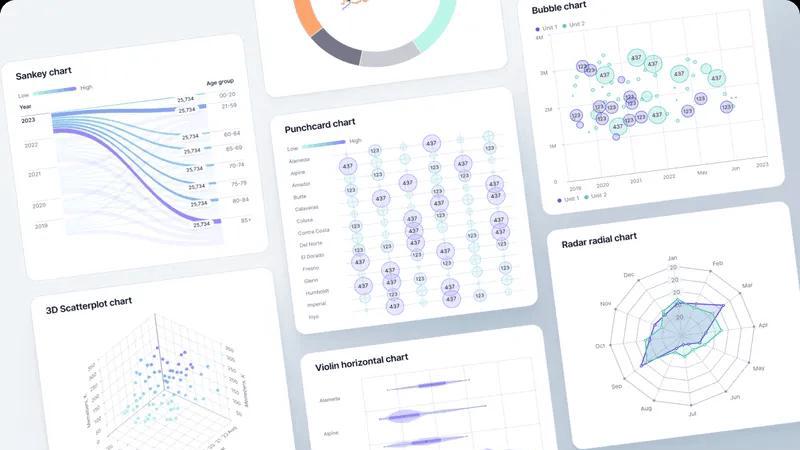
Fusedash
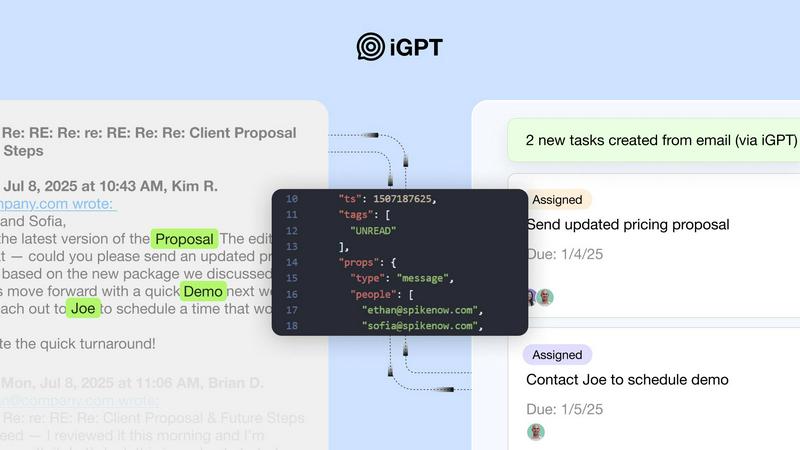
iGPT
Feature Comparison
Fusedash
Unified AI-Powered Workspace
Fusedash consolidates the entire data visualization workflow into a single platform, eliminating the need to juggle multiple tools. Users can create decision-ready dashboards, interactive charts, detailed geospatial maps, and narrative reports all from the same connected dataset. This integrated approach, which combines visualization, storytelling, and real-time monitoring, significantly reduces the time spent on rebuilding and reconciling reports across different systems, allowing teams to focus on deriving and acting on insights.
AI Chart Generator
This feature accelerates the initial stages of data analysis by enabling users to generate clear, appropriate charts from CSV files or connected APIs in minutes. The AI assists in selecting the optimal chart type, applying relevant comparisons, and refining labels to ensure the visual accurately tells the data's story. These AI-generated charts can be used as standalone visuals for quick reports or seamlessly dropped into comprehensive dashboards, promoting reusability and consistency.
Consistent Metric Definitions & Governance
A foundational feature of Fusedash is the ability to define core metrics, dimensions, and KPIs in a centralized manner. Once established, these definitions are automatically applied and reused across every view, dashboard, and report built on the platform. This enforced consistency is critical for data integrity, ensuring all stakeholders across departments are analyzing and making decisions based on the same trusted numbers, thereby eliminating conflicting data stories.
Smart AI Chat for Data Exploration
Fusedash incorporates a natural language interface that allows users to interact with their data conversationally. Users can ask questions in plain language, request specific breakdowns by segment or region, and receive AI-suggested metrics and chart types. This feature lowers the barrier to entry for data exploration and can instantly turn conversational insights into shareable, persistent dashboard views, streamlining the path from question to actionable visual.
iGPT
Unified Intelligence Endpoint
iGPT consolidates the entire process of email intelligence into a single API call. This eliminates the need for developers to build and maintain separate systems for retrieval, context shaping, and reasoning, a common challenge noted in complex RAG implementations. A user simply submits a natural language query, and the API handles deep indexing, hybrid retrieval, and optimized context preparation automatically, returning a structured response with citations in approximately 3 seconds to the first token.
Deep Contextual Understanding & Thread Reconstruction
The API goes beyond simple keyword matching by semantically understanding email content and its relational context. It automatically reconstructs fragmented email threads across time, participants, and related attachments, rebuilding the complete narrative of a conversation. This capability is crucial for accurate understanding, as critical information is often distributed across multiple messages and replies, a nuance that standard search fails to capture.
Advanced Attachment Processing
iGPT extracts and indexes text, data, and structural information from a wide array of attachments, including documents, PDFs, and spreadsheets. This processing is performed in the context of the surrounding email thread and its participants, allowing the system to answer questions about contract clauses, invoice details, or report figures as they were discussed, turning static files into queryable knowledge assets.
Enterprise-Grade Security & Compliance Framework
Built for regulated industries, iGPT enforces a strict security model. It guarantees zero data training or retention, with all inferences processed in memory. Access is controlled via OAuth-only processing with Role-Based Access Control (RBAC), and every response includes a full audit trail, linking answers directly to source messages. This ensures data sovereignty and compliance with stringent data protection standards.
Use Cases
Fusedash
Executive & Leadership Reporting
Leadership teams require a high-level, consistent view of organizational health. Fusedash enables the creation of executive dashboards that combine real-time KPI monitoring with narrative "storytelling" sections. This provides context on what changed, why it matters, and what the next steps are, ensuring all leaders are aligned on performance and strategy without sifting through conflicting reports from different departments.
Marketing Performance Analysis
Marketing teams can use Fusedash to unify data from various channels (social media APIs, ad platforms, CRM systems) into a single dashboard. They can track campaign KPIs, use the AI chart generator for rapid analysis of A/B test results, and employ geospatial maps to visualize regional performance. The consistent definitions ensure that metrics like CAC (Customer Acquisition Cost) or ROAS (Return on Ad Spend) are calculated uniformly across all reports.
Operational & Real-Time Monitoring
Operations and support teams need live visibility into key processes. Fusedash's real-time interface allows for the creation of monitoring dashboards that track live metrics, such as website uptime, customer support ticket volume, or production line output. Teams can set alerts and drill down into specific time periods or segments to diagnose issues as they occur, moving from passive observation to proactive management.
Cross-Departmental Data Democratization
Organizations seeking to foster a data-driven culture can deploy Fusedash as a shared platform. Different teams—sales, finance, product—can build their own tailored views (dashboards, charts, reports) from the same governed dataset. The AI chat feature empowers non-analyst employees to ask their own data questions, reducing the bottleneck on data specialists and enabling faster, more widespread insight discovery.
iGPT
Intelligent Email Assistants & Copilots
Organizations can build AI agents that draft, prioritize, summarize, and act on email with full historical and contextual awareness. For support teams, this means a copilot that can instantly reconstruct a customer's entire issue history across long email chains and attachments, enabling faster, more informed responses and reducing handle times significantly.
Automated Workflow & Task Orchestration
iGPT automates the extraction of actionable items from communication streams. It can automatically parse email threads to identify decisions, action items, owners, and deadlines, then feed this structured data into project management tools like Asana or Jira. This transforms unstructured conversations into tracked tasks and approvals, flagging stalled items for follow-up.
CRM Enrichment & Deal Intelligence
Sales and account management teams can use iGPT to extract critical deal momentum, customer sentiment, and decision rationale directly from email exchanges. The API can summarize key points from lengthy negotiation threads or identify all pending approvals mentioned in communications with a client, providing real-time insights that keep CRM data accurate and actionable.
Compliance Auditing & Legal Discovery
For legal, finance, and compliance departments, iGPT provides a powerful tool for tracing feedback, approvals, and contractual agreements back to their original source emails and attachments. This creates a verifiable audit trail, streamlining internal reviews, e-discovery processes, and ensuring that corporate decisions are fully documented and easily retrievable.
Overview
About Fusedash
Fusedash is an AI-powered data visualization and business intelligence platform engineered to eliminate data silos and reporting inconsistencies within modern organizations. It functions as a unified workspace where teams can transform raw, connected data from disparate sources into clear, interactive, and actionable insights. The platform is specifically designed for teams burdened by manual reporting cycles, conflicting data narratives, and the inefficiency of rebuilding the same analytical logic across multiple, disconnected tools like spreadsheets, standalone BI software, and presentation decks. Its core value proposition, as supported by industry research on data-driven decision-making, is the establishment of a single source of truth. By allowing users to define key metrics and KPIs once, Fusedash ensures these consistent definitions are reused across every dashboard, chart, map, and narrative report. This governance model not only accelerates report creation but also guarantees alignment across the organization—from executive leadership to marketing and operations teams. Furthermore, Fusedash integrates advanced AI capabilities, including natural language data chat and smart visualization assistance, to democratize data exploration and make sophisticated analysis accessible to non-technical users. Ultimately, it empowers organizations to move beyond passive monitoring to active understanding, enabling users to drill down into the "why" behind performance shifts and drive unified action based on trusted data.
About iGPT
iGPT is an advanced email intelligence API engineered to transform unstructured email data into structured, actionable insights for enterprise workflows and AI agents. It directly addresses the critical gap where traditional AI models fail: understanding the complex, contextual, and often messy nature of real-world email communication, which includes long threads, multiple participants, and diverse attachments. The platform serves a diverse range of industries, including customer support, legal, finance, and operations, by providing a secure, auditable gateway for AI systems to access and comprehend email data. Its core value proposition lies in its unified endpoint that replaces the need for complex, multi-step retrieval-augmented generation (RAG) pipelines. Organizations can bypass the burdens of parsing, chunking, indexing, and prompt tuning, instead sending a single natural language request to receive a context-aware, cited answer in seconds. With a foundational commitment to security—featuring zero data training, zero data retention, and full audit trails—iGPT empowers teams to automate tasks, enhance decision-making, and build sophisticated agents that operate with the full context of an organization's communication history.
Frequently Asked Questions
Fusedash FAQ
What types of data sources can I connect to Fusedash?
Fusedash offers flexible data integration capabilities. You can start by uploading static CSV files for one-time analysis or connect directly to live data sources via API integrations. The platform is designed to combine multiple datasets—including enriching your views with public data for geographic or market context—into a single, coherent workspace for analysis and reporting.
How does Fusedash ensure data consistency across my organization?
Fusedash employs a centralized metric definition system. When you define a key performance indicator (KPI), such as "Monthly Recurring Revenue," you establish its calculation formula, data source, and filters once. This definition is then locked and reused automatically in every dashboard, chart, and report that references that KPI, ensuring absolute consistency and eliminating version control issues common in spreadsheet-based reporting.
Is the AI Chat feature suitable for users without technical or SQL knowledge?
Absolutely. The Smart AI Chat feature is specifically designed to democratize data access. Users can ask questions using natural, plain language (e.g., "What were sales in the Northwest region last quarter?" or "Show me a trend of website traffic by source"). The AI interprets the query, fetches the relevant data, and can suggest appropriate visualizations, making advanced data exploration accessible to business users without coding skills.
Can I share the dashboards and reports created in Fusedash with external stakeholders?
Yes, Fusedash includes robust sharing and collaboration functionalities. You can share interactive dashboards or snapshot reports with both internal team members and external stakeholders, such as clients or investors. Access can be controlled, and views can be customized with specific filters to ensure each audience sees the most relevant information without exposing underlying sensitive data.
iGPT FAQ
How does iGPT's performance compare to building a custom RAG pipeline?
iGPT is designed to outperform and simplify custom RAG pipelines. While a custom pipeline requires significant engineering effort for parsing, chunking, embedding, vector store management, and prompt optimization, iGPT delivers a production-ready solution through a single API call. Benchmarks indicate it provides ~200ms retrieval and ~3s to first token across large email datasets, a performance level that typically requires extensive tuning in a custom setup.
What makes email a uniquely difficult data source for AI?
Email is inherently unstructured, conversational, and context-dependent. Critical information is dispersed across long threads with multiple participants, nested replies, and various file attachments. Traditional AI and search tools struggle with thread reconstruction, understanding tone shifts, and connecting data in attachments to the discussion about them. iGPT is specifically engineered to solve these "last-mile" context problems that break general-purpose LLMs.
Is my company's email data secure and private with iGPT?
Yes, iGPT is built with a foundational principle of data security. It employs a zero-data retention policy, meaning your inputs, prompts, and outputs are never stored after processing. The company also adheres to a strict zero-data training policy, ensuring your proprietary communications are never used to train or improve any AI models. All access is governed by OAuth and RBAC, keeping data under your organization's control.
How quickly can I integrate iGPT and start getting value?
Integration is designed for immediacy. iGPT provides a live playground for testing, comprehensive SDKs (including Python), and connectors for platforms like LangChain. Developers can connect email sources, test queries with different Context Engineering Framework (CEF) tiers, and receive structured, cited answers without any upfront data pipeline development, allowing teams to prototype and ship agents in days, not months.
Alternatives
Fusedash Alternatives
Fusedash is an AI-powered business intelligence and data visualization platform. It is designed to help teams consolidate data from various sources into a unified workspace, creating consistent dashboards, charts, and reports that serve as a single source of truth for organizational decision-making. Users may explore alternatives to Fusedash for several common reasons. These include budget constraints and specific pricing model needs, the requirement for specialized features or deeper integrations with an existing tech stack, and differing preferences for user interface complexity or scalability for larger enterprise deployments. The search often stems from a need to find the optimal balance of power, accessibility, and cost for a team's unique data maturity and workflow. When evaluating alternatives, key considerations should include the platform's core data modeling capabilities, ensuring metric definitions remain consistent across reports. Assess the ease of use for both analysts building views and business users consuming insights, and verify robust data security and governance features. Finally, consider the total cost of ownership, including implementation effort and the platform's ability to scale with your data volume and team growth.
iGPT Alternatives
iGPT is an advanced email intelligence API that falls within the Business Intelligence category. It specializes in transforming enterprise email data into secure, contextual insights to streamline agent workflows and automate decision-making processes. By providing a secure gateway for AI agents to understand email conversations and attachments, it helps organizations unlock the operational value of their communication data. Users may explore alternatives to iGPT for various reasons. Common drivers include budget constraints and specific pricing model needs, the requirement for different feature sets or integration capabilities with other platforms, and the desire for a solution tailored to a particular industry use case or company size. Evaluating the total cost of ownership and specific functional requirements is a standard part of the enterprise software selection process. When assessing an alternative email intelligence solution, key considerations should include the depth and security of its email data processing, the accuracy and contextual awareness of its AI responses, and the ease of integration into existing tech stacks. Compliance with data governance standards and the solution's ability to provide auditable, traceable insights are also critical factors for enterprise adoption, as noted in industry analyses of AI-powered workflow tools.