Hostim.dev vs OpenMark AI
Side-by-side comparison to help you choose the right product.

Hostim.dev
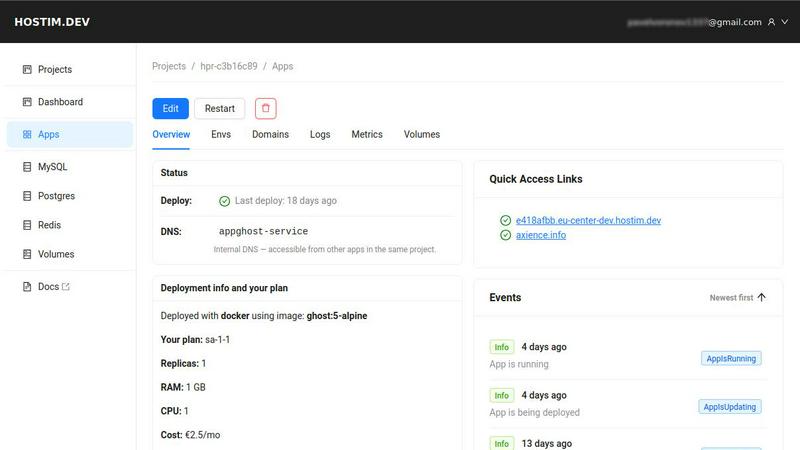
Hostim.dev deploys Docker apps with managed databases on EU bare-metal for fast, GDPR-compliant hosting.
Last updated: March 1, 2026

OpenMark AI benchmarks over 100 LLMs on your specific tasks, delivering rapid insights into cost, speed, quality, and stability without setup.
Last updated: March 26, 2026
Visual Comparison
Hostim.dev
OpenMark AI
Feature Comparison
Hostim.dev
EU Bare-Metal Hosting with GDPR Compliance
Hostim.dev operates on dedicated bare-metal servers located in Germany, ensuring high performance and low latency for European users. This architecture is inherently compliant with the General Data Protection Regulation (GDPR) by default, addressing critical data sovereignty requirements. For businesses handling EU citizen data, this eliminates the legal and logistical complexities of international data transfers, a concern frequently highlighted in cloud compliance discussions.
Docker & Docker Compose Native Deployment
The platform allows direct deployment from any Docker image, Git repository, or a full Docker Compose file without modification. This eliminates the need to rewrite application configurations for proprietary platforms or learn complex orchestration tools like Kubernetes. This native container support ensures full application portability, allowing developers to use the same tooling locally and in production, streamlining the development workflow significantly.
Built-in Managed Databases and Storage
Hostim.dev automatically provisions and wires managed instances of MySQL, PostgreSQL, and Redis, as well as persistent volumes, directly into each project. This integrated approach removes the time-consuming process of manually setting up, securing, and connecting external database services. Research on developer productivity indicates that reducing context-switching between different service providers can dramatically accelerate deployment cycles.
Per-Project Isolation and Cost Tracking
Every application or client project exists in a fully isolated environment with its own resources, networking, and access controls. Crucially, each project has real-time cost tracking and a flat, predictable monthly fee. This model provides exceptional financial clarity, especially for agencies and freelancers, by preventing the unpredictable, usage-based billing that is a common pain point with major cloud providers.
OpenMark AI
User-Friendly Task Configuration
OpenMark AI features an intuitive task configuration interface that allows users to describe their benchmarking tasks in simple language. This accessibility ensures that even those without extensive technical knowledge can effectively set up their tests and receive meaningful results.
Comprehensive Model Comparison
The platform supports benchmarking against over 100 different AI models, enabling users to gain a comprehensive understanding of which models perform best for their specific tasks. This wide-ranging comparison helps teams make informed decisions based on real-world performance metrics.
Real-Time API Results
OpenMark AI provides side-by-side results of real API calls, ensuring that users receive accurate data reflective of actual performance. This real-time feedback is crucial for developers looking to understand how different models behave under similar conditions.
Cost Efficiency Analysis
One of the standout features of OpenMark AI is its ability to analyze the cost efficiency of different models. Users can see not only the quality of outputs but also how the costs compare against each model, enabling them to make financially sound decisions when selecting an AI solution.
Use Cases
Hostim.dev
Freelance Developers and Solo Builders
Independent developers can rapidly ship full-stack applications for clients or personal projects without managing servers. The per-project billing allows for clean cost pass-through to clients, and the simple Docker/Compose deployment model means less time on DevOps and more time on feature development, enabling faster iteration and delivery.
Digital and Development Agencies
Agencies can maintain strict isolation between different client projects, each with its own dedicated resources and clear cost breakdown. This simplifies client billing and handovers. The EU hosting is a significant advantage for serving European clients with stringent data privacy requirements, providing a compliant and performant solution out of the box.
Startups and SaaS Companies
Early-stage companies can deploy a production-ready, scalable backend in minutes instead of days. The included databases, automatic HTTPS, and monitoring provide a robust foundation without upfront infrastructure investment. Predictable flat pricing aids in financial forecasting, which is critical for bootstrapped or seed-stage startups.
Students and Educators
Students learning modern development with Docker, databases, and web frameworks can deploy real projects on real infrastructure using the free trial. This hands-on experience with deployment and managed services is invaluable for building a professional portfolio, bridging the gap between academic exercises and production environments.
OpenMark AI
Model Selection for AI Features
Developers can utilize OpenMark AI to select the most appropriate model for their AI-driven features by benchmarking performance on specific tasks. This ensures that the chosen model aligns with both performance goals and budget constraints.
Pre-Deployment Validation
Product teams can validate their model choices before deployment by testing outputs for consistency and quality. This capability reduces the risk associated with deploying a less effective model, ensuring a smoother transition from development to production.
Cost-Benefit Analysis
Businesses seeking to optimize their AI spending can leverage OpenMark AI to perform a detailed cost-benefit analysis. By comparing the actual costs of API calls with the outputs generated, organizations can identify the best value options.
Research and Development
Researchers can use OpenMark AI to experiment with various models for academic or product development purposes. The tool allows for thorough testing of hypotheses regarding model performance across different tasks and environments.
Overview
About Hostim.dev
Hostim.dev is a specialized Platform-as-a-Service (PaaS) engineered to eliminate the traditional DevOps burden for developers deploying containerized applications. It provides a streamlined, bare-metal hosting environment in Germany, designed for GDPR compliance by default. The platform's core value proposition is operational simplicity: developers can deploy directly from Docker images, Git repositories, or full Docker Compose files without any rewrites, abstracting away the underlying Kubernetes infrastructure. This approach allows teams to launch production-ready applications in minutes, not days, with all necessary ancillary services—including managed MySQL, PostgreSQL, Redis databases, and persistent volumes—automatically provisioned and connected. Hostim.dev champions transparency and control, offering per-project isolation, real-time cost tracking, and predictable, flat-rate pricing to avoid the surprise bills common in usage-based cloud models. It is ideally suited for individual developers, startups, digital agencies, and SaaS builders who prioritize rapid iteration, clear cost management, and European data sovereignty without needing to become infrastructure experts. As noted by industry analysts, the demand for developer-centric platforms that abstract infrastructure complexity is a key trend, allowing teams to focus on core product development rather than operational overhead.
About OpenMark AI
OpenMark AI is an innovative web application designed specifically for task-level benchmarking of large language models (LLMs). It allows users to articulate their testing requirements in plain language, facilitating the benchmarking of over 100 AI models within a single session. By running identical prompts across multiple models, users can effectively compare key metrics such as cost per request, latency, scored quality, and stability, providing insights into the variance of model outputs rather than relying on potentially misleading singular results. This is particularly valuable for developers and product teams who need to evaluate or validate AI models before deploying features that incorporate artificial intelligence.
OpenMark AI eliminates the complexity of managing multiple API keys by using a credit system for hosted benchmarking, making it easier to conduct comprehensive comparisons without the need for extensive configuration. Users benefit from real-time results based on actual API calls rather than pre-cached marketing data, making the tool essential for those who prioritize cost efficiency and consistent performance over simply choosing the lowest-priced token option. The platform supports a wide array of models and is designed to assist teams in pre-deployment decisions, ensuring they select the most suitable model for their specific workflow while maintaining budget considerations. OpenMark AI offers both free and paid plans, providing flexibility according to user needs.
Frequently Asked Questions
Hostim.dev FAQ
Do I need to know Kubernetes to use Hostim.dev?
No, Kubernetes knowledge is not required. Hostim.dev is specifically designed to abstract away the complexity of Kubernetes and other orchestration tools. You interact with the platform using familiar tools like Docker, Docker Compose, and Git. The platform manages all underlying orchestration, clustering, and networking automatically.
Where is my application data hosted?
All applications and data are hosted exclusively on bare-metal servers in German data centers. This ensures physical data resides within the European Union, providing a strong foundation for GDPR compliance and optimal performance for users in Europe.
Can I deploy with just a Docker Compose file?
Yes. You can paste an existing Docker Compose file directly into the Hostim.dev dashboard, and the platform will parse and deploy the defined services, networks, and volumes. No rewrite or adaptation to a proprietary format is necessary, maintaining the portability of your application configuration.
Is Hostim.dev suitable for team collaboration?
While ideal for individual developers, Hostim.dev supports team workflows through per-project isolation and clear resource attribution. Teams can collaborate on a project, and the flat-rate, per-project pricing model makes it straightforward to allocate infrastructure costs to specific clients or internal initiatives.
OpenMark AI FAQ
What types of models can I benchmark with OpenMark AI?
OpenMark AI supports a wide variety of models from leading AI providers, including OpenAI, Anthropic, and Google, enabling users to benchmark over 100 different LLMs.
Do I need to manage multiple API keys to use OpenMark AI?
No, OpenMark AI streamlines the process by utilizing a credit system for hosted benchmarking, which means you do not need to configure separate API keys for each model comparison.
Is OpenMark AI suitable for non-technical users?
Yes, the user-friendly interface allows individuals without extensive technical knowledge to easily describe tasks and benchmark models, making it accessible to a broader audience.
What kind of results can I expect from OpenMark AI?
Users can expect detailed results that include cost per request, latency, scored quality, and stability metrics, allowing for a comprehensive evaluation of model performance based on real API calls.
Alternatives
Hostim.dev Alternatives
Hostim.dev is a specialized Platform-as-a-Service (PaaS) designed for deploying Docker-based applications on EU bare-metal infrastructure. It belongs to the category of developer-centric, container-native hosting platforms that prioritize operational simplicity and GDPR compliance by default. Users often explore alternatives for several key reasons. These include budget constraints, where flat-rate pricing may not align with all financial models, or specific technical requirements not fully met by the platform's current feature set. Others may seek different geographic regions for data residency, require integrations with specific cloud ecosystems, or need more granular control over the underlying infrastructure than a fully managed service provides. When evaluating an alternative, developers should prioritize a clear understanding of their project's core needs. Key considerations include the platform's deployment model compatibility with your existing Docker or Compose workflows, the transparency and predictability of its pricing structure, the availability and performance of managed data services, and the legal jurisdiction of its data centers to ensure compliance with regulations like GDPR.
OpenMark AI Alternatives
OpenMark AI is a powerful web application designed for benchmarking over 100 large language models (LLMs) on various tasks, focusing on key metrics such as cost, speed, quality, and stability. This tool is particularly beneficial for developers and product teams seeking to make informed decisions about AI model selection before deploying features. Users often search for alternatives to OpenMark AI due to factors like pricing, specific feature sets, or platform compatibility that may better suit their unique project needs. When considering alternatives, it is essential to evaluate the specific functionalities offered, such as user interface design, supported models, and benchmarking capabilities. Additionally, users should assess the pricing structure, including free and paid plans, and the degree of support provided for integration and usage. Ultimately, finding the right tool hinges on identifying a solution that aligns with both project requirements and budget constraints.