diffray vs qtrl.ai
Side-by-side comparison to help you choose the right product.

diffray
Diffray's multi-agent AI catches real bugs with 87% fewer false positives than single-agent tools.
Last updated: February 28, 2026

qtrl.ai
qtrl.ai empowers QA teams to scale testing with AI agents while maintaining full control and governance throughout.
Last updated: March 4, 2026
Visual Comparison
diffray
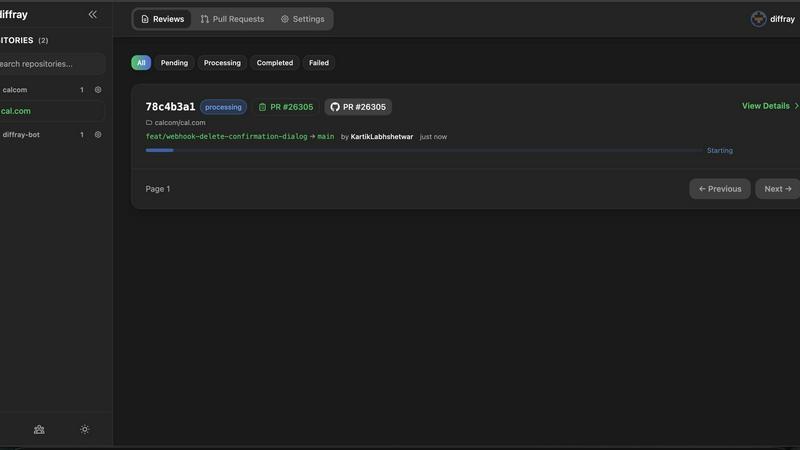
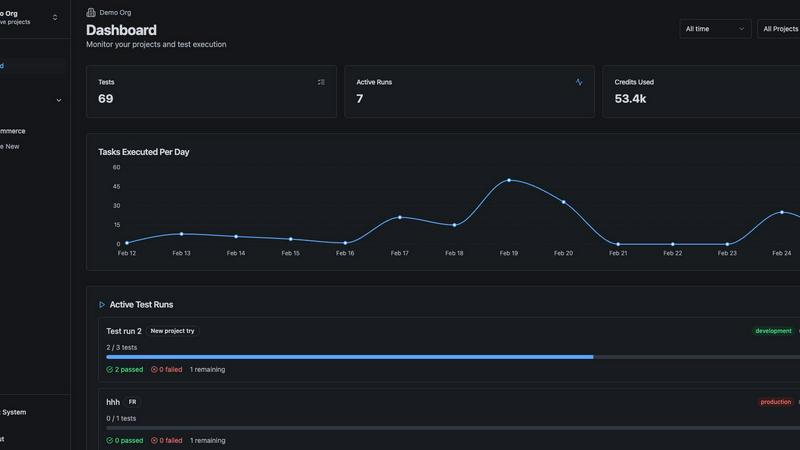
qtrl.ai
Feature Comparison
diffray
Multi-Agent Specialized Architecture
Unlike monolithic AI models, diffray employs a system of over 30 independent, specialized agents. Each agent is fine-tuned for a specific review category, such as detecting SQL injection vulnerabilities, identifying memory leaks, enforcing React best practices, or optimizing image loading. This division of labor ensures expert-level analysis in each domain, leading to more nuanced findings and significantly fewer irrelevant alerts, which research in software engineering shows is critical for maintaining developer trust in automated tools.
Full-Codebase Context Awareness
diffray analyzes pull requests with an understanding of the broader codebase context. It doesn't just review the changed lines in a vacuum; it cross-references them with existing functions, dependencies, and architectural patterns. This context allows it to identify issues like breaking API contracts, duplicated logic, or violations of established project conventions that simpler diff-only tools would completely miss, providing insights that are both relevant and immediately actionable.
Quantifiable Reduction in False Positives
A core differentiator of diffray is its empirically verified accuracy. By leveraging its multi-agent system and deep context analysis, the platform achieves an 87% reduction in false positive alerts. This metric, crucial for developer adoption, means engineers spend less time sifting through erroneous warnings and more time addressing legitimate problems, directly increasing productivity and the perceived value of the automated review process.
Integrated Performance and SEO Auditing
Beyond traditional bug detection, diffray includes dedicated agents for performance and web-centric concerns. It can flag inefficient database queries, suggest lazy loading for components, identify unoptimized assets, and check for common SEO pitfalls in front-end code, such as missing meta tags or poor heading structures. This makes it a comprehensive quality gate for full-stack development teams.
qtrl.ai
Autonomous QA Agents
qtrl.ai features autonomous QA agents that can execute instructions on demand or continuously across multiple environments. These agents operate within predefined rules, ensuring compliance while performing real browser executions instead of simulations. This capability allows teams to efficiently scale their testing efforts without losing oversight.
Enterprise-Grade Test Management
With a centralized system for managing test cases, plans, and runs, qtrl.ai provides comprehensive traceability and audit trails. This feature supports both manual and automated workflows, making it particularly well-suited for enterprises that require stringent compliance and governance in their QA processes.
Progressive Automation
Starting with human-written instructions, qtrl.ai allows teams to gradually incorporate AI-generated tests. As teams connect requirements, qtrl.ai automatically generates and executes tests, all of which remain fully reviewable. This progressive approach enables teams to scale their automation intelligently and securely.
Adaptive Memory
qtrl.ai employs adaptive memory to build a living knowledge base of the application, learning from exploration, test execution, and reported issues. This feature powers smarter, context-aware test generation that becomes increasingly effective with each interaction, thereby enhancing the overall quality assurance process.
Use Cases
diffray
Accelerating Enterprise Development Cycles
Large organizations with multiple development teams and high PR volume use diffray to standardize code quality and speed up merges. By providing consistent, instant first-pass reviews, diffray acts as a tireless senior engineer on every PR, enabling human reviewers to focus on higher-level architectural and design discussions. This reduces bottlenecks and helps maintain velocity at scale.
Onboarding Junior Developers
diffray serves as an excellent mentoring tool for new team members. By providing immediate, educational feedback on code style, security practices, and common pitfalls, it helps junior developers learn best practices and internalize team standards more quickly, reducing the mentoring burden on senior staff while improving the quality of contributions from day one.
Enhancing Open Source Project Maintenance
Maintainers of open-source projects can integrate diffray to automatically screen community contributions. It efficiently filters out submissions with obvious bugs, security issues, or style violations before human maintainers invest time in review. This ensures a higher baseline quality for incoming PRs and protects the project's integrity.
Pre-Deployment Quality Gate
Teams can configure diffray as a mandatory check in their CI/CD pipeline. Every PR must pass diffray's automated review before it can be merged, acting as an automated quality gate that enforces coding standards, catches regressions, and prevents known bug patterns or vulnerabilities from reaching production, thereby strengthening the overall security and stability of the application.
qtrl.ai
Product-Led Engineering Teams
Product-led engineering teams can utilize qtrl.ai to manage their testing processes efficiently. By leveraging both manual and automated testing capabilities, these teams can ensure rapid product development cycles without sacrificing quality.
QA Teams Scaling Beyond Manual Testing
For QA teams transitioning from manual testing to automation, qtrl.ai offers a seamless path forward. Teams can start with basic automation and gradually adopt more advanced features, ensuring a controlled and manageable scaling process.
Companies Modernizing Legacy QA Workflows
Organizations looking to modernize outdated QA workflows can benefit greatly from qtrl.ai. The platform integrates easily with existing tools and supports CI/CD pipelines, making it an ideal choice for companies aiming to enhance efficiency while maintaining quality standards.
Enterprises Requiring Governance and Traceability
Enterprises that need to adhere to strict governance and audit requirements can rely on qtrl.ai's comprehensive traceability and audit trails. This ensures that all test activities are documented, providing the necessary transparency and accountability for compliance purposes.
Overview
About diffray
diffray is a sophisticated AI-powered code review assistant engineered to transform the efficiency and effectiveness of software development workflows. It is designed for development teams and engineering organizations seeking to enhance code quality, accelerate release cycles, and reduce developer burnout associated with manual code review processes. At its core, diffray utilizes a revolutionary multi-agent architecture, deploying over 30 specialized AI agents, each an expert in a distinct domain such as security vulnerabilities, performance bottlenecks, bug patterns, language-specific best practices, and SEO considerations for web code. This targeted, ensemble approach allows diffray to conduct a deeply contextual analysis of pull requests (PRs), understanding the proposed changes in relation to the entire codebase rather than in isolation. The result is a dramatic improvement in diagnostic accuracy: diffray reduces false positives by 87% and triples the detection of genuine, critical issues compared to generic, single-model AI tools. By delivering precise, actionable insights directly into the developer's workflow, diffray empowers teams to slash average PR review time from 45 minutes to just 12 minutes per week, according to user reports. Its primary value proposition lies in elevating code quality through intelligent, context-aware automation, making it an indispensable asset for modern software engineering teams committed to excellence and operational efficiency.
About qtrl.ai
qtrl.ai is an innovative quality assurance (QA) platform meticulously crafted to aid software teams in scaling their QA efforts while maintaining control and governance. By integrating enterprise-grade test management with robust AI automation, qtrl.ai serves as a centralized hub where teams can efficiently organize test cases, plan test runs, and trace requirements to coverage. Its real-time dashboards provide critical visibility into test outcomes, highlighting what has been tested, what is passing, and identifying potential risks, which is essential for engineering leads and QA managers.
What distinguishes qtrl.ai is its progressive AI layer, which introduces intelligent automation in a phased manner. Teams can begin with manual test management and gradually transition to leveraging built-in autonomous agents. These agents can create UI tests from plain English descriptions, adapt to application changes, and execute tests across various browsers and environments at scale. This adaptability makes qtrl.ai ideal for product-led engineering teams, QA groups seeking to move beyond manual testing, organizations modernizing outdated workflows, and enterprises that prioritize compliance and audit trails. Ultimately, qtrl.ai aims to reconcile the slow nature of manual testing with the intricate complexities of traditional automation, providing a reliable pathway to accelerated and more intelligent quality assurance processes.
Frequently Asked Questions
diffray FAQ
How does diffray's accuracy compare to other AI code review tools?
diffray's multi-agent architecture is specifically designed to address the accuracy shortcomings of single-model tools. By using specialized agents and full-codebase context, it reduces false positives by 87% and detects three times more real issues, as validated by user data. This leads to higher developer trust and adoption, as the feedback is precise and relevant.
Does diffray support my programming language and framework?
diffray's ensemble of specialized agents includes support for a wide array of popular programming languages, including JavaScript/TypeScript, Python, Java, Go, C#, and PHP, along with major frameworks like React, Angular, Vue.js, Django, and Spring. The platform's architecture allows for the continuous addition of new language and framework-specific agents.
How does diffray integrate into our existing development workflow?
diffray integrates seamlessly with popular development platforms like GitHub, GitLab, and Bitbucket. It operates as a GitHub App or GitLab integration, posting review comments directly on your pull requests. This requires minimal setup and allows developers to receive and act on feedback within their existing tools without context switching.
Is my source code kept private and secure when using diffray?
Yes, diffray is built with enterprise-grade security in mind. The tool typically operates by receiving only the diff and necessary context from your pull request via secure APIs. Reputable AI code review vendors implement strict data handling policies, encryption in transit and at rest, and do not train models on private customer code. You should always review the vendor's specific security whitepaper and data privacy policy for detailed assurances.
qtrl.ai FAQ
What makes qtrl.ai different from traditional QA platforms?
qtrl.ai stands out by integrating AI automation with robust test management in a progressive manner. This allows teams to maintain control while gradually adopting automated testing, unlike traditional platforms that often require a complete shift to automation.
Can teams start with manual testing on qtrl.ai?
Yes, qtrl.ai is designed to accommodate teams at various stages of their testing journey. Teams can begin with manual test management and introduce automation as they become more comfortable, making the transition smooth and manageable.
How does qtrl.ai ensure compliance and traceability?
qtrl.ai provides comprehensive traceability and audit trails for all test management activities. This feature supports enterprises in maintaining compliance with regulatory standards by documenting every step of the QA process.
Is qtrl.ai suitable for small teams as well as large enterprises?
Absolutely. qtrl.ai is flexible and scalable, making it suitable for small teams looking to improve their QA processes as well as large enterprises that require stringent governance and automation capabilities.
Alternatives
diffray Alternatives
diffray is a multi-agent AI code review tool in the software development category, designed to automate and enhance the code review process. It utilizes a specialized architecture to analyze pull requests, significantly reducing false positives and improving issue detection. Users may seek alternatives for various reasons, including budget constraints, specific feature requirements not met by diffray, or the need for integration with platforms outside its current support. Different team sizes, tech stacks, and development workflows also drive the search for a fitting solution. When evaluating alternatives, key criteria include the accuracy of feedback to minimize noise, the depth of codebase context awareness, ease of integration into existing CI/CD pipelines, and the overall value proposition regarding time savings and code quality improvement. The goal is to find a tool that aligns with both technical requirements and team processes.
qtrl.ai Alternatives
qtrl.ai is a cutting-edge platform in the quality assurance (QA) category, designed to empower software teams by enhancing their testing capabilities through AI-driven automation while maintaining control and governance. It serves as a centralized hub for organizing test cases, planning test runs, and tracking quality metrics, ensuring teams have clear visibility into their testing processes. Users often seek alternatives to qtrl.ai for various reasons, including pricing structures, feature sets, and specific platform requirements. When evaluating other options, it is essential to consider factors such as ease of integration with existing workflows, the level of automation offered, and the ability to manage compliance and auditing effectively. Finding a solution that fits seamlessly with team dynamics while offering robust support and scalability is crucial for long-term success.