
Deeploy vs iGPT
Side-by-side comparison to help you choose the right product.

Deeploy
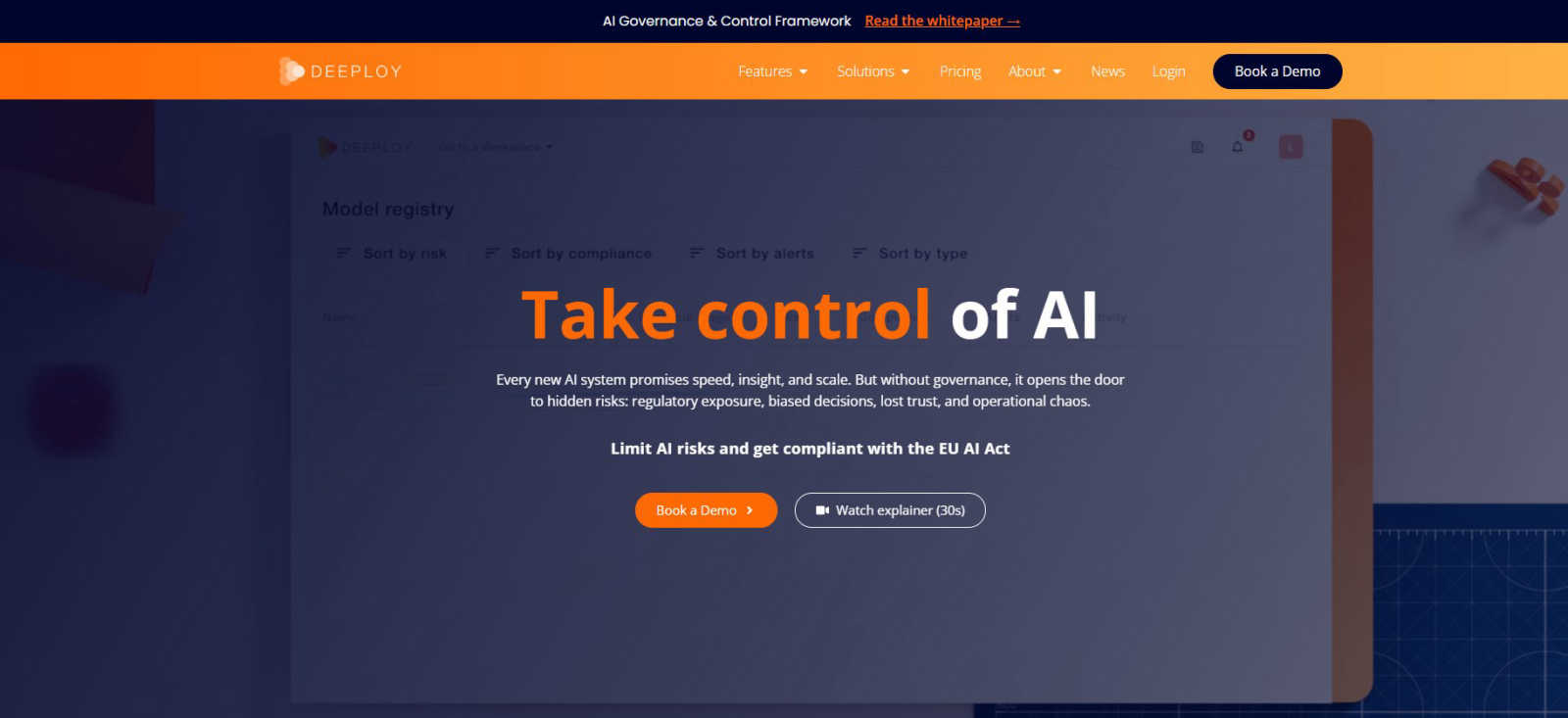
Deeploy provides the essential governance infrastructure to manage AI risk and ensure compliance at scale.
Last updated: March 1, 2026

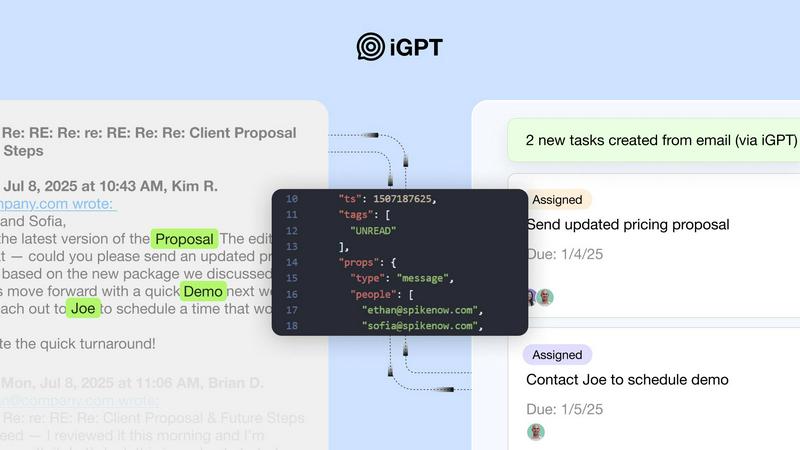
iGPT is an enterprise API that transforms email data into secure, contextual insights for agents.
Last updated: March 1, 2026
Visual Comparison
Deeploy
iGPT
Feature Comparison
Deeploy
AI Discovery and Onboarding
Deeploy provides complete visibility across an organization's AI landscape. It allows teams to discover, onboard, and manage every AI system—whether built on MLOps platforms, GenAI tools, or embedded systems—from a centralized dashboard. This eliminates blind spots and creates a single source of truth for all AI assets without requiring costly migration from existing platforms. The flexible onboarding process ensures that even disparate AI implementations can be brought under unified governance, establishing the foundational inventory required for effective oversight and compliance documentation.
Control Frameworks and Compliance
The platform simplifies navigating complex AI regulations through guided workflows and pre-built control frameworks. Organizations can adopt default frameworks aligned with major standards like ISO 42001 and the NIST AI Risk Management Framework (RMF) or build custom ones tailored to internal policies. Deeploy enables rapid AI system risk classification and establishes clear accountability with structured approval processes. This feature demystifies compliance, turning what is often a manual, legal-heavy burden into a streamlined, manageable operational procedure, directly addressing mandates like the EU AI Act.
Control Implementation and Automation
Deeploy translates high-level governance policies into enforceable, engineer-friendly controls. It automatically assigns the correct requirements to each AI system based on its risk profile, giving technical teams clear and actionable tasks. The platform accelerates compliance by up to 90% through the use of templates and automated evidence collection, reducing manual documentation work. Furthermore, it employs AI-powered assessments to handle repetitive compliance checks, ensuring governance is consistently applied and actually followed by engineering teams rather than being a bureaucratic hurdle.
Real-Time Monitoring and Explainability
This feature provides proactive oversight of AI systems in production. Deeploy monitors model performance, data drift, and output anomalies in real-time, sending instant alerts to prevent incidents before they impact users or create compliance breaches. It adds crucial tracing and guardrails to protect Large Language Model (LLM) outputs. Integrated explainability tools, such as feature contribution analysis, make AI decisions interpretable for both technical and non-technical stakeholders, building transparency and enabling effective human feedback loops to ensure safe and responsible AI operation.
iGPT
Unified Intelligence Endpoint
iGPT consolidates the entire process of email intelligence into a single API call. This eliminates the need for developers to build and maintain separate systems for retrieval, context shaping, and reasoning, a common challenge noted in complex RAG implementations. A user simply submits a natural language query, and the API handles deep indexing, hybrid retrieval, and optimized context preparation automatically, returning a structured response with citations in approximately 3 seconds to the first token.
Deep Contextual Understanding & Thread Reconstruction
The API goes beyond simple keyword matching by semantically understanding email content and its relational context. It automatically reconstructs fragmented email threads across time, participants, and related attachments, rebuilding the complete narrative of a conversation. This capability is crucial for accurate understanding, as critical information is often distributed across multiple messages and replies, a nuance that standard search fails to capture.
Advanced Attachment Processing
iGPT extracts and indexes text, data, and structural information from a wide array of attachments, including documents, PDFs, and spreadsheets. This processing is performed in the context of the surrounding email thread and its participants, allowing the system to answer questions about contract clauses, invoice details, or report figures as they were discussed, turning static files into queryable knowledge assets.
Enterprise-Grade Security & Compliance Framework
Built for regulated industries, iGPT enforces a strict security model. It guarantees zero data training or retention, with all inferences processed in memory. Access is controlled via OAuth-only processing with Role-Based Access Control (RBAC), and every response includes a full audit trail, linking answers directly to source messages. This ensures data sovereignty and compliance with stringent data protection standards.
Use Cases
Deeploy
Regulatory Compliance for Financial Services
Financial institutions use Deeploy to achieve and demonstrate compliance with stringent regulations like the EU AI Act and internal risk mandates. The platform's centralized registry and automated evidence collection provide auditors with a clear, documented trail of all AI systems, their risk classifications, and the controls in place. This is critical for high-stakes use cases like credit scoring or fraud detection, where explainability and auditability are non-negotiable for both regulators and customer trust.
Scalable AI Governance in Healthcare
Healthcare providers and digital health platforms leverage Deeploy to govern AI used in patient diagnostics, treatment recommendations, and mental health support. The platform's real-time monitoring and built-in explainability are crucial for clinical oversight, allowing medical professionals to understand AI-driven insights. The human feedback loop feature enables continuous improvement and validation of models, ensuring AI tools are safe, effective, and ethically deployed within sensitive care environments.
Centralized AI Oversight for Enterprise IT
Large enterprises with AI scattered across multiple business units and vendor platforms use Deeploy to regain control. The AI discovery capability maps all active systems, while the unified dashboard gives CIOs and heads of AI complete visibility into performance, costs, and risks. This central oversight prevents shadow IT, optimizes resource allocation, and ensures all AI initiatives align with corporate governance standards, enabling scalable and secure AI adoption across the organization.
Accelerating Model Deployment and MLOps
Data science and MLOps teams utilize Deeploy to streamline the path from development to production. The platform simplifies model deployment, reducing the process from weeks to hours. Once deployed, it provides continuous observability with performance dashboards and explainability reports. This not only accelerates innovation cycles but also bridges the gap between technical teams and business stakeholders by making model behavior transparent and actionable for continuous improvement.
iGPT
Intelligent Email Assistants & Copilots
Organizations can build AI agents that draft, prioritize, summarize, and act on email with full historical and contextual awareness. For support teams, this means a copilot that can instantly reconstruct a customer's entire issue history across long email chains and attachments, enabling faster, more informed responses and reducing handle times significantly.
Automated Workflow & Task Orchestration
iGPT automates the extraction of actionable items from communication streams. It can automatically parse email threads to identify decisions, action items, owners, and deadlines, then feed this structured data into project management tools like Asana or Jira. This transforms unstructured conversations into tracked tasks and approvals, flagging stalled items for follow-up.
CRM Enrichment & Deal Intelligence
Sales and account management teams can use iGPT to extract critical deal momentum, customer sentiment, and decision rationale directly from email exchanges. The API can summarize key points from lengthy negotiation threads or identify all pending approvals mentioned in communications with a client, providing real-time insights that keep CRM data accurate and actionable.
Compliance Auditing & Legal Discovery
For legal, finance, and compliance departments, iGPT provides a powerful tool for tracing feedback, approvals, and contractual agreements back to their original source emails and attachments. This creates a verifiable audit trail, streamlining internal reviews, e-discovery processes, and ensuring that corporate decisions are fully documented and easily retrievable.
Overview
About Deeploy
Deeploy is an advanced AI governance and risk management platform designed to provide organizations with centralized oversight, compliance, and monitoring for their entire artificial intelligence portfolio. As AI systems proliferate across models, vendors, and embedded applications, they create a fragmented landscape fraught with operational blind spots and regulatory risks. Deeploy addresses this critical gap by serving as the essential governance infrastructure for the modern AI stack. It enables enterprises to discover, document, and manage every AI system from a single interface, transforming a chaotic "jungle of AI systems" into a controlled, auditable, and compliant environment. The platform is particularly vital for sectors like finance and healthcare, where stringent regulations such as the EU AI Act demand rigorous accountability and transparency. By integrating flexible onboarding, real-time monitoring, explainability, and automated compliance workflows, Deeploy empowers organizations to scale their AI initiatives with confidence, ensuring innovation is balanced with responsibility and trust.
About iGPT
iGPT is an advanced email intelligence API engineered to transform unstructured email data into structured, actionable insights for enterprise workflows and AI agents. It directly addresses the critical gap where traditional AI models fail: understanding the complex, contextual, and often messy nature of real-world email communication, which includes long threads, multiple participants, and diverse attachments. The platform serves a diverse range of industries, including customer support, legal, finance, and operations, by providing a secure, auditable gateway for AI systems to access and comprehend email data. Its core value proposition lies in its unified endpoint that replaces the need for complex, multi-step retrieval-augmented generation (RAG) pipelines. Organizations can bypass the burdens of parsing, chunking, indexing, and prompt tuning, instead sending a single natural language request to receive a context-aware, cited answer in seconds. With a foundational commitment to security—featuring zero data training, zero data retention, and full audit trails—iGPT empowers teams to automate tasks, enhance decision-making, and build sophisticated agents that operate with the full context of an organization's communication history.
Frequently Asked Questions
Deeploy FAQ
How does Deeploy help with the EU AI Act?
Deeploy is specifically engineered to address the core requirements of the EU AI Act. It provides tools for mandatory AI system inventory creation, risk classification based on the Act's categories, and implementation of corresponding conformity measures. The platform's automated evidence collection and audit trails generate the necessary documentation for compliance assessments. Its real-time monitoring and explainability features directly support the Act's mandates for transparency and human oversight, particularly for high-risk AI systems.
Can Deeploy integrate with our existing MLOps and AI vendor platforms?
Yes, a core strength of Deeploy is its flexible integration capability. It is designed to connect with any major MLOps platform (e.g., MLflow, Sagemaker) and GenAI vendor APIs without requiring you to migrate your existing workflows. This "connect-first" approach allows you to maintain your current tech stack while adding a centralized governance layer on top, eliminating blind spots and bringing all AI activities under a single pane of glass for management and oversight.
What is meant by "explainability" in Deeploy?
Explainability in Deeploy refers to the platform's ability to make AI model decisions interpretable to humans. For traditional machine learning models, it provides techniques like feature importance scores to show which input factors most influenced a specific prediction. For Large Language Models (LLMs), it offers tracing and output analysis. This transparency is crucial for debugging models, building trust with end-users, fulfilling regulatory "right to explanation" clauses, and enabling subject matter experts to provide meaningful feedback to improve system performance.
Who are the primary users of Deeploy within an organization?
Deeploy serves a cross-functional audience. AI Governance & Risk Officers use it to set policies and ensure compliance. Data Science & MLOps Engineers use it to deploy models and implement controls. Business Leaders & Product Managers rely on its dashboards for visibility into AI performance and risk. Legal & Compliance Teams utilize its automated documentation for audits. This multi-user design ensures governance is a collaborative, integrated process rather than a standalone compliance checkpoint.
iGPT FAQ
How does iGPT's performance compare to building a custom RAG pipeline?
iGPT is designed to outperform and simplify custom RAG pipelines. While a custom pipeline requires significant engineering effort for parsing, chunking, embedding, vector store management, and prompt optimization, iGPT delivers a production-ready solution through a single API call. Benchmarks indicate it provides ~200ms retrieval and ~3s to first token across large email datasets, a performance level that typically requires extensive tuning in a custom setup.
What makes email a uniquely difficult data source for AI?
Email is inherently unstructured, conversational, and context-dependent. Critical information is dispersed across long threads with multiple participants, nested replies, and various file attachments. Traditional AI and search tools struggle with thread reconstruction, understanding tone shifts, and connecting data in attachments to the discussion about them. iGPT is specifically engineered to solve these "last-mile" context problems that break general-purpose LLMs.
Is my company's email data secure and private with iGPT?
Yes, iGPT is built with a foundational principle of data security. It employs a zero-data retention policy, meaning your inputs, prompts, and outputs are never stored after processing. The company also adheres to a strict zero-data training policy, ensuring your proprietary communications are never used to train or improve any AI models. All access is governed by OAuth and RBAC, keeping data under your organization's control.
How quickly can I integrate iGPT and start getting value?
Integration is designed for immediacy. iGPT provides a live playground for testing, comprehensive SDKs (including Python), and connectors for platforms like LangChain. Developers can connect email sources, test queries with different Context Engineering Framework (CEF) tiers, and receive structured, cited answers without any upfront data pipeline development, allowing teams to prototype and ship agents in days, not months.
Alternatives
Deeploy Alternatives
Deeploy is an AI governance platform within the business intelligence and compliance software category. It provides organizations with a centralized system for managing oversight, compliance, and risk across their AI initiatives, which is increasingly critical under regulations like the EU AI Act. Organizations may seek alternatives to Deeploy for various reasons. Common considerations include budget constraints and specific pricing models, the need for different feature sets or deeper integrations with existing MLOps tools, and platform requirements such as deployment options (SaaS vs. on-premise) or scalability needs for very large or complex AI portfolios. When evaluating an alternative AI governance solution, key factors to assess include the platform's ability to provide comprehensive visibility and automated discovery of AI models, its support for relevant regulatory frameworks and customizable controls, and the depth of its monitoring, explainability, and audit trail capabilities. The ideal solution should reduce manual compliance overhead while integrating smoothly into your existing technology stack.
iGPT Alternatives
iGPT is an advanced email intelligence API that falls within the Business Intelligence category. It specializes in transforming enterprise email data into secure, contextual insights to streamline agent workflows and automate decision-making processes. By providing a secure gateway for AI agents to understand email conversations and attachments, it helps organizations unlock the operational value of their communication data. Users may explore alternatives to iGPT for various reasons. Common drivers include budget constraints and specific pricing model needs, the requirement for different feature sets or integration capabilities with other platforms, and the desire for a solution tailored to a particular industry use case or company size. Evaluating the total cost of ownership and specific functional requirements is a standard part of the enterprise software selection process. When assessing an alternative email intelligence solution, key considerations should include the depth and security of its email data processing, the accuracy and contextual awareness of its AI responses, and the ease of integration into existing tech stacks. Compliance with data governance standards and the solution's ability to provide auditable, traceable insights are also critical factors for enterprise adoption, as noted in industry analyses of AI-powered workflow tools.