Clinic Comply vs Skene
Side-by-side comparison to help you choose the right product.

Clinic Comply
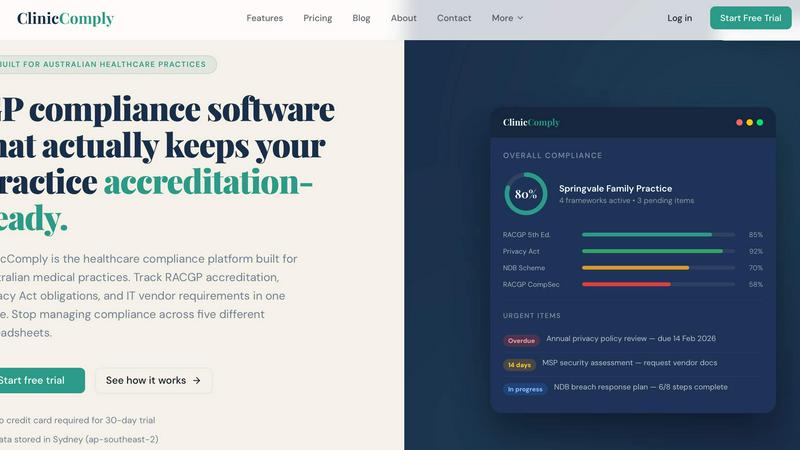
ClinicComply is the all-in-one platform that streamlines RACGP accreditation and vendor compliance for Australian healthcare practices.
Last updated: March 19, 2026

Skene is a code-native growth engine that automates product-led growth directly within your codebase.
Last updated: February 28, 2026
Visual Comparison
Clinic Comply
Skene
Feature Comparison
Clinic Comply
RACGP Accreditation Module
This feature provides a fully digitized and interactive checklist of the entire RACGP 5th Edition Standards. Each criterion is broken down with clear guidance, allowing practices to upload evidence documents and link them directly to specific requirements. The system automatically calculates a live, actionable compliance score and enables one-click generation of a structured evidence pack for assessor visits, transforming a traditionally manual and stressful process into a streamlined, organized workflow.
Integrated IT Vendor Portal
Clinic Comply simplifies the arduous task of collecting compliance documentation from third-party IT vendors and Managed Service Providers (MSPs). Instead of endless email threads, users can send secure, direct upload links to vendors. Documents are automatically filed into the platform's evidence library and linked to the relevant compliance criteria (e.g., data processing agreements for Privacy Act compliance), drastically reducing chase-up time and ensuring critical vendor security assessments are properly recorded.
Multi-Framework Compliance Hub
The platform is pre-loaded with over ten Australian-specific healthcare compliance frameworks, including state-based regulations like the NSW HRIP Act and VIC Health Records Act, as well as standards for dental (HDAA) and disability (NDIS) services. This native integration means the platform's checklists and scoring are mapped to the exact criteria assessors evaluate, unlike generic Governance, Risk and Compliance (GRC) tools that lack healthcare-specific context.
Real-Time Compliance Dashboard & Deadline Management
Users gain an immediate overview of their practice's compliance status through a central dashboard displaying overall scores, progress per framework, and urgent action items. The system tracks deadlines for recurring tasks (e.g., annual policy reviews) and highlights overdue items. This proactive visibility enables clinic managers to effectively delegate tasks and prioritize efforts to address compliance gaps before they become critical issues.
Skene
Codebase-Integrated Signal Detection
Skene derives growth signals directly from your application's source code, creating a context layer for AI-driven optimization. By analyzing the repository structure, it automatically identifies key user flows, components, and potential friction points without requiring manual tagging or external scripts. This deep integration ensures that growth instrumentation is version-controlled, performant, and never becomes a "black box" that breaks with deployments, providing a single source of truth for both your product and growth logic.
Autonomous Growth Loop Orchestration
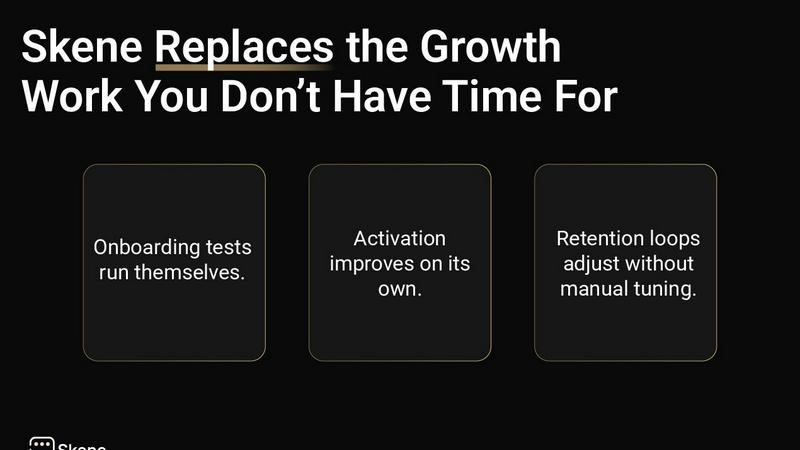
The platform acts as a self-learning engine that autonomously observes user behavior, identifies bottlenecks in journeys like onboarding, and implements data-driven optimizations. Skene can automatically generate, A/B test, and deploy improved versions of user flows, creating a continuous feedback loop for metrics such as activation and retention. This removes the manual burden of hypothesis testing and implementation, allowing the system to systematically improve conversion paths without constant developer intervention.
Prompt-Driven Growth Implementation
Growth workflows are managed through natural language prompts within your existing development environment, such as Cursor or a terminal. Developers can instruct Skene to analyze code, generate growth manifests, or implement specific optimizations using simple commands like uvx skene-growth analyze .. This shifts growth work from managing disparate SaaS dashboards to a programmable, code-first workflow that integrates seamlessly with modern development practices.
Owned Infrastructure & Performance
Skene replaces legacy stacks of third-party snippets and widgets with owned code that you control, version, and deploy. By eliminating external JavaScript bloat and siloed data pipelines, it preserves your application's core performance and security posture. This architecture ensures that growth tooling enhances rather than hinders site speed and user experience, while keeping all data and logic within your ecosystem.
Use Cases
Clinic Comply
Preparing for RACGP Accreditation Reassessment
A GP practice facing its triennial RACGP accreditation visit uses Clinic Comply to audit its current standing against all 5th Edition Standards. The team works through the guided checklists, uploading updated policies and procedure documents directly into the system. One week before the assessor arrives, the practice manager uses the "evidence pack" feature to download a complete, organized digital portfolio, ensuring a smooth and confident assessment process.
Managing a Notifiable Data Breach Response
Following a potential privacy breach, a clinic must adhere to strict NDB Scheme timelines. The practice manager accesses the NDB framework checklist in Clinic Comply, which provides a step-by-step response plan. The platform guides the team through containment, assessment, notification, and review steps, while providing a secure repository for all documentation related to the incident, ensuring legal obligations are met comprehensively.
Streamlining IT Vendor Compliance Audits
A medical practice needs to verify the security posture of its new cloud-based practice management software provider. Using the Vendor Portal, the clinic sends a secure document request for the vendor's security policy and data processing agreement. The vendor uploads the files directly, which are automatically categorized and stored as evidence for both RACGP CompSec and Privacy Act compliance, eliminating manual filing and follow-up.
Centralizing Compliance for a Multi-Practice Group
A healthcare organization managing several clinics across different states must comply with varying regional regulations (e.g., HRIP in NSW, Health Records Act in VIC). Clinic Comply allows the corporate compliance officer to oversee all locations from a single platform, monitor framework-specific progress, and ensure standardized policies are implemented correctly while accounting for local legislative differences.
Skene
Automated Onboarding Flow Optimization
For product teams aiming to improve user activation, Skene automatically analyzes the onboarding journey within the code, identifies where users drop off, and deploys tailored improvements. It can test different guidance strategies, UI tweaks, or feature introductions to maximize the rate at which new users reach the "aha!" moment, all without engineering writing new code for each experiment.
Continuous Retention & Lifecycle Automation
Skene enables the creation of self-optimizing lifecycle campaigns based on actual user behavior derived from the product. It can detect signs of churn risk or feature underutilization and automatically trigger in-app messages, email sequences, or feature prompts to re-engage users, turning the product itself into the primary driver of customer retention and expansion.
Product-Led Customer Success
Customer success teams can leverage Skene's deep product integration to move beyond reactive support. The platform identifies users struggling with specific features or workflows and can proactively deliver contextual, in-app guidance or resources. This transforms the product into a scalable success tool, ensuring users derive value independently and reducing support ticket volume.
Data-Driven Feature Adoption Campaigns
For launching new features or increasing adoption of existing ones, Skene analyzes which user segments are not utilizing key functionality. It then automatically designs and targets in-product campaigns or tutorials to specific user cohorts, measuring impact on usage metrics and iterating on the messaging and placement to drive organic feature discovery and usage.
Overview
About Clinic Comply
Clinic Comply is a specialized healthcare compliance management platform engineered exclusively for Australian medical practices. It addresses the critical and complex challenge of maintaining ongoing accreditation and regulatory adherence, which is a significant administrative burden for clinics. The platform consolidates the management of multiple compliance frameworks—including the RACGP 5th Edition Standards, the Privacy Act 1988 (APPs), the Notifiable Data Breaches (NDB) Scheme, and IT security protocols—into a single, intuitive system. Designed for General Practitioners, practice managers, and healthcare administrators, Clinic Comply replaces error-prone, fragmented methods like spreadsheets and shared drives with a centralized "source of truth." Its core value proposition is to ensure practices remain perpetually accreditation-ready, thereby reducing audit stress, minimizing non-compliance risk, and saving substantial administrative time. This allows healthcare providers to reallocate focus from paperwork back to primary patient care, enhancing both operational efficiency and clinical service quality.
About Skene
Skene is an AI-powered, fully automated Product-Led Growth (PLG) infrastructure that fundamentally reimagines growth tooling by integrating directly with a product's codebase. It functions as a self-learning growth engine, eliminating the need for external scripts, siloed dashboards, and manual optimization. The platform operates by first analyzing a user's code to understand the product's structure and user flows. It then automatically observes user behavior to detect friction points and drop-offs in critical journeys like onboarding and activation. Using this intelligence, Skene autonomously creates, A/B tests, and deploys improved versions of these flows, continuously optimizing for key metrics like activation and retention without human intervention. Its core value proposition is turning growth into a programmable, owned layer of infrastructure rather than a collection of brittle third-party services. Primarily built for indie developers, early-stage startups, and established PLG companies, Skene serves as a "growth team in a box." It enables technical teams to scale their product's growth loops efficiently without adding headcount or sacrificing the technical control, performance, and data ownership intrinsic to their core product.
Frequently Asked Questions
Clinic Comply FAQ
Is Clinic Comply suitable for specialist practices or only GP clinics?
While Clinic Comply is optimized for General Practice against the RACGP Standards, it is highly suitable for specialist medical and dental practices. The platform includes frameworks like the HDAA Standards for dental practices and the NDIS Practice Standards, which are relevant to many specialists. Its core functionality for managing policies, evidence, and vendor compliance is universally applicable across healthcare providers.
How does Clinic Comply ensure the security of our sensitive practice data?
Clinic Comply states that all customer data is stored in Sydney-based data centres (ap-southeast-2 region), ensuring it remains within Australian jurisdiction. The platform is designed to handle sensitive healthcare information, employing robust security measures including encryption and secure access controls. It is the user's responsibility to ensure their use of the platform aligns with their own privacy and security policies.
What happens when the RACGP releases the 6th Edition Standards?
The platform is built to evolve with Australian healthcare standards. Clinic Comply explicitly states that new frameworks are added as standards evolve, including the forthcoming RACGP 6th Edition. Users can expect the platform to be updated with new checklists and guidance, ensuring a seamless transition and ongoing compliance support without the need for manual framework overhauls.
Can multiple staff members use Clinic Comply simultaneously?
Yes, Clinic Comply includes team collaboration features. Different staff members (e.g., doctors, nurses, practice managers) can be assigned specific tasks or checklist items relevant to their role. The central dashboard and deadline tracking provide visibility for managers, facilitating teamwork and ensuring accountability across the entire practice for maintaining compliance.
Skene FAQ
What is PLG software?
PLG (Product-Led Growth) software is designed to help users discover value in a product without manual intervention from sales or customer success teams. It automates the user journey, guiding users to activation, driving feature adoption, and strengthening retention through the product experience itself. According to industry frameworks, effective PLG turns the product into the primary acquisition, conversion, and expansion channel.
How is Skene different from traditional customer experience software?
Traditional tools like walkthrough builders require manual tour creation, constant maintenance, and rely on brittle UI selectors that break with every code deploy. Skene is fundamentally different; it reads your codebase to understand your product's structure and automatically generates and maintains onboarding, analytics, and automation. When you push new code, Skene's understanding and implementations update themselves, eliminating maintenance overhead and selector fragility.
How long does it take to set up Skene?
Setup is designed to take less than 60 seconds. You simply connect your GitHub or GitLab repository with read-only access. Skene then automatically analyzes your codebase to generate an initial set of PLG flows and signals. No initial code changes, API modifications, or snippet installations are required to begin receiving insights and automation.
Is my source code secure with Skene?
Absolutely. Security is a core tenet of Skene's architecture. The platform only requires read-only access to your repository. All code analysis occurs in a secure, isolated environment. Your code is not used for training models, and the infrastructure is designed to ensure that your proprietary logic and data remain within your controlled ecosystem, aligning with enterprise security standards.
Alternatives
Clinic Comply Alternatives
Clinic Comply is a specialized productivity and management platform designed to streamline healthcare compliance for Australian medical practices. It centralizes the tracking of critical requirements like RACGP accreditation and privacy obligations, moving clinics away from inefficient, error-prone spreadsheet systems. Users may explore alternatives for various reasons, including budget constraints, the need for different feature integrations, or a preference for a platform that caters to a broader range of business types beyond healthcare. The specific compliance needs of a practice, such as the depth of vendor management or audit trail capabilities, can also drive the search for other solutions. When evaluating alternatives, key considerations should include the platform's specialization in Australian healthcare regulations, its ability to provide a real-time, centralized view of compliance status, and the quality of customer support. The ideal solution should demonstrably reduce administrative burden while ensuring robust data security and accreditation readiness.
Skene Alternatives
Skene is a code-native growth engine, representing a new category of fully automated Product-Led Growth (PLG) infrastructure. It integrates directly into an application's codebase to automate the analysis, testing, and optimization of user journeys like onboarding and activation, functioning as a self-learning system. Users may explore alternatives for several reasons. These include budget constraints, a need for more traditional marketing tools, or a preference for platforms with a visual, no-code interface rather than a code-native approach. The specific stage of a company, its technical resources, and its desired level of control over growth experiments are also key decision factors. When evaluating alternatives, consider the core methodology: code-native versus API-based or pixel-tracking solutions. Assess the depth of automation, from basic analytics to automated A/B testing and deployment. Security posture, integration requirements, and the ability to scale with your product's technical complexity are also critical dimensions for comparison.