
claude ide vs LLMWise
Side-by-side comparison to help you choose the right product.

claude ide
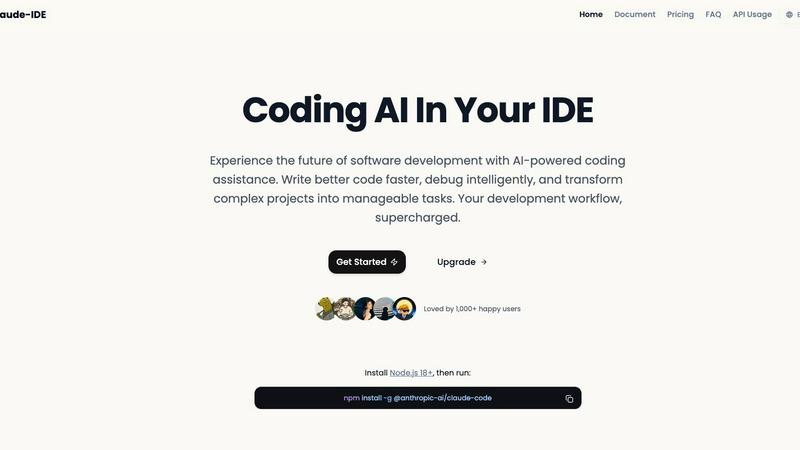
Claude IDE embeds powerful AI coding assistance directly in your terminal and VS Code for streamlined development.
Last updated: February 28, 2026

LLMWise
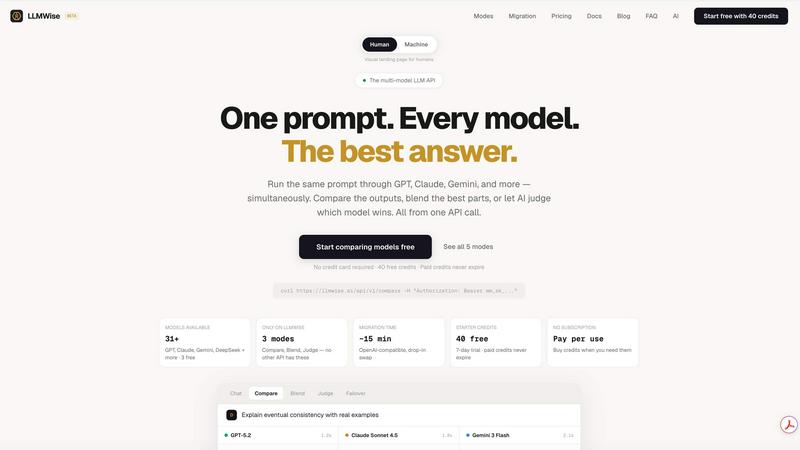
Access 62+ AI models seamlessly with LLMWise's smart auto-routing and pay only for what you use, with no subscriptions.
Last updated: February 27, 2026
Visual Comparison
claude ide
LLMWise
Feature Comparison
claude ide
Intelligent Whole-Codebase Understanding
Claude IDE's most significant feature is its ability to comprehend an entire project's architecture, dependencies, and inter-file relationships. Unlike basic code completion tools that analyze single files, Claude IDE ingests the full context of a codebase. This allows it to make accurate, coordinated suggestions and execute edits across multiple files while maintaining consistency and functionality. This deep understanding is powered by Anthropic's Claude Opus model, enabling the assistant to grasp project purpose and structure without manual context file selection, as demonstrated in its ability to analyze and explain complex projects like Excalidraw within seconds.
Seamless Terminal and IDE Integration
The tool is designed for zero friction, operating directly within a developer's primary environments. It can be installed globally via npm (npm install -g @anthropic-ai/claude-code) and invoked from the command line, and it offers deep plugins for VS Code and JetBrains IDEs. This integration philosophy eliminates the disruptive need to switch between a coding window and a separate AI chat interface, keeping the developer in a state of flow. All interactions, from code generation to executing complex edits, happen within the terminal or IDE sidebar, enhancing productivity.
End-to-End Development Workflow Management
Claude IDE extends beyond simple code generation to manage complete software development tasks. It integrates with version control platforms like GitHub and GitLab, enabling a streamlined workflow from issue reading to code submission. Developers can instruct Claude IDE to read an issue, write the corresponding code, execute tests, and even prepare and submit a Pull Request (PR), all through conversational commands in the terminal. This turns the AI into a proactive partner in the development cycle.
Powerful Multi-File Editing Capability
Leveraging its whole-codebase understanding, Claude IDE can execute sophisticated refactoring and feature implementation tasks that span numerous files. It ensures that changes made in one part of the codebase are correctly reflected in all dependent modules, maintaining architectural integrity. This capability is crucial for large-scale code modifications, dependency updates, or implementing new features that touch multiple components, reducing the risk of human error and saving considerable manual effort.
LLMWise
Smart Routing
LLMWise employs intelligent routing to ensure that every prompt is sent to the most appropriate model based on the task at hand. For instance, coding-related queries are directed to GPT, while creative writing prompts are routed to Claude. This feature enhances the accuracy and relevance of AI responses, optimizing overall performance for developers.
Compare & Blend
This feature allows users to run prompts across multiple models simultaneously, providing side-by-side comparisons of their outputs. The blending functionality synthesizes the best parts of each response into a single, cohesive answer. This capability is instrumental for users seeking to leverage the strengths of different models for improved results.
Always Resilient
LLMWise includes a circuit-breaker failover system that automatically reroutes requests to backup models if a primary provider experiences downtime. This ensures that applications remain operational and responsive, preventing disruptions and maintaining a seamless user experience.
Test & Optimize
Developers can utilize benchmarking suites and batch tests to evaluate model performance based on speed, cost, and reliability. Additionally, LLMWise offers automated regression checks, allowing users to continuously optimize their AI integrations and ensure consistent quality in output.
Use Cases
claude ide
Rapid Codebase Familiarization and Onboarding
For developers joining a new project or reviewing unfamiliar code, Claude IDE can instantly analyze and provide a comprehensive overview of the codebase. As shown in the provided example, it can explain the project's purpose, architecture, key components, and technology stack in seconds. This dramatically reduces the learning curve and onboarding time, allowing developers to become productive contributors much faster than through manual code exploration.
From Issue Triage to Pull Request Creation
Claude IDE can manage the entire lifecycle of a feature or bug fix. A developer can present a GitHub issue to Claude IDE within the terminal. The AI can read the issue requirements, plan the implementation, write the necessary code across relevant files, run associated tests to verify functionality, and finally, craft and submit a well-documented Pull Request. This creates a highly efficient, single-threaded workflow for task completion.
Complex Refactoring and Code Maintenance
When a project requires significant architectural changes, dependency upgrades, or widespread code style updates, Claude IDE is an invaluable tool. Developers can describe the refactoring goal (e.g., "Replace all uses of library X with library Y" or "Restructure the data layer into a repository pattern"), and Claude IDE will intelligently execute the changes across all affected files, ensuring the code remains functional and consistent.
Intelligent Debugging and Problem-Solving
When encountering a bug or unexpected behavior, developers can ask Claude IDE to analyze the relevant code sections, error logs, and stack traces. Using its deep context, it can hypothesize the root cause, suggest specific fixes, and even implement the corrective code. This transforms debugging from a time-consuming, solitary task into an interactive, assisted process.
LLMWise
Software Development
Developers can leverage LLMWise to access the best models for coding tasks, utilizing smart routing to direct programming prompts to GPT. This significantly reduces debugging time and enhances code quality by providing tailored recommendations.
Content Creation
Writers and marketers can utilize the compare and blend feature to generate high-quality content. By running creative prompts through models like Claude and Gemini, users can create compelling narratives that combine the best elements from each model's output.
Language Translation
LLMWise supports translation tasks by routing queries to the most efficient model for linguistic conversion. This ensures accurate and contextually relevant translations, making it ideal for businesses operating in multilingual environments.
Research and Analysis
Researchers can benefit from LLMWise by comparing outputs from different models when analyzing data or generating insights. The ability to test multiple models concurrently allows for comprehensive evaluations, leading to more informed conclusions.
Overview
About claude ide
Claude IDE is a sophisticated AI-powered coding assistant designed to integrate directly into a developer's existing workflow, fundamentally enhancing the software development lifecycle. It is not a standalone Integrated Development Environment (IDE) but rather an intelligent agent that embeds itself within popular development environments like the terminal, Visual Studio Code, and JetBrains IDEs. Its core value proposition lies in leveraging Anthropic's Claude Opus model to provide deep, context-aware assistance by analyzing entire codebases, as opposed to operating on isolated code snippets. This holistic understanding enables developers to perform complex, multi-file refactoring, debug intricate issues, and rapidly familiarize themselves with new projects. According to its documentation, Claude IDE is engineered for a broad spectrum of users, from solo developers and students to professional teams, offering a cost-effective alternative to expensive proprietary tools. By minimizing context switching and operating within familiar tools, it significantly boosts productivity, allowing developers to focus on building higher-quality software with intelligent support for tasks ranging from code explanation to full feature implementation and pull request management.
About LLMWise
LLMWise is an advanced API solution designed to streamline access to multiple large language models (LLMs) from renowned providers like OpenAI, Anthropic, Google, Meta, xAI, and DeepSeek. It eliminates the hassle of managing various AI subscriptions by offering a single API interface that intelligently routes requests to the most suitable model for each task. Whether it is coding, creative writing, or translation, LLMWise optimizes performance by intelligently matching prompts to the best-suited AI model. This platform is particularly beneficial for developers seeking a flexible, efficient solution without the complications of managing multiple APIs or incurring high subscription costs. By harnessing the power of diverse LLMs, LLMWise enhances productivity, reduces operational complexity, and delivers superior results in AI-driven projects.
Frequently Asked Questions
claude ide FAQ
What is Claude IDE and how is it different from GitHub Copilot?
Claude IDE is an AI coding assistant that integrates into terminals and IDEs, powered by Anthropic's Claude Opus model. Its key differentiator is its focus on whole-codebase understanding and end-to-end task management. While Copilot primarily offers inline code completions, Claude IDE operates conversationally and can execute complex, multi-file edits and manage full workflows from issue to PR, acting more as an autonomous coding partner than just a suggestion tool.
How do I install and start using Claude IDE?
Installation is straightforward for users with Node.js 18 or above installed. You simply run the command npm install -g @anthropic-ai/claude-code in your terminal. This installs the CLI tool globally. After installation, you can invoke it directly from your terminal or integrate it into your VS Code or JetBrains IDE using the provided extensions. Authentication with an Anthropic API key is required to begin using its features.
Does Claude IDE work with private repositories and code?
Yes, Claude IDE is designed to work with private codebases. According to Anthropic's policies, data sent via the API is not used for training their models without explicit permission. The tool operates locally within your development environment and communicates with the API to process your code context, allowing it to be used securely on proprietary and private projects.
What are the system requirements and supported platforms?
The primary requirement is having Node.js version 18 or higher installed on your system. Claude IDE itself runs as a global Node.js package. It is platform-agnostic and works on Windows, macOS, and Linux. For IDE integration, it supports Visual Studio Code and the suite of JetBrains IDEs (like IntelliJ IDEA, WebStorm, PyCharm), in addition to its core terminal/CLI interface.
LLMWise FAQ
What types of models can I access with LLMWise?
LLMWise provides access to over 62 models from 20 different providers, including well-known names like OpenAI, Google, and Meta. This diverse range allows users to select the best tool for their specific needs.
How does the pricing work for LLMWise?
LLMWise operates on a pay-per-use model, allowing users to pay only for the credits they consume. There are no subscriptions required, and users can also bring their own API keys for additional flexibility.
Is there a way to test LLMWise before committing?
Yes, LLMWise offers a free trial with 20 credits that never expire. Users can start testing the platform without needing to provide credit card information, making it easy to explore its capabilities risk-free.
What happens if a model I am using goes down?
LLMWise features a circuit-breaker failover mechanism that automatically reroutes requests to backup models if a primary model fails. This ensures that your applications remain functional and efficient, even during outages.
Alternatives
claude ide Alternatives
Claude IDE is an advanced AI coding assistant that falls into the category of AI-powered development tools. It integrates directly into a developer's terminal and popular integrated development environments (IDEs) like VS Code and JetBrains, providing intelligent code understanding and multi-file editing capabilities to streamline the software development process. Users often explore alternatives to such tools for a variety of reasons. Common factors include budget constraints and pricing models, the need for specific features not offered, compatibility with different operating systems or development stacks, and preferences for a different user interface or workflow integration. The rapidly evolving landscape of AI development tools also prompts developers to regularly assess the market for the most effective solution. When evaluating an alternative, key considerations should include the depth of the tool's codebase analysis, the quality and context-awareness of its suggestions, and the seamlessness of its integration into your existing development environment. It is also prudent to assess the tool's security posture, its support for your primary programming languages, and the overall value proposition relative to its cost.
LLMWise Alternatives
LLMWise is an innovative platform that provides a single API for accessing a range of large language models (LLMs), including those from prominent providers like OpenAI, Anthropic, and Google. It simplifies the process for developers by offering intelligent routing to ensure that each prompt is handled by the most suitable model, thereby enhancing the quality and efficiency of AI interactions. As AI technology evolves, users often seek alternatives to address various needs such as cost-effectiveness, feature sets, or compatibility with specific platforms and applications. When exploring alternatives to LLMWise, it is crucial to consider criteria such as pricing structures, available features, and ease of integration. Users should look for solutions that not only meet their current requirements but also offer scalability and adaptability for future needs. This ensures that they can leverage the best AI technology without unnecessary complexity or limitations.