3DAIStudio vs Vidgo API
Side-by-side comparison to help you choose the right product.

3DAIStudio
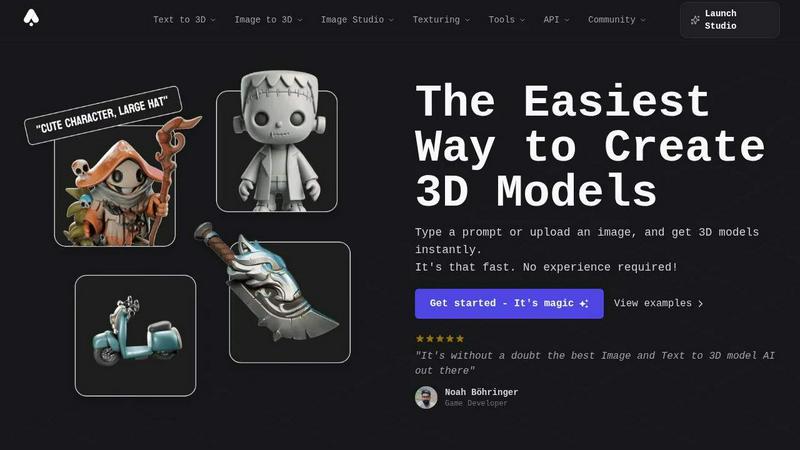
3DAIStudio is an AI-powered platform that instantly generates production-ready 3D models from text prompts or images, as evidenced by its use by over.
Last updated: April 4, 2026

Vidgo API
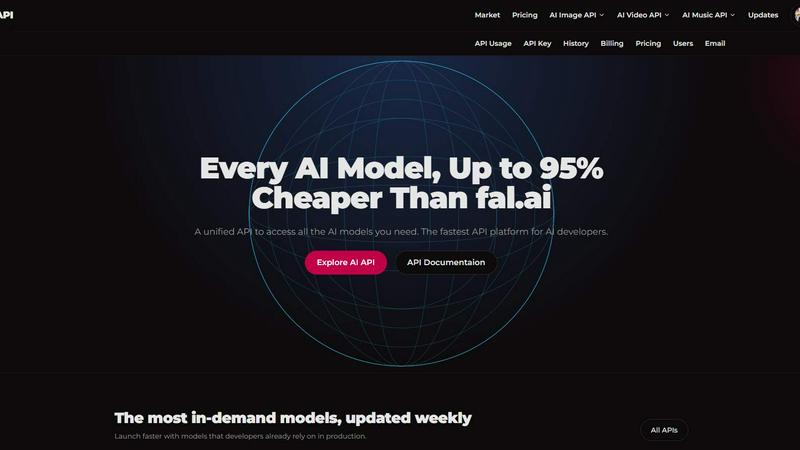
Vidgo API provides unified, low-cost access to diverse AI models for rapid development.
Last updated: February 28, 2026
Visual Comparison
3DAIStudio
Vidgo API
Feature Comparison
3DAIStudio
Text to 3D
This core feature allows users to generate fully textured 3D models by simply typing a descriptive text prompt. The AI interprets the natural language description, such as "realistic fantasy orc warrior, muscular, wearing rugged armor," and constructs a corresponding 3D asset with appropriate geometry and surface details. This eliminates the need for manual modeling from scratch, enabling rapid prototyping and concept visualization directly from written ideas.
Image to 3D
Users can upload any 2D image, sketch, or illustration, and 3DAIStudio's AI will extrapolate depth and form to create a three-dimensional model. This process converts flat reference artwork into a tangible 3D object, preserving the visual style and intent of the original image. It is particularly valuable for turning concept art, product photos, or hand-drawn sketches into immediate 3D assets for further use.
AI Texturing
Beyond geometry creation, the platform includes an AI-powered texturing system that can apply realistic, physically-based rendering (PBR) materials to models. Users can generate textures from text prompts or paint and edit details directly onto the model's surface. This ensures that outputs are not just geometric meshes but are visually complete with colors, materials, and surface properties ready for rendering in game engines or animations.
Quad-Remesh & Optimization
To ensure assets are production-ready, 3DAIStudio provides automated retopology tools like Quad-Remesh. This feature optimizes the mesh topology generated by the AI, creating clean, efficient polygon flow, reducing polygon count, and generating levels of detail (LODs). This critical step prepares models for performance-sensitive applications like real-time gaming and VR, fixing potential mesh issues before export.
Vidgo API
Unified AI Model Marketplace
Vidgo API consolidates access to a curated selection of over 36 state-of-the-art AI models for video, image, and music generation into one dashboard. This marketplace is continuously updated with the "most in-demand models, updated weekly," such as Kling 2.6 for motion control and Hailuo 02 for ultra-realistic video. Developers can browse, test, and integrate these models without negotiating separate contracts or navigating different API standards, significantly accelerating the prototyping and development cycle for AI-powered media features.
Cost-Effective & Predictable Pricing
A defining feature of Vidgo API is its aggressive, transparent pricing model designed as a cost-effective alternative. The platform explicitly positions itself as offering services "up to 95% cheaper than fal.ai," with per-request costs clearly listed for each model (e.g., Sora 2 at $0.15 per request). This predictable, pay-per-use structure allows development teams to forecast expenses accurately and scale their AI media generation without encountering prohibitive costs, a common barrier cited in industry reports on generative AI adoption.
Production-Ready Reliability & Performance
Built for enterprise and developer teams, Vidgo API guarantees high availability with a 99.9% uptime SLA and optimizes for speed with an average response time of 120ms. This performance consistency is critical for applications requiring real-time or near-real-time media generation. The platform provides "stable throughput" and "smart" routing, ensuring that integrations remain robust under load, a necessity for maintaining user experience in production applications as noted in software reliability engineering principles.
Simplified Developer Integration
The platform is designed with a developer-first approach, featuring a single authentication flow, consistent API endpoints across all models, and clear, comprehensive documentation. The integration process is standardized: developers use one API key, one billing account, and a uniform request structure to access any model. Example code snippets, like the provided cURL command for task submission, demonstrate the straightforward workflow, reducing integration time from days to minutes and lowering the technical barrier to implementing advanced AI capabilities.
Use Cases
3DAIStudio
Game Development
Game developers and studios use 3DAIStudio to rapidly generate a vast array of 3D assets, including characters, props, weapons, and environmental elements. The speed of generation allows for faster iteration on game design concepts and helps small teams or indie developers overcome resource constraints by quickly populating their worlds with unique, high-quality models, accelerating the entire content creation pipeline.
Film & Animation Pre-Visualization
In film and animation production, the tool is invaluable for pre-visualization (previs). Directors and artists can quickly generate 3D models of characters, creatures, or set pieces from script descriptions or concept art. This allows for faster storyboarding, scene blocking, and asset planning before committing to costly, time-intensive final modeling and rendering processes.
Product Design & Prototyping
Industrial and product designers can upload sketches or describe new product ideas to instantly create 3D visualizations. This facilitates rapid prototyping, client presentations, and early-stage design validation. The ability to quickly iterate on form and aesthetic in 3D space significantly shortens the design cycle and improves communication of concepts.
Educational Content Creation
Educators and e-learning content creators leverage 3DAIStudio to build engaging 3D models for instructional materials, simulations, and interactive lessons. Without needing expert 3D modeling skills, they can create accurate models of historical artifacts, scientific molecules, or geographical formations, making complex subjects more tangible and accessible for students.
Vidgo API
Dynamic Content Creation for Marketing & Social Media
Marketing agencies and social media managers can leverage Vidgo API to generate high volumes of tailored visual and audio content rapidly. By utilizing text-to-video models like Wan 2.6 or image-editing capabilities of Seedream 4.5, teams can produce platform-specific ads, promotional videos, and engaging social posts. The significant cost savings enable A/B testing of different creative concepts at scale, allowing data-driven optimization of campaign performance, a best practice highlighted in modern digital marketing strategies.
Enhanced Features for Software & App Development
SaaS companies and app developers can integrate AI media generation directly into their products. For instance, a design tool could use the image API for instant mockup generation, while a video editing app could offer AI-powered scene extension using models like Sora 2 Pro. The unified API allows development teams to add multiple AI features without building complex backend integrations for each service, accelerating feature deployment and improving product competitiveness in fast-moving tech markets.
Prototyping and Production in Media & Entertainment
Film studios, game developers, and independent creators can use Vidgo API for storyboarding, concept art generation, and soundtrack creation. Motion control models like Kling 2.6 can animate character designs, while Suno v5 can generate original, studio-quality music scores. This provides a powerful, affordable toolkit for pre-visualization and rapid iteration during creative development, a process that traditionally requires significant time and resource investment according to entertainment production studies.
Automated Asset Generation for E-commerce & Retail
E-commerce platforms can automate the creation of product visuals and demonstration videos. Using image-to-video models, a retailer can transform static product photos into engaging lifestyle videos. The API's cost structure makes it feasible to generate unique media for thousands of product listings, enhancing online storefronts and improving conversion rates. Research in e-commerce consistently shows that high-quality, dynamic media directly correlates with increased customer engagement and sales.
Overview
About 3DAIStudio
3DAIStudio is a revolutionary AI-powered platform that democratizes 3D content creation by enabling users to generate high-quality, production-ready 3D models from simple text prompts or 2D images in seconds. This tool fundamentally transforms a traditionally complex and time-intensive process, which according to industry standards can take skilled artists days or weeks, into an accessible and instantaneous workflow. It serves a broad spectrum of users, from game developers, film and VR/AR studios, and product designers to educators, 3D printing enthusiasts, and independent creators with no prior 3D modeling experience. The core value proposition of 3DAIStudio lies in its ability to drastically accelerate the 3D asset pipeline, reduce technical barriers to entry, and provide a comprehensive suite of AI tools that extend beyond simple generation to include texturing, mesh optimization, and image editing. By leveraging advanced generative AI, the platform allows for rapid iteration and ideation, empowering professionals to meet tight deadlines and enabling newcomers to bring their creative visions to life without the steep learning curve associated with conventional 3D software like Blender or Maya.
About Vidgo API
Vidgo API is a comprehensive, unified platform that provides developers and creative teams with streamlined access to a vast marketplace of cutting-edge AI models for video, image, and music generation through a single, consistent REST API. It addresses a critical pain point in the AI development landscape: the fragmentation and complexity of integrating multiple, disparate AI services. By aggregating over 36 top-tier models—including industry leaders like OpenAI's Sora 2, Google's Nano Banana Pro, ByteDance's Seedream 4.5, and Suno v5—Vidgo API eliminates the need for developers to manage separate accounts, authentication keys, and billing systems for each AI capability. Its core value proposition is threefold: significant cost reduction, operational simplicity, and production-grade reliability. Independent analysis of its pricing structure indicates services are offered at 15-95% lower cost than competing platforms like Fal.ai, providing a compelling economic advantage for scaling applications. The platform is engineered for production environments, boasting a 99.9% uptime SLA and an average response time of 120ms, ensuring consistent performance for user-facing applications. With comprehensive documentation and dedicated support, Vidgo API empowers businesses to efficiently enhance their digital content pipelines, from marketing and entertainment to software development and social media.
Frequently Asked Questions
3DAIStudio FAQ
What 3D file formats can I export my models in?
3DAIStudio is designed for production pipelines and supports export in industry-standard formats. This typically includes .glb/.glTF (for web and real-time applications), .obj, .fbx, and .stl (for 3D printing). These formats ensure compatibility with major platforms like Unity, Unreal Engine, Blender, Maya, and various 3D printing slicers.
Do I need any prior 3D modeling experience to use 3DAIStudio?
No, one of the primary advantages of 3DAIStudio is its accessibility to users with zero 3D modeling experience. The interface is built around simple inputs: text prompts and image uploads. The AI handles the complex tasks of geometry generation, texturing, and optimization, allowing complete beginners to create professional-looking 3D assets.
How does the AI handle complex or specific text prompts?
The platform's AI is trained on vast datasets of 3D models and associated descriptions. For best results, users should provide clear, descriptive prompts that include details about the subject, style, materials, and context (e.g., "a low-poly cartoon red apple on a wooden table"). The more descriptive the prompt, the more accurate and detailed the resulting 3D model will be.
Is the output from 3DAIStudio ready for commercial use?
Yes, models generated on 3DAIStudio are intended to be production-ready and suitable for commercial projects. The platform includes tools like Quad-Remesh specifically to optimize topology for real-time performance in games and VR. However, users should always review the generated model's polygon count and texture maps to ensure they meet the specific technical requirements of their project.
Vidgo API FAQ
What AI models are available on Vidgo API?
Vidgo API provides access to a growing marketplace of over 36 leading AI models spanning video, image, and music generation. This includes cutting-edge models such as OpenAI's Sora 2 and Sora 2 Pro for video, Google's Nano Banana Pro and ByteDance's Seedream 4.5 for images, and Suno v5 for music. The catalog is frequently updated with new and in-demand models, ensuring developers have access to the latest advancements in generative AI technology through a single integration point.
How does the pricing compare to other AI API providers?
Vidgo API is positioned as a highly cost-effective solution, with public pricing indicating savings of 15% to 95% compared to competitors like Fal.ai. Pricing is transparent and on a per-request basis for each specific model, allowing for precise cost control. For example, generating a video with Sora 2 costs $0.15 per request, while using the Nano Banana Pro image model costs $0.05 per request. This model can lead to substantial cost reductions at scale for development teams.
Is Vidgo API suitable for production applications?
Yes, Vidgo API is explicitly built for production use. The platform guarantees 99.9% uptime, offers consistent endpoints, and maintains an average response time of 120ms to ensure reliable performance for user-facing applications. Features like callback URLs for asynchronous task handling and comprehensive documentation support stable integration. This focus on reliability and predictable performance makes it a viable backbone for commercial applications requiring dependable AI media generation.
How do I get started and integrate the API?
Getting started is a streamlined three-step process. First, sign up for an account to instantly generate an API key with no waitlist. Second, browse the API marketplace to select the best models for your use case. Third, integrate using the provided documentation, which includes consistent endpoints and code examples. You can submit a generation task with a simple cURL command or SDK, and scale your usage without changing the integration as your needs grow.
Alternatives
3DAIStudio Alternatives
3DAIStudio is an AI-powered content creation tool designed to rapidly generate quality 3D models from simple text prompts or uploaded images. It falls within the burgeoning category of generative AI for 3D asset creation, aiming to democratize 3D design for professionals and enthusiasts alike. Users often explore alternatives to such tools for several practical reasons. These can include seeking different pricing models or subscription tiers, needing specific export formats or integration capabilities with other software, or requiring a different balance between automation and manual control. The specific feature set, output quality for particular use cases, and platform compatibility are also common drivers for comparison. When evaluating alternatives, key considerations should include the core AI technology's reliability, the supported input and output file types, the learning curve and user interface, and the scalability of the service for project needs. Assessing the tool's intended audience—whether for game development, product visualization, or animation—is crucial to ensure it aligns with your specific creative or professional workflow.
Vidgo API Alternatives
Vidgo API is a unified platform providing access to a diverse array of AI models for video, image, and music generation through a single REST API. It belongs to the development tools category, specifically designed for integrating advanced AI media capabilities into applications. This makes it a key resource for developers and creative teams building AI-focused projects. Users often explore alternatives for several strategic reasons. These include seeking different pricing structures or specific billing models that better fit their budget, requiring niche features or specialized models not available in a generalist platform, or needing integration with a particular existing tech stack or ecosystem. The decision is typically driven by the unique technical and financial requirements of a project. When evaluating alternatives, key considerations should include the breadth and specialism of the available AI models, the clarity and reliability of the API documentation and developer support, the overall cost-effectiveness and transparency of the pricing model, and the platform's performance metrics, such as generation speed and output quality. A thorough assessment ensures the selected tool aligns with both immediate project goals and long-term scalability.