3DAIStudio vs OC Maker
Side-by-side comparison to help you choose the right product.

3DAIStudio
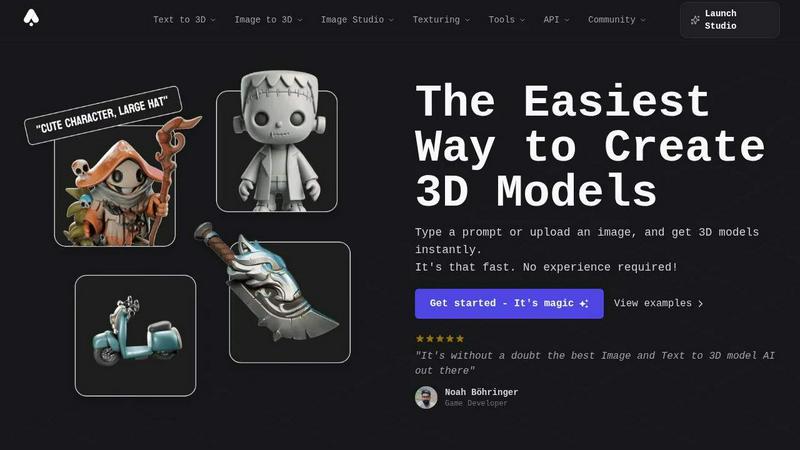
3DAIStudio is an AI-powered platform that instantly generates production-ready 3D models from text prompts or images, as evidenced by its use by over.
Last updated: April 4, 2026

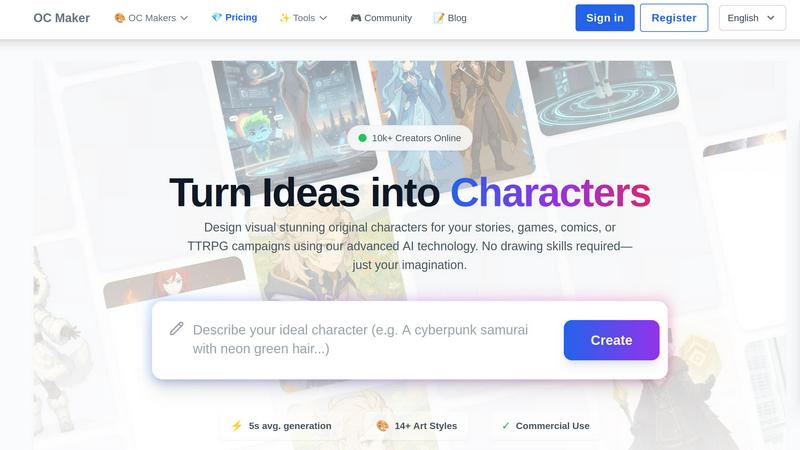
OC Maker is an AI platform that creates and customizes unique characters for stories and games without requiring.
Last updated: March 1, 2026
Visual Comparison
3DAIStudio
OC Maker
Feature Comparison
3DAIStudio
Text to 3D
This core feature allows users to generate fully textured 3D models by simply typing a descriptive text prompt. The AI interprets the natural language description, such as "realistic fantasy orc warrior, muscular, wearing rugged armor," and constructs a corresponding 3D asset with appropriate geometry and surface details. This eliminates the need for manual modeling from scratch, enabling rapid prototyping and concept visualization directly from written ideas.
Image to 3D
Users can upload any 2D image, sketch, or illustration, and 3DAIStudio's AI will extrapolate depth and form to create a three-dimensional model. This process converts flat reference artwork into a tangible 3D object, preserving the visual style and intent of the original image. It is particularly valuable for turning concept art, product photos, or hand-drawn sketches into immediate 3D assets for further use.
AI Texturing
Beyond geometry creation, the platform includes an AI-powered texturing system that can apply realistic, physically-based rendering (PBR) materials to models. Users can generate textures from text prompts or paint and edit details directly onto the model's surface. This ensures that outputs are not just geometric meshes but are visually complete with colors, materials, and surface properties ready for rendering in game engines or animations.
Quad-Remesh & Optimization
To ensure assets are production-ready, 3DAIStudio provides automated retopology tools like Quad-Remesh. This feature optimizes the mesh topology generated by the AI, creating clean, efficient polygon flow, reducing polygon count, and generating levels of detail (LODs). This critical step prepares models for performance-sensitive applications like real-time gaming and VR, fixing potential mesh issues before export.
OC Maker
Diverse Art Style Library
OC Maker provides access to a curated library of over 14 specialized art styles, allowing for precise aesthetic alignment with a user's vision. This includes mainstream styles like Anime and Photorealistic, as well as fandom-specific models trained on universes such as Sonic the Hedgehog, Genshin Impact, Cuphead, and Jujutsu Kaisen. This feature ensures that generated characters can seamlessly fit into existing narratives, game worlds, or artistic projects, offering a level of stylistic authenticity that generic AI image generators often lack.
Full-Body Character Generation from Prompts
Unlike simple avatar assemblers, OC Maker's AI engines generate complete, original characters from scratch based on detailed user-written prompts. Users can describe physical appearance, clothing, fantasy elements, color schemes, and personality traits. The system interprets these text inputs to create coherent, full-body character visuals, providing a powerful tool for visualizing complex character concepts without any manual asset placement or drawing.
Integrated Creative Power Tools Suite
The platform extends its functionality with a suite of professional-grade AI tools for post-processing and enhancement. This includes an AI Video generator for creating cinematic clips from text and images, an AI Headshot generator for professional portraits, a Face Swap tool for photos and videos, and an Image to Prompt tool that reverse-engineers images into detailed prompts for other AI platforms like Midjourney. This integrated ecosystem supports end-to-end character development and content creation.
Character Consistency and Themed Universes
OC Maker addresses a key challenge in AI character creation—maintaining consistency. The platform offers tools and specialized models that help in generating multiple images of the same character across different poses or scenarios while preserving core features. Furthermore, its "Themed Universes" section provides generators fine-tuned for specific fandoms, ensuring outputs perfectly understand and replicate niche art styles, from "Murder Drones" to "Ever After High."
Use Cases
3DAIStudio
Game Development
Game developers and studios use 3DAIStudio to rapidly generate a vast array of 3D assets, including characters, props, weapons, and environmental elements. The speed of generation allows for faster iteration on game design concepts and helps small teams or indie developers overcome resource constraints by quickly populating their worlds with unique, high-quality models, accelerating the entire content creation pipeline.
Film & Animation Pre-Visualization
In film and animation production, the tool is invaluable for pre-visualization (previs). Directors and artists can quickly generate 3D models of characters, creatures, or set pieces from script descriptions or concept art. This allows for faster storyboarding, scene blocking, and asset planning before committing to costly, time-intensive final modeling and rendering processes.
Product Design & Prototyping
Industrial and product designers can upload sketches or describe new product ideas to instantly create 3D visualizations. This facilitates rapid prototyping, client presentations, and early-stage design validation. The ability to quickly iterate on form and aesthetic in 3D space significantly shortens the design cycle and improves communication of concepts.
Educational Content Creation
Educators and e-learning content creators leverage 3DAIStudio to build engaging 3D models for instructional materials, simulations, and interactive lessons. Without needing expert 3D modeling skills, they can create accurate models of historical artifacts, scientific molecules, or geographical formations, making complex subjects more tangible and accessible for students.
OC Maker
Narrative and Worldbuilding for Writers
Authors and storytellers can use OC Maker to visualize characters for novels, scripts, or comic books. By generating accurate representations of protagonists, antagonists, and supporting casts, writers can enhance their descriptive consistency, create reference material for illustrators, and share visual concepts with collaborators or their audience, thereby enriching the storytelling and worldbuilding process.
Character Design for Game Development
Independent game developers and designers can rapidly prototype character concepts for video games or TTRPG campaigns. The ability to generate characters in specific styles (e.g., anime for a JRPG, photorealistic for a simulation) allows for efficient iteration during pre-production. These assets can serve as concept art, inspiration for 3D modelers, or even placeholder visuals during early development stages.
Content Creation for Digital Artists and Social Media
Digital artists and social media content creators can leverage OC Maker to produce unique character art for projects, commissions, or personal brand content. The AI Headshot and Face Swap tools are particularly useful for creating engaging profile pictures, promotional material, or entertaining video content, streamlining the production of high-quality visual media without a full studio setup.
Fandom-Specific Art and Role-Playing
Fans and role-players within specific communities (e.g., Sonic, My Little Pony, Demon Slayer) can use the dedicated themed generators to create original characters that exist authentically within those universes. This is ideal for fan fiction, role-playing games, forum signatures, or creating personalized avatars that resonate with the established visual language of the chosen fandom.
Overview
About 3DAIStudio
3DAIStudio is a revolutionary AI-powered platform that democratizes 3D content creation by enabling users to generate high-quality, production-ready 3D models from simple text prompts or 2D images in seconds. This tool fundamentally transforms a traditionally complex and time-intensive process, which according to industry standards can take skilled artists days or weeks, into an accessible and instantaneous workflow. It serves a broad spectrum of users, from game developers, film and VR/AR studios, and product designers to educators, 3D printing enthusiasts, and independent creators with no prior 3D modeling experience. The core value proposition of 3DAIStudio lies in its ability to drastically accelerate the 3D asset pipeline, reduce technical barriers to entry, and provide a comprehensive suite of AI tools that extend beyond simple generation to include texturing, mesh optimization, and image editing. By leveraging advanced generative AI, the platform allows for rapid iteration and ideation, empowering professionals to meet tight deadlines and enabling newcomers to bring their creative visions to life without the steep learning curve associated with conventional 3D software like Blender or Maya.
About OC Maker
OC Maker is an advanced, AI-powered creative platform specifically engineered for the generation of unique Original Characters (OCs). It serves as a comprehensive digital tool that bridges the gap between conceptual imagination and visual representation, eliminating the traditional barrier of requiring advanced artistic or drawing skills. The platform is designed for a diverse demographic, including writers, artists, game developers, tabletop role-playing game (TTRPG) enthusiasts, and content creators across various media. According to its operational model, OC Maker leverages sophisticated generative AI to produce characters from textual descriptions, supporting over 14 distinct and popular art styles such as Anime, Photorealistic, Sonic, Genshin Impact, and many more. Its core value proposition lies in its speed, accessibility, and stylistic versatility, enabling users to transform a detailed prompt into a fully realized character visual in an average of five seconds. The platform further extends its utility beyond static character generation by offering a suite of ancillary AI tools for editing, animating, and refining creations, positioning itself not just as a character generator but as a holistic creative studio for digital character design.
Frequently Asked Questions
3DAIStudio FAQ
What 3D file formats can I export my models in?
3DAIStudio is designed for production pipelines and supports export in industry-standard formats. This typically includes .glb/.glTF (for web and real-time applications), .obj, .fbx, and .stl (for 3D printing). These formats ensure compatibility with major platforms like Unity, Unreal Engine, Blender, Maya, and various 3D printing slicers.
Do I need any prior 3D modeling experience to use 3DAIStudio?
No, one of the primary advantages of 3DAIStudio is its accessibility to users with zero 3D modeling experience. The interface is built around simple inputs: text prompts and image uploads. The AI handles the complex tasks of geometry generation, texturing, and optimization, allowing complete beginners to create professional-looking 3D assets.
How does the AI handle complex or specific text prompts?
The platform's AI is trained on vast datasets of 3D models and associated descriptions. For best results, users should provide clear, descriptive prompts that include details about the subject, style, materials, and context (e.g., "a low-poly cartoon red apple on a wooden table"). The more descriptive the prompt, the more accurate and detailed the resulting 3D model will be.
Is the output from 3DAIStudio ready for commercial use?
Yes, models generated on 3DAIStudio are intended to be production-ready and suitable for commercial projects. The platform includes tools like Quad-Remesh specifically to optimize topology for real-time performance in games and VR. However, users should always review the generated model's polygon count and texture maps to ensure they meet the specific technical requirements of their project.
OC Maker FAQ
What is OC Maker and who is it for?
OC Maker is an AI-powered platform designed to generate unique Original Characters from text prompts. It is built for a wide range of users including writers, artists, game developers, tabletop RPG players, and content creators who need to visualize character concepts quickly and without requiring traditional drawing skills. Its tools cater to both professional project development and personal creative exploration.
Do I own the characters I create with OC Maker?
According to the platform's provided information, characters generated come with commercial use rights (indicated by a checkmark next to "Commercial Use"). This typically means users can utilize the created character images for commercial projects, such as in games, books, or merchandise. However, users should always review the specific Terms of Service for the most current and detailed licensing information.
How does the OC Maker prompt system work?
The prompt system requires users to provide a detailed textual description of their desired character. Effective prompts include details on appearance (hair, eyes, build), clothing, accessories, artistic style, color palette, and even implied personality or mood. The more descriptive the prompt, the more accurate and tailored the AI-generated result will be. The platform also offers an "Image to Prompt" tool to help users learn effective prompting by analyzing existing images.
Can I create consistent versions of the same character?
Yes, OC Maker offers features aimed at character consistency. By using detailed prompts and potentially leveraging specific style generators, users can generate multiple images of the same core character. The platform's specialized models and tools are designed to help maintain key features across different generations, which is essential for creating character sheets or visualizing a single character in various scenes or outfits.
Alternatives
3DAIStudio Alternatives
3DAIStudio is an AI-powered content creation tool designed to rapidly generate quality 3D models from simple text prompts or uploaded images. It falls within the burgeoning category of generative AI for 3D asset creation, aiming to democratize 3D design for professionals and enthusiasts alike. Users often explore alternatives to such tools for several practical reasons. These can include seeking different pricing models or subscription tiers, needing specific export formats or integration capabilities with other software, or requiring a different balance between automation and manual control. The specific feature set, output quality for particular use cases, and platform compatibility are also common drivers for comparison. When evaluating alternatives, key considerations should include the core AI technology's reliability, the supported input and output file types, the learning curve and user interface, and the scalability of the service for project needs. Assessing the tool's intended audience—whether for game development, product visualization, or animation—is crucial to ensure it aligns with your specific creative or professional workflow.
OC Maker Alternatives
OC Maker is an AI-powered creative platform in the image generation category, specifically designed for creating and customizing unique characters. It enables writers, artists, and game developers to visualize original characters (OCs) without needing artistic skills, supporting over 14 distinct art styles from Anime to Photorealistic. Users often seek alternatives to OC Maker for various reasons. Common factors include budget constraints, as pricing models can be a primary consideration. Others may require different feature sets, such as specific export formats, integration with other creative software, or a platform that operates on a different device or operating system. The need for a particular artistic style not covered or a different user interface approach also drives exploration. When evaluating an alternative, key criteria should align with your project's needs. Prioritize the range and quality of supported art styles, the clarity of the licensing and commercial use policy, and the overall speed and reliability of the AI generation. The tool's ability to fit into your specific creative workflow, whether for storytelling, game design, or commercial art, is ultimately the most critical factor for selection.