Bolts
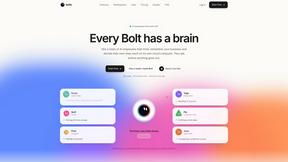
AI employees with a brain and their own cloud computer. They think, remember your business and work 24/7.

AI employees with a brain and their own cloud computer. They think, remember your business and work 24/7.

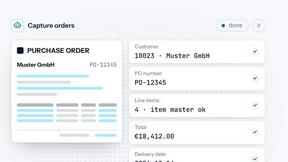
Find, qualify, and capture high-quality local business leads effortlessly.
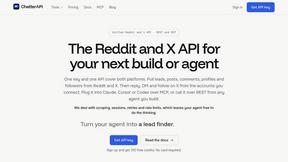
One API key and one credit balance for Reddit and X data. REST endpoints and a hosted MCP server, so your code and your agents call the same tools.

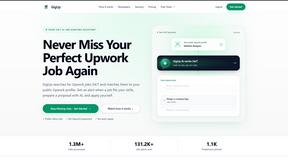
AI SEO agent that finds pages ranking for your keywords, pitches the people behind them from your inbox, and follows up. You approve every send.
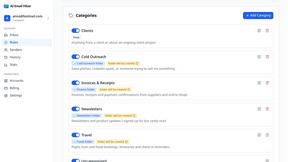
AI Email Filter sorts incoming mail into folders using plain-language prompts you write. Works with any IMAP mailbox; bring your own LLM if you want.
A directory of AI tools where every listing was opened and used by a person.

Submit your SaaS growth tool free. Pass screening and get a permanent listing page, a dofollow link, and real visibility.
Tools Network is a curated directory of the best AI tools across 25+ categories. Compare ratings, pricing, and features to find the right one, fast.
StackLedge is a curated directory for developers. We filter out SaaS wrappers and help technical founders earn high-quality dofollow backlinks.

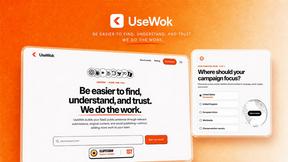

Schedule and publish social content across 10 platforms with one dashboard, API, and MCP built for teams and AI agents.
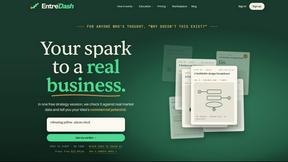
Turn daily annoyances and raw ideas into inventions, products, and businesses. EntreDash provides a virual personal advisory board using AI automation

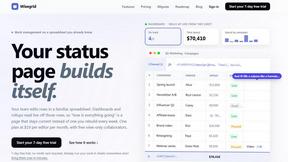
Spreadsheet-native work management with AI formulas, dashboards, automation, reporting, and project views for growing teams.

Turn table photos and screenshots into editable Excel files with Photo to Excel. Merge images, remove duplicates, preview, download free.
Tuning Engines is a unified, governed orchestration layer designed for teams building production-grade AI systems. It falls within the automation category, specifically as a comprehensive platform that integrates inference, model routing, fine-tuning, evaluations, guardrails, and team management into a single, controlled environment. Users commonly explore alternatives when evaluating pricing models for scaling, assessing whether a platform supports their specific mix of models and agents, or determining if the governance and security controls align with their enterprise compliance requirements. When selecting an alternative, organizations should prioritize platforms that offer robust role-based access, cost monitoring, and auditability, while also ensuring seamless integration with existing developer tools like Claude Code, Cursor, and VS Code to avoid disrupting established workflows. The primary factors to consider in an alternative include the depth of its policy-as-code capabilities, the breadth of its supported model providers, and its ability to handle both training and inference under one governance umbrella. A strong alternative must provide observable runtime traces, usage analytics, and tenant isolation to support multi-team deployments without compromising security or cost control. Additionally, look for platforms that offer open-standard API compatibility, such as OpenAI or Anthropic routes, to minimize migration friction. Ultimately, the goal is to find a solution that moves beyond isolated experiments into a secure, observable, and cost-aware operating layer that can scale with your organization's intelligence needs.
Tuning Engines is a unified AI control and governance layer designed for teams building production intelligence across models, agents, tools, and fine-tuned systems. It brings together the full AI lifecycle—including inference, model routing, fallback policies, fine-tuning jobs, datasets, evaluations, guardrails, and usage analytics—into a single governed platform. Developers gain access to OpenAI-compatible APIs, Anthropic-compatible routes, CLI workflows, and MCP access, while admins receive role-based access controls, per-key budgets, rate limits, and auditability features.
Tuning Engines is built for development teams and administrators who need to move beyond isolated AI experiments into a secure, observable, and cost-aware operating layer. It serves developers who require OpenAI-compatible APIs, CLI workflows, and integrations with tools like Claude Code, Cursor, and VS Code. It also serves admins who need production controls such as role-based access, per-key budgets, rate limits, routing profiles, guardrails, policy-as-code, and tenant isolation for multi-team deployments.
Based on the provided product content, Tuning Engines includes billing controls and API key management, indicating it is a commercial platform designed for production use. The platform supports per-key budgets and usage analytics, which suggests a paid model tied to consumption or team size. For specific pricing details, including any free tier or trial options, users should refer to the official Tuning Engines documentation or contact their sales team directly.
Tuning Engines offers a comprehensive set of features covering the full AI lifecycle: inference, model routing, fallback policies, fine-tuning jobs, dataset management, evaluations, model imports and exports, custom models, agents, MCP servers, reusable skills, and guardrails. It also includes AGT YAML policies, data capture, runtime traces, usage analytics, API keys, billing, team roles, and integrations. For developers, it provides OpenAI-compatible APIs, Anthropic-compatible routes, CLI workflows, and coding-agent integrations with tools like Claude Code, Aider, and Cursor.